Crypto-to-fiat infrastructure Africa is evolving rapidly as fintech companies build payment rails that connect digital assets with local banking systems. Growing cryptocurrency adoption, increasing stablecoin usage and rising demand for efficient cross-border payments are driving investment in digital financial infrastructure across the continent.
Key Overview
- Stablecoin adoption continues accelerating.
- IMF highlights growing crypto payment usage.
- Sub-Saharan Africa recorded over US$205 billion in on-chain value.
- Breet expands crypto-to-fiat infrastructure.
- Businesses gain faster payment settlement.
- APIs simplify digital asset payments.
- Payment rails bridge blockchain and banks.
- Fintech innovation strengthens Africa’s financial ecosystem.
Crypto-to-Fiat Infrastructure Africa Expands as Stablecoin Adoption Accelerates
The development of crypto-to-fiat infrastructure Africa is transforming how businesses and individuals move money across borders, creating new opportunities for faster, more affordable international payments. As stablecoins become increasingly integrated into commercial activity, fintech companies are building the digital infrastructure needed to connect blockchain-based assets with traditional banking systems.
Growing demand for cross-border payments, expanding cryptocurrency adoption, and the rise of stablecoins such as USDT and USDC are encouraging African payment providers to develop technology that enables businesses to seamlessly convert digital assets into local currencies. These innovations are helping bridge the long-standing gap between blockchain networks and conventional financial infrastructure.
IMF Highlights Rising Crypto Activity in Africa
Recent analysis by the International Monetary Fund (IMF) underscores the rapid expansion of digital asset usage across Africa.
According to the IMF, Nigeria received approximately US$59 billion in crypto-asset inflows between July 2023 and June 2024, illustrating the country’s growing importance within the global digital asset economy.
The IMF also observed that stablecoins have evolved into an increasingly important cross-border payment channel for households and small businesses, particularly in markets where conventional international transfers remain expensive, slow or difficult to access.
The findings suggest that digital assets are increasingly serving practical commercial purposes beyond speculative investment, particularly within emerging economies facing payment infrastructure challenges.
Stablecoins Support Cross-Border Business Payments
Stablecoins have become central to Africa’s growing digital payments ecosystem.
Unlike more volatile cryptocurrencies, stablecoins are designed to maintain relatively stable values by tracking traditional currencies such as the U.S. dollar, making them suitable for commercial transactions and international settlements.
For businesses engaged in international trade, stablecoins provide faster settlement, lower transaction costs and improved accessibility compared with many conventional cross-border payment systems.
These advantages are particularly valuable for small and medium-sized enterprises, importers, exporters and freelancers operating across multiple countries.
As adoption continues increasing, stablecoins are becoming an important component of Africa’s evolving financial infrastructure.
Sub-Saharan Africa Records Strong Blockchain Growth
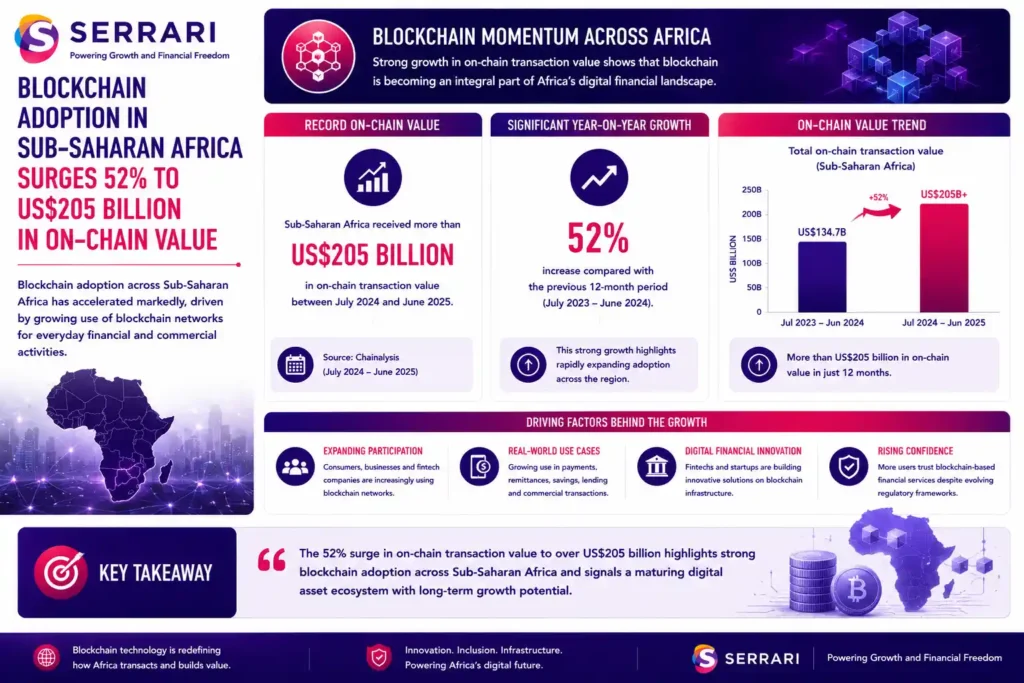
Blockchain adoption has also accelerated significantly across the region.
According to Chainalysis, Sub-Saharan Africa received more than US$205 billion in on-chain transaction value between July 2024 and June 2025, representing an increase of approximately 52% compared with the previous twelve-month period.
The strong growth reflects expanding participation by consumers, businesses and financial technology companies using blockchain networks for payments, remittances and commercial transactions.
Increasing transaction volumes also demonstrate rising confidence in blockchain-based financial services despite ongoing regulatory developments across many African jurisdictions.
Context is everything. Stay ahead of shifting trends with today’s market updates, and uncover emerging opportunities using the Serrari Group Market Index and Marketplace. Then, take control of your own financial future by exploring our Money & Life Reset Transformation Blueprint ™ to build stronger habits, create better systems, and design a path toward lasting wealth.
Breet Builds Digital Asset Infrastructure
One of the companies contributing to the expansion of crypto-to-fiat infrastructure Africa is Breet, a cryptocurrency payment platform operated by Inbreetic Technologies Limited.
Initially launched as a consumer-focused cryptocurrency off-ramping service, Breet has expanded into business payment infrastructure by introducing an application programming interface (API) that enables companies to accept supported cryptocurrencies while automatically converting proceeds into local currency.
The platform simplifies what has traditionally been a complex process involving multiple exchanges, wallets and banking transactions.
By integrating cryptocurrency conversion directly into payment workflows, businesses can receive digital assets while continuing to operate using familiar local banking systems.
API Simplifies Business Payment Processing
According to Techpoint Africa, Breet’s business API enables companies to accept stablecoins including USDT and USDC, with conversion and settlement taking place automatically in the background.
This approach removes much of the operational complexity associated with cryptocurrency transactions.
Instead of manually transferring digital assets between wallets, exchanges and bank accounts, businesses can receive payments while the platform manages currency conversion and local settlement.
The automation improves operational efficiency while reducing delays commonly associated with traditional international payment processes.
For companies expanding internationally, integrated business payments infrastructure can significantly improve customer experience and cash flow management.
Payment Rails Connect Blockchain and Banking
The rapid growth of digital asset infrastructure is helping address one of Africa’s most significant payment challenges.
Although Sub-Saharan Africa has developed the world’s fastest-growing mobile money ecosystem alongside one of the highest rates of stablecoin adoption by transaction volume, these two financial systems generally operate independently.
For example, a Kenyan business holding USDC on the Ethereum blockchain cannot directly transfer those funds to an M-Pesa account.
Similarly, a Nigerian customer with funds in a traditional bank account cannot deposit local currency directly into a USDC wallet without using intermediary services.
Payment providers such as Breet are attempting to solve this disconnect by building infrastructure that links blockchain networks with traditional financial systems.
These payment rails effectively act as bridges between digital assets and real-world banking services.
Crypto-to-Fiat Services Continue Expanding
Breet reports that it has processed more than US$1 billion across over five million transactions, illustrating growing demand for cryptocurrency conversion services.
Although the company notes that these figures have not been independently audited for the purposes of public reporting, they indicate increasing adoption of crypto-to-fiat payment solutions among businesses and consumers.
As more companies integrate blockchain-based payment capabilities into their operations, demand for reliable conversion infrastructure is expected to continue rising.
Rather than replacing traditional banking systems, many fintech providers are focusing on integrating digital assets with existing payment networks, enabling businesses to use whichever payment method best suits their operational requirements.
Outlook for Crypto-to-Fiat Infrastructure Africa
The continued expansion of crypto-to-fiat infrastructure Africa reflects the continent’s growing role in global digital finance. Rising stablecoin adoption, increasing blockchain transaction volumes and stronger fintech innovation are creating the payment infrastructure needed to connect digital assets with traditional banking systems.
As businesses seek faster and more efficient cross-border payments, companies building digital asset infrastructure are likely to play an increasingly important role in supporting international trade, financial inclusion and the broader growth of fintech Africa. By bridging the gap between blockchain networks and conventional financial services, crypto-to-fiat platforms are helping modernise Africa’s evolving financial ecosystem.
FAQs
What is crypto-to-fiat infrastructure?
Crypto-to-fiat infrastructure refers to payment systems that enable users to convert cryptocurrencies into traditional government-issued currencies such as the Kenyan shilling or Nigerian naira. These platforms connect blockchain networks with banks and payment systems, allowing businesses and consumers to use digital assets more easily in everyday transactions.
Why is crypto-to-fiat infrastructure important in Africa?
Many African businesses face high costs and slow settlement times when making international payments. Crypto-to-fiat infrastructure provides faster and often more cost-effective alternatives by allowing businesses to receive cryptocurrency payments and automatically settle them in local currencies.
How does Breet support business payments?
Breet provides an API that enables businesses to accept supported cryptocurrencies, including stablecoins such as USDT and USDC. The platform automatically converts digital assets into local currency and settles the funds through traditional banking channels, simplifying payment processing for businesses.
What role do stablecoins play in cross-border payments?
Stablecoins provide price stability while using blockchain technology to facilitate rapid international transfers. They allow businesses to move money across borders more efficiently than many traditional payment systems, reducing transaction costs and improving settlement speed for international trade and commercial payments.
Sources: Honey Coin, TVC News
Your financial future isn’t something you wait for—it’s something you build.
The real question is: when do you begin?
Move beyond simply staying informed.
Navigate the markets with clarity—track trends through the Serrari Group Market Index, uncover opportunities in the Serrari Marketplace, and build practical knowledge with our Curated Wealth Builder Platform.
Stay connected to what truly matters.
Get daily insights on macro trends and financial movements across Kenya, Africa, and global markets—delivered through the Serrari Newsletter.
Growth opens doors.
Advance your career through professional programs including ACCA, HESI A2, ATI TEAS 7 , HESI EXIT , NCLEX – RN and NCLEX – PN, Financial Literacy!🌟—designed to move you forward with confidence.
See where money is flowing—clearly and in real time.
Track Money Market Funds, Treasury Bills, Treasury Bonds, Green Bonds, and Fixed Deposits, alongside global and African indexes, key economic indicators, and the evolving Crypto and stablecoin landscape—all within Serrari’s Market Index.