
The Nigeria Employers’ Consultative Association (NECA) has launched Africa’s first Environmental, Social and Governance (ESG) Implementation Guide designed specifically for Micro, Small and Medium Enterprises (MSMEs). Developed in collaboration with the International Labour Organization (ILO), the guide aims to help Nigerian businesses prepare for mandatory ESG reporting expected by 2030 while improving competitiveness, access to finance, and long-term sustainability.
Key Overview
- NECA has launched Africa’s first ESG Implementation Guide for MSMEs.
- The guide was developed in partnership with the International Labour Organization (ILO).
- It prepares Nigerian businesses for mandatory ESG reporting expected by 2030.
- ESG adoption is expected to improve MSMEs’ access to finance and global value chains.
- NECA will train MSMEs nationwide to support sustainable business practices.
New ESG Guide Supports Sustainable Business Growth
The Nigeria Employers’ Consultative Association (NECA) has officially launched Africa’s first Environmental, Social and Governance (ESG) Implementation Guide for Micro, Small and Medium Enterprises (MSMEs), providing Nigerian businesses with practical tools to strengthen sustainability and prepare for evolving environmental and corporate governance requirements.
The guide was unveiled during the Nigeria Employers’ Summit 2026 in Abuja in collaboration with the International Labour Organization (ILO). It is designed to help MSMEs understand and progressively implement ESG principles while improving business resilience and competitiveness in both domestic and international markets.
The initiative comes as regulators, investors, financial institutions, and global supply chains increasingly expect businesses to adopt sustainable practices and improve ESG performance.
Preparing MSMEs for Mandatory ESG Reporting
Speaking at the launch, Chairman of the NECA ESG Advisory Board, Mr Femi Jaiyeola, described the guide as a major milestone for strengthening the competitiveness and long-term sustainability of Nigerian MSMEs.
He noted that small and medium-sized enterprises remain the backbone of Nigeria’s economy and require practical guidance to compete in an increasingly sustainability-focused business environment.
According to Jaiyeola, ESG has evolved beyond regulatory compliance and is now a strategic business tool that helps enterprises attract investment, improve competitiveness, strengthen resilience, and create long-term value.
He added that mandatory ESG reporting is expected to become a reality in Nigeria by 2030, making early preparation increasingly important for businesses of all sizes.
Practical Roadmap for ESG Adoption
The implementation guide provides MSMEs with a structured roadmap for gradually adopting ESG principles without placing unnecessary burdens on businesses.
According to NECA, the guide aims to simplify ESG concepts while helping enterprises identify practical opportunities to integrate environmental responsibility, social impact, and sound governance into everyday business operations.
Jaiyeola explained that adopting ESG practices can help businesses improve access to finance, strengthen their reputation, attract investors, and expand opportunities within regional and international value chains.
He described the publication as a practical resource that will enable Nigerian MSMEs to compete, grow, and thrive within an increasingly sustainability-driven global economy.
ILO Partnership Strengthens Capacity Building
NECA acknowledged the contribution of the International Labour Organization (ILO) and members of its ESG Advisory Board in developing the implementation guide.
The organisation noted that an ESG assessment conducted in December 2025, with support from the ILO, highlighted the need to integrate MSMEs more fully into Nigeria’s sustainability agenda because of their significant contribution to employment generation and economic growth.
NECA believes the guide fills an important gap by offering practical ESG guidance tailored specifically for smaller businesses, making it the first initiative of its kind in Nigeria and, to the association’s knowledge, across Africa.
Context is everything. Stay ahead of shifting trends with today’s market updates, and uncover emerging opportunities using the Serrari Group Market Index and Marketplace. Then, take control of your own financial future by exploring our Money & Life Reset Transformation Blueprint ™ to build stronger habits, create better systems, and design a path toward lasting wealth.
Training Programme to Reach Businesses Nationwide
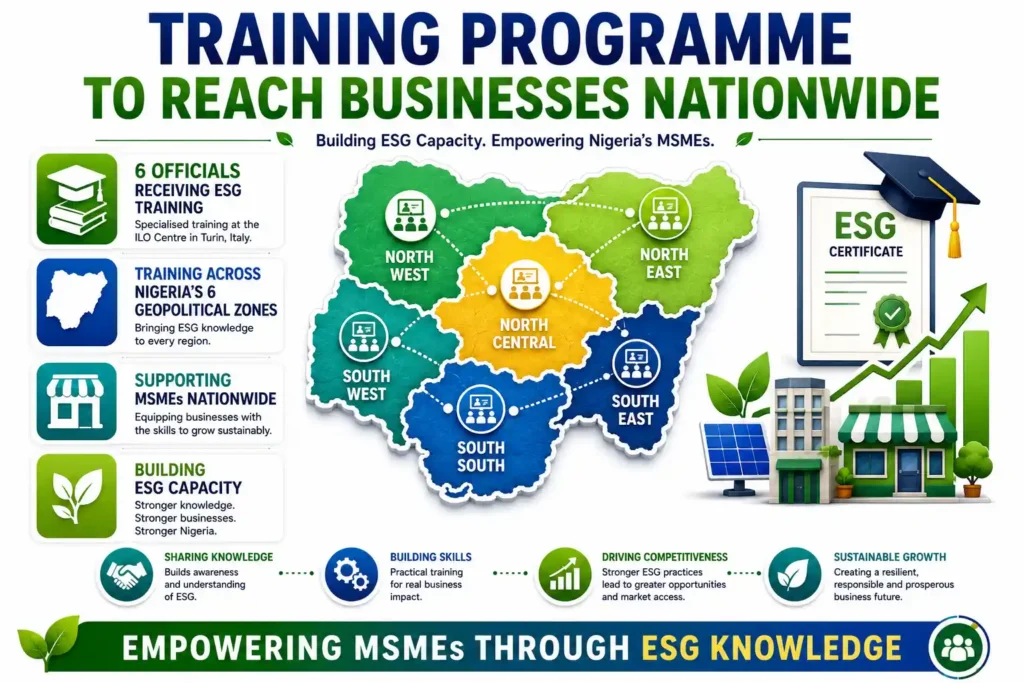
To support implementation, NECA revealed that six of its officials are currently undergoing specialised ESG training for SMEs at the ILO International Training Centre in Turin, Italy.
Upon completing the programme, the officials will deliver ESG capacity-building training to MSMEs across Nigeria’s six geopolitical zones.
According to the association, this initiative demonstrates its commitment to strengthening business capacity while promoting sustainability, competitiveness, and long-term economic growth.
NECA said building awareness and technical knowledge is essential to helping businesses successfully adopt ESG practices.
ESG Creates New Business Opportunities
NECA Director-General Adewale-Smatt Oyerinde emphasised that the first step is helping MSMEs understand the opportunities presented by ESG.
He explained that once businesses understand the benefits and receive the necessary training, implementing ESG principles becomes significantly easier.
According to Oyerinde, stronger ESG adoption can open access to finance, business concessions, investment opportunities, and international markets while helping Nigerian enterprises scale their operations sustainably.
He added that the initiative forms part of NECA’s broader strategy to improve enterprise competitiveness and promote inclusive economic development.
Economic Reforms Require Private Sector Collaboration
Beyond the ESG guide, discussions during the Nigeria Employers’ Summit also focused on ongoing economic reforms and the importance of collaboration between government and the organised private sector.
Oyerinde acknowledged that reforms such as foreign exchange liberalisation have helped reduce market distortions, although measures including fuel subsidy removal have increased production costs and placed additional pressure on businesses and households.
Despite these short-term challenges, he maintained that the reforms remain necessary for achieving long-term economic stability.
He also urged the government to continuously review, reassess, and refine reform implementation while engaging closely with the private sector to ensure policies deliver their intended outcomes.
According to Oyerinde, recommendations from the summit will be compiled into a communiqué and submitted to relevant government ministries and agencies for consideration.
Outlook
The launch of Africa’s first ESG Implementation Guide for MSMEs marks an important step in strengthening sustainable business practices across Nigeria. As ESG reporting expectations continue evolving globally, the guide is expected to help Nigerian MSMEs improve their competitiveness, attract investment, strengthen access to finance, and participate more effectively in international value chains. Combined with nationwide capacity-building initiatives and continued collaboration between NECA, the ILO, government, and the private sector, the programme could play a significant role in preparing businesses for mandatory ESG reporting while supporting long-term economic resilience and sustainable growth.
FAQs
1. Who launched the ESG Implementation Guide?
The guide was launched by the Nigeria Employers’ Consultative Association (NECA) in partnership with the International Labour Organization (ILO).
2. Who is the guide designed for?
It is specifically designed for Micro, Small and Medium Enterprises (MSMEs) operating in Nigeria.
3. Why is the guide important?
It helps businesses prepare for expected mandatory ESG reporting by 2030 while improving sustainability, competitiveness, and access to finance.
4. What additional support will NECA provide?
NECA will train MSMEs across Nigeria’s six geopolitical zones through officials receiving specialised ESG training from the ILO International Training Centre.
Sources: Business Day, MSME Africa, Business Post, PUNCH
Your financial future isn’t something you wait for—it’s something you build.
The real question is: when do you begin?
Move beyond simply staying informed.
Navigate the markets with clarity—track trends through the Serrari Group Market Index, uncover opportunities in the Serrari Marketplace, and build practical knowledge with our Curated Wealth Builder Platform.
Stay connected to what truly matters.
Get daily insights on macro trends and financial movements across Kenya, Africa, and global markets—delivered through the Serrari Newsletter.
Growth opens doors.
Advance your career through professional programs including ACCA, HESI A2, ATI TEAS 7 , HESI EXIT , NCLEX – RN and NCLEX – PN, Financial Literacy!🌟—designed to move you forward with confidence.
See where money is flowing—clearly and in real time.
Track Money Market Funds, Treasury Bills, Treasury Bonds, Green Bonds, and Fixed Deposits, alongside global and African indexes, key economic indicators, and the evolving Crypto and stablecoin landscape—all within Serrari’s Market Index.