
Global stock markets closed the second quarter on a strong note as investors rewarded technology stocks, particularly companies linked to artificial intelligence, while easing geopolitical tensions pushed oil prices sharply lower. The stock market rally lifted major U.S., Asian and European indices, with the MSCI All-World Index delivering its strongest quarterly performance since 2020. Meanwhile, the U.S. dollar strengthened, gold prices recorded their biggest quarterly decline in more than a decade, and the Japanese yen weakened to its lowest level in 40 years.
Key Overview
- Global stock markets recorded one of their strongest quarters since 2020.
- The MSCI All-World Index gained 14.5% during the quarter.
- The Nasdaq Composite advanced more than 21% on AI-driven optimism.
- South Korea’s KOSPI surged 68%, while Taiwan’s benchmark rose 45%.
- Brent crude oil prices fell nearly 40% during the quarter.
- Gold prices posted their biggest quarterly decline since 2013.
- The Japanese yen weakened to a 40-year low against the U.S. dollar.
- The U.S. dollar recorded its fourth consecutive quarterly gain.
Global Stock Markets End Quarter with Broad-Based Rally
Global stock markets finished the second quarter of 2026 with impressive gains as technology shares extended their artificial intelligence-driven rally, geopolitical tensions eased, and investors continued betting on resilient economic growth despite expectations of higher interest rates.
The quarter demonstrated how quickly investor sentiment can shift. Falling energy prices, strong corporate earnings, and continued investment in artificial intelligence helped push equity markets across multiple regions to record or multi-year highs.
Although higher interest rate expectations strengthened the U.S. dollar, equity investors remained focused on long-term earnings growth, particularly among technology companies driving the global AI revolution.
The combination of robust equity performance, declining oil prices and improving risk appetite produced one of the strongest quarter-end market performance periods seen in recent years.
U.S. Markets Continue Setting Records
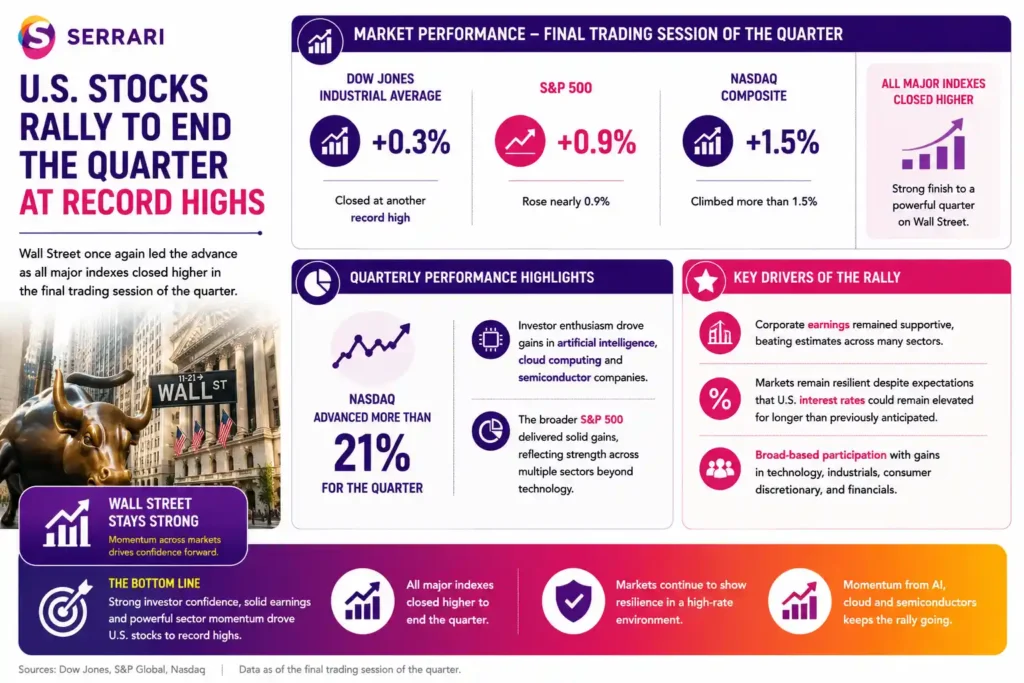
Wall Street once again led the advance.
The Dow Jones Industrial Average closed at another record high after gaining approximately 0.3%, while the S&P 500 rose nearly 0.9% and the Nasdaq Composite climbed more than 1.5% during the final trading session of the quarter.
For the quarter as a whole, the Nasdaq advanced more than 21%, continuing to benefit from investor enthusiasm surrounding artificial intelligence, cloud computing and semiconductor companies.
The broader S&P 500 also delivered solid gains, reflecting strength across multiple sectors beyond technology.
Corporate earnings remained supportive despite expectations that U.S. interest rates could remain elevated for longer than previously anticipated.
AI Continues Driving the Stock Market Rally
Artificial intelligence remained one of the strongest themes shaping global markets throughout the second quarter.
Technology companies involved in AI infrastructure, semiconductor manufacturing and cloud computing continued attracting significant investor interest.
The sustained investment in AI technologies supported valuations across several major technology companies while boosting broader market indices.
The enthusiasm was particularly evident in Asia.
South Korea’s KOSPI Index surged an impressive 68% during the quarter, making it one of the world’s strongest-performing equity markets.
Taiwan’s benchmark index also posted remarkable gains of approximately 45%, supported largely by companies involved in global semiconductor production.
These performances reinforced AI as one of the dominant investment themes of 2026.
Global Equity Markets Deliver Strong Returns
The positive momentum extended well beyond the United States.
The MSCI All-World Index, which tracks developed and emerging market equities globally, gained approximately 14.5% during the quarter while reaching a record high earlier in the month.
This represented its strongest quarterly performance since 2020.
Emerging market equities also performed exceptionally well, rising approximately 23% over the three-month period.
In Europe, the STOXX 600 Index advanced roughly 10% during the quarter despite having fewer technology companies benefiting directly from the AI investment boom.
Japan’s Nikkei Index also continued climbing, closing above 70,000 points, another indication of improving global investor confidence.
The broad participation across developed and emerging markets suggests the latest rally has become increasingly diversified rather than relying solely on a handful of large technology companies.
Oil Prices Fall Sharply
One of the quarter’s biggest surprises came from energy markets.
Following easing tensions between the United States and Iran and the gradual reopening of shipping through the Strait of Hormuz, oil prices experienced a dramatic decline.
Brent crude fell nearly 40% during the quarter, while U.S. crude declined approximately 31%.
The decline followed concerns earlier in the year that regional conflict could significantly disrupt global oil supplies.
Although both Brent and West Texas Intermediate crude remained higher for the year overall, the sharp quarterly correction helped ease inflation concerns that had previously weighed on financial markets.
Lower energy costs also improved investor sentiment by reducing expectations of sustained inflationary pressure.
Dollar Strength Pressures Gold and Yen
Currency markets experienced significant movements throughout the quarter.
The U.S. dollar recorded its fourth consecutive quarterly gain, supported by expectations that the Federal Reserve may still raise interest rates before the end of the year.
Persistent inflation and resilient economic growth have led investors to anticipate tighter monetary policy for longer.
The stronger dollar placed pressure on several other asset classes.
Gold prices declined approximately 14% during the quarter, marking their largest quarterly fall since 2013.
At the same time, the Japanese yen weakened to around 162.6 per U.S. dollar, its lowest level in four decades.
The rapid depreciation prompted renewed warnings from Japanese authorities regarding the possibility of currency market intervention to stabilise the yen.
Interest Rate Expectations Remain Key
Markets continued adjusting to changing expectations surrounding Federal Reserve policy.
While policymakers left interest rates unchanged during the quarter, updated economic projections suggested that additional tightening remains possible if inflation remains above the central bank’s target.
Investors increasingly priced in the possibility of further rate increases before year-end.
Ordinarily, rising interest rate expectations can weigh on equity valuations.
However, strong corporate earnings, continued economic expansion and optimism surrounding artificial intelligence investment largely offset these concerns.
The result was a quarter in which both higher interest rate expectations and rising equity prices occurred simultaneously.
Emerging Markets Show Renewed Strength
Emerging markets also delivered encouraging performance.
Emerging market stocks rose approximately 23% during the quarter, supported by improving investor appetite for risk assets and stronger economic conditions across several regions.
Interestingly, emerging market currencies also appreciated collectively against the U.S. dollar despite the dollar’s strength against most developed-market currencies.
This reflects increasing investor confidence in several emerging economies despite ongoing global monetary tightening.
Improving capital flows into emerging markets could continue supporting equity performance if global economic conditions remain favourable.
Outlook for Global Markets
Looking ahead, investors are expected to remain focused on several key themes.
Artificial intelligence investment continues driving corporate earnings growth across the technology sector, while central bank decisions will remain critical for interest rate expectations.
Oil prices, inflation trends and geopolitical developments will also influence investor sentiment during the second half of the year.
Although market volatility is likely to persist, the broad-based nature of the latest rally suggests investors remain optimistic about global economic resilience.
Conclusion
The second quarter ended with global stock markets delivering one of their strongest performances in years. Record gains across major equity indices, falling oil prices, resilient corporate earnings and continued enthusiasm for artificial intelligence helped sustain the stock market rally despite expectations of higher interest rates. While the stronger U.S. dollar pressured gold prices and pushed the Japanese yen to a 40-year low, investors remained focused on long-term growth opportunities. As the second half of 2026 begins, monetary policy, technology investment and global economic conditions are likely to remain the key drivers shaping global markets.
FAQs
1. Why did global stock markets perform so well during the second quarter?
Several factors contributed to the strong performance of global stock markets. Continued investment in artificial intelligence supported technology shares, while easing geopolitical tensions reduced pressure on energy markets. Strong corporate earnings, resilient economic growth and improving investor confidence also encouraged buying across developed and emerging markets. Together, these factors helped major stock indices deliver some of their strongest quarterly returns since 2020.
2. How did falling oil prices influence financial markets?
The sharp decline in oil prices helped reduce concerns about persistent inflation and rising business costs. Lower energy prices can ease pressure on consumers and companies by reducing transportation and production expenses. As inflation expectations moderate, investors often become more optimistic about economic growth and corporate profitability, which can support higher equity valuations across global markets.
3. Why did the Japanese yen weaken despite strong global markets?
The Japanese yen weakened primarily because interest rate expectations diverged between Japan and the United States. While the Federal Reserve is expected to maintain relatively high interest rates, Japan continues to pursue a much more accommodative monetary policy. This difference encouraged investors to favour U.S. dollar-denominated assets, pushing the yen to its weakest level in four decades and prompting concerns about possible government intervention.
4. What should investors watch in global markets during the second half of 2026?
Investors are likely to monitor several major developments, including future Federal Reserve interest rate decisions, corporate earnings, inflation trends and continued investment in artificial intelligence. Geopolitical developments, oil price movements and economic data from major economies will also influence market direction. While volatility may continue, the broad strength across global equity markets suggests investors remain optimistic about long-term growth opportunities.
Sources: Reuters, Kontan, Trading View, Kitco News, AOL
Your financial future isn’t something you wait for—it’s something you build.
The real question is: when do you begin?
Move beyond simply staying informed.
Navigate the markets with clarity—track trends through the Serrari Group Market Index, uncover opportunities in the Serrari Marketplace, and build practical knowledge with our Curated Wealth Builder Platform.
Stay connected to what truly matters.
Get daily insights on macro trends and financial movements across Kenya, Africa, and global markets—delivered through the Serrari Newsletter.
Growth opens doors.
Advance your career through professional programs including ACCA, HESI A2, ATI TEAS 7 , HESI EXIT , NCLEX – RN and NCLEX – PN, Financial Literacy!🌟—designed to move you forward with confidence.
See where money is flowing—clearly and in real time.
Track Money Market Funds, Treasury Bills, Treasury Bonds, Green Bonds, and Fixed Deposits, alongside global and African indexes, key economic indicators, and the evolving Crypto and stablecoin landscape—all within Serrari’s Market Index.