Oil prices rose on Monday as uncertainty persisted over the possible reopening of the Strait of Hormuz, after Iran said a deal with Oman to establish new shipping lanes was in its final stages but maintained that the waterway would only reopen if the United States met additional conditions. Brent crude rose 91 cents, or 1.09%, to $84.46 a barrel, while U.S. West Texas Intermediate (WTI) increased 61 cents, or 0.78%, to $78.79. Both benchmarks had fallen more than 7% the previous week on expectations of an agreement that could restore shipping through the strategic waterway, which carried a fifth of the world’s oil before the war.
Key Overview
- Brent crude rose 1.09% to $84.46 a barrel.
- WTI crude increased 0.78% to $78.79 a barrel.
- Both benchmarks had fallen more than 7% last week.
- Iran said a deal with Oman on new shipping lanes was in its final stages.
- Iran said reopening the Strait of Hormuz remains subject to additional conditions.
- The waterway carried a fifth of the world’s oil before the war.
- The Iran-aligned Houthis said they had hit Saudi Aramco’s Jazan refinery.
- ADNOC said 15 of its vessels had been attacked while transiting the Strait of Hormuz since the conflict began.
Oil Prices Rise on Strait of Hormuz Uncertainty
Oil prices rose on Monday as markets assessed uncertainty over the reopening of the Strait of Hormuz, after Iran said an agreement with Oman defining new shipping lanes was in its final stages.
However, Tehran reiterated that the strategic waterway would only reopen once Washington met other conditions, including compensation to Iran for widespread U.S. attacks.
The uncertainty has kept oil markets focused on the possibility of a breakthrough while also maintaining concerns over potential supply disruptions.
Brent and WTI Prices Increase
Brent crude futures rose 91 cents, or 1.09%, to $84.46 a barrel by 0056 GMT.
Meanwhile, U.S. West Texas Intermediate crude futures increased 61 cents, or 0.78%, to $78.79 a barrel.
The gains followed a sharp decline in both benchmarks during the previous week.
Both oil benchmarks had fallen more than 7% last week on hopes that Iran and Oman were close to reaching an agreement that could result in the reopening of the Strait of Hormuz.
The waterway carried approximately a fifth of the world’s oil before the war, making developments around its reopening particularly important for oil markets.
Iran and Oman Deal Remains Uncertain
Iran said on Sunday that a deal with Oman was in its “final stages” as the two sides worked on establishing new shipping routes through the Strait of Hormuz.
However, Iran also reiterated that reopening the waterway remains conditional on the United States meeting additional requirements.
These include U.S. compensation to Iran for its widespread attacks, according to the information provided.
The conditions have left traders weighing the possibility of restored shipping against the risk that negotiations could fail to produce unrestricted access through the strategic waterway.
Markets Watch for Evidence of a Breakthrough
The uncertainty has kept traders cautious about the potential impact of any agreement.
Tim Waterer, chief market analyst at KCM Trade, said traders are waiting for tangible evidence before further reducing the risk premium in oil prices.
He pointed to verified tanker movements or formal agreements as examples of evidence that could provide greater clarity around the situation.
The market therefore remains caught between expectations of improved shipping conditions and continued geopolitical supply risks.
Context is everything. Stay ahead of shifting trends with today’s market updates, and uncover emerging opportunities using the Serrari Group Market Index and Marketplace. Then, take control of your own financial future by exploring our Money & Life Reset Transformation Blueprint ™ to build stronger habits, create better systems, and design a path toward lasting wealth.
Iran Rules Out Talks With the US
The uncertainty extends beyond the discussions involving Iran and Oman.
Iranian Foreign Minister Abbas Araqchi said on Sunday that Iran and the United States are not engaged in talks and that Tehran will not start negotiations as long as Washington breaches an interim deal signed in June.
The position adds another layer of uncertainty to the prospects for a broader resolution and the reopening of the strategic waterway.
Additional Supply Risks Emerge
Further concerns over oil supplies emerged after the Iran-aligned Houthis said they had hit Saudi Aramco’s Jazan refinery on Sunday.
The attack came two days after Saudi Arabia signed a defence pact with Turkey and Pakistan amid growing regional instability related to the U.S.-Israeli war on Iran.
Separately, the United Arab Emirates’ ADNOC said on Friday that 15 of its vessels had been attacked while transiting the Strait of Hormuz since the beginning of the conflict.
These developments have added to concerns about the security of energy shipments through the region.
Oil Market Remains Caught Between Two Forces
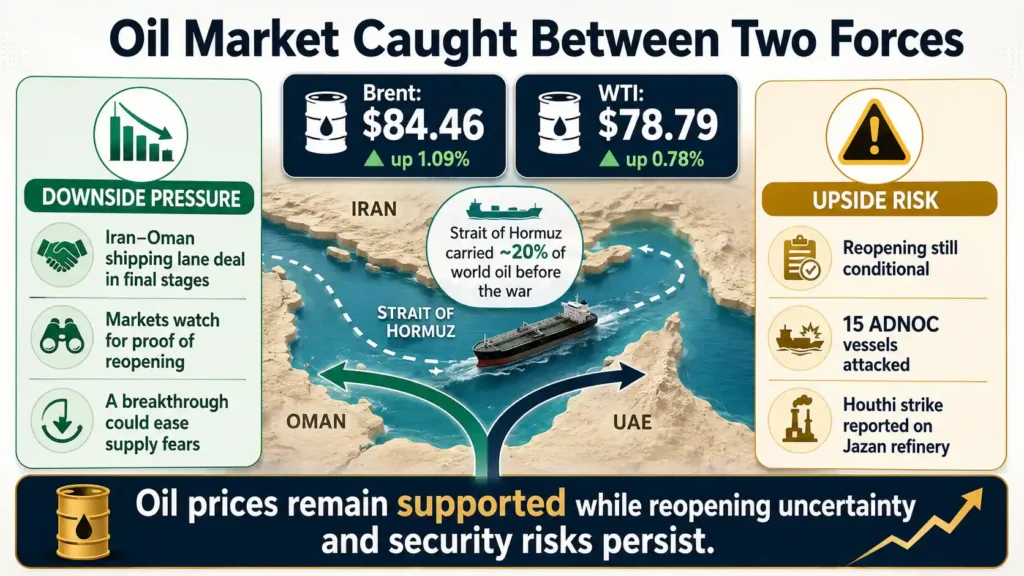
The conflicting developments have left crude prices exposed to both potential downside and upside pressures.
Sugandha Sachdeva, founder of SS WealthStreet, said crude oil prices remain caught between opposing forces as markets assess the possibility of a breakthrough over the Strait of Hormuz against Iran’s conditions for reopening the strategic waterway.
A successful reopening could ease concerns over supply disruptions and place downward pressure on oil prices.
However, a breakdown in negotiations or renewed disruptions could quickly restore the geopolitical risk premium.
Outlook
The direction of oil prices will remain closely linked to developments surrounding the Strait of Hormuz and the possibility of an agreement between Iran and Oman. A breakthrough that restores unrestricted shipping could reduce supply concerns and exert downward pressure on crude prices, while continued uncertainty, attacks on energy infrastructure or disruptions to tanker movements could keep geopolitical risks elevated. With Brent crude and WTI already reacting sharply to changing expectations, traders are likely to remain focused on tangible evidence of progress, including formal agreements and verified tanker movements.
FAQs
1. Why did oil prices rise?
Oil prices rose because of continued uncertainty over the reopening of the Strait of Hormuz, despite Iran saying a deal with Oman was in its final stages.
2. What was the price of Brent crude?
Brent crude futures rose 91 cents, or 1.09%, to $84.46 a barrel.
3. What was the price of WTI crude?
U.S. West Texas Intermediate crude futures rose 61 cents, or 0.78%, to $78.79 a barrel.
4. Why is the Strait of Hormuz important to oil markets?
The Strait of Hormuz carried approximately a fifth of the world’s oil before the war, making its reopening and the security of shipping through the waterway important to global oil supply.
Sources: Daily Nation, KLSE Screener, The Business Standard, The Daily Star
Your financial future isn’t something you wait for—it’s something you build.
The real question is: when do you begin?
Move beyond simply staying informed.
Navigate the markets with clarity—track trends through the Serrari Group Market Index, uncover opportunities in the Serrari Marketplace, and build practical knowledge with our Curated Wealth Builder Platform.
Stay connected to what truly matters.
Get daily insights on macro trends and financial movements across Kenya, Africa, and global markets—delivered through the Serrari Newsletter.
Growth opens doors.
Advance your career through professional programs including ACCA, HESI A2, ATI TEAS 7 , HESI EXIT , NCLEX – RN and NCLEX – PN, Financial Literacy!🌟—designed to move you forward with confidence.
See where money is flowing—clearly and in real time.
Track Money Market Funds, Treasury Bills, Treasury Bonds, Green Bonds, and Fixed Deposits, alongside global and African indexes, key economic indicators, and the evolving Crypto and stablecoin landscape—all within Serrari’s Market Index.