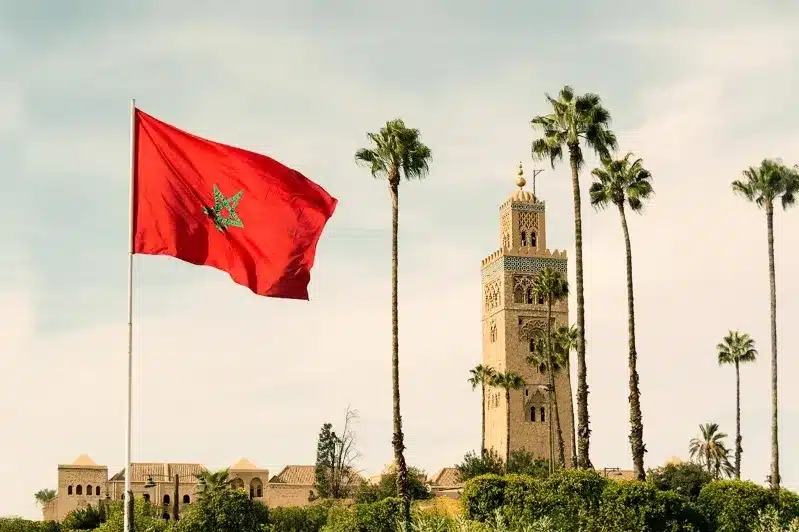
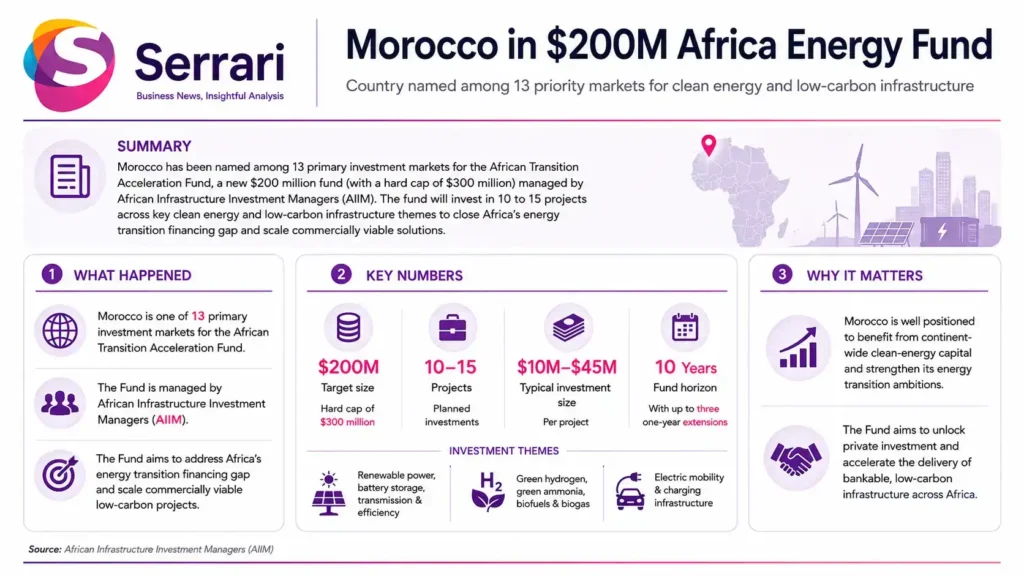
Morocco has been selected as one of 13 priority markets for the African Transition Acceleration Fund, a blended-finance vehicle targeting $200 million for early-stage and scaling investments in Africa’s energy transition. The fund will back renewable electricity, storage, clean fuels and sustainable transport projects, positioning Morocco alongside some of the continent’s largest emerging clean-energy markets.
The fund is managed by African Infrastructure Investment Managers and is designed to tackle an underserved part of Africa’s climate-finance market; (AIIM Africa) it intends to provide capital at stages where projects are often considered too early for conventional infrastructure investors but require more funding than typical seed financing.
Key Overview
- ATAF is targeting $200 million, while an environmental and social assessment cited for the fund sets out a $300 million hard cap; (Morocco World News) the vehicle is structured to support energy-transition infrastructure across Africa.
- Morocco is one of 13 primary investment markets, alongside Botswana, Côte d’Ivoire, Egypt, Ghana, Kenya, Namibia, Nigeria, Senegal, South Africa, Tanzania, Uganda and Zambia.
- The fund plans a portfolio of approximately 10 to 15 investments over its life; (AIIM Africa) individual investments are expected to typically range from $10 million to $45 million.
- Its three principal themes are clean electrons, clean molecules and sustainable transport.
- A combined $50 million in catalytic capital was announced for ATAF’s first close in March 2026; (FSD Africa) additional development-finance participation is helping mobilise private investors.
- The fund is structured with a 25% first-loss junior equity tranche, intended to reduce risk for senior investors and attract more commercial capital.
Morocco Joins a 13-Market Clean-Energy Push
Morocco’s inclusion places the North African economy within a targeted group of markets expected to offer scalable opportunities across clean power, fuels and transport. According to the fund assessment outlining its targeted markets, (Morocco World News) ATAF’s geographic scope stretches across North, West, East and Southern Africa.
The inclusion is particularly relevant because ATAF is not structured purely as a traditional renewable-energy fund. Its investment mandate extends across technologies required to support broader decarbonisation, including electricity transmission, battery storage, energy efficiency and technologies associated with producing cleaner industrial fuels.
For Morocco, that creates potential alignment with projects across renewable generation, storage, green molecules and electric mobility rather than restricting investment opportunities to utility-scale solar or wind projects alone.
Context is everything. Stay ahead of shifting trends with today’s market updates, and uncover emerging opportunities using the Serrari Group Market Index and Marketplace. Then, take control of your own financial future by exploring our Money & Life Reset Transformation Blueprint ™ to build stronger habits, create better systems, and design a path toward lasting wealth.
Three Investment Themes Shape the Fund
ATAF divides its strategy into three main decarbonisation themes. The first, clean electrons, includes technologies such as solar, wind, geothermal and hydropower alongside energy storage and electricity transmission; (AIIM Africa) this allows the fund to invest not only in generation but also in infrastructure needed to integrate clean electricity into power systems.
The second category, clean molecules, encompasses green hydrogen, green ammonia, biofuels and biogas. These technologies are increasingly important to sectors where direct electrification can be difficult, particularly industrial processes, heavy transport and production of lower-carbon fuels.
The third theme covers sustainable transport, including electric mobility, charging infrastructure and related logistics platforms. The fund’s broader investment mandate explicitly includes electric vehicles and low-carbon transportation systems; (FSD Africa) together, the three areas give ATAF exposure across multiple stages of Africa’s transition away from carbon-intensive energy systems.
Blended Finance Targets Africa’s Funding Gap
A defining feature of ATAF is its focus on investments that may be too early for conventional infrastructure funds. The vehicle intends to provide development and growth capital to platforms and companies capable of taking climate infrastructure projects closer to bankability and commercial scale.
The structure includes a 25% first-loss junior equity tranche, (AIIM Africa) using catalytic capital to absorb a greater share of potential initial losses and improve the risk-return profile available to senior investors. This is intended to encourage institutional and private-sector participation in projects that might otherwise struggle to secure financing.
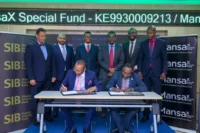
Momentum behind the fund increased in March when investors announced a combined $50 million catalytic commitment to anchor its first close; (FSD Africa) the investor group also includes development-finance institutions and senior equity participants.
Separately, a further $15 million investment was announced at the first close; (Proparco) this added to the pool of institutional capital supporting the fund’s rollout.
Institutional Capital Builds Behind ATAF
The fund has also attracted backing at the European development-finance level. A project approved in July 2026 lists proposed financing of approximately $40 million toward the $200 million vehicle; (European Investment Bank) the assessment identifies renewable power, green hydrogen, electric mobility, energy efficiency and storage among the technologies within its investment pipeline.
ATAF ultimately plans to build a portfolio of roughly 10 to 15 investments during its 10-year fund life. Its approach is designed around building commercially viable platforms rather than financing isolated demonstration projects, with the goal of helping businesses reach sufficient scale to attract larger pools of private capital.
For Morocco and the other targeted markets, the significance therefore extends beyond the fund’s headline $200 million size. If its blended-finance structure succeeds in absorbing early-stage risks and attracting commercial investors behind it, ATAF could help unlock substantially larger amounts of capital for renewable infrastructure, cleaner transport and emerging low-carbon industries across Africa.
Sources: African Development Bank / African Infrastructure Investment Managers / FSD Africa / Proparco / European Investment Bank / Morocco World News
Your financial future isn’t something you wait for—it’s something you build.
The real question is: when do you begin?
Move beyond simply staying informed.
Navigate the markets with clarity—track trends through the Serrari Group Market Index, uncover opportunities in the Serrari Marketplace, and build practical knowledge with our Curated Wealth Builder Platform.
Stay connected to what truly matters.
Get daily insights on macro trends and financial movements across Kenya, Africa, and global markets—delivered through the Serrari Newsletter.
Growth opens doors.
Advance your career through professional programs including ACCA, HESI A2, ATI TEAS 7 , HESI EXIT , NCLEX – RN and NCLEX – PN, Financial Literacy!🌟—designed to move you forward with confidence.
See where money is flowing—clearly and in real time.
Track Money Market Funds, Treasury Bills, Treasury Bonds, Green Bonds, and Fixed Deposits, alongside global and African indexes, key economic indicators, and the evolving Crypto and stablecoin landscape—all within Serrari’s Market Index.