
Kenya’s diaspora economy is larger than previously captured, after a new national survey found that households received Sh931.8 billion in remittances between June 2024 and May 2025. The figure includes both formal cash transfers and previously undercounted support sent through informal channels and in-kind items.
The survey, conducted by the Kenya National Bureau of Statistics, the Central Bank of Kenya and Financial Sector Deepening Kenya, gives a wider view of how money and goods sent by Kenyans abroad support families, strengthen foreign exchange inflows and shape household welfare. It also reveals that a large share of remittances had been invisible in regular official data because it moved outside banks, mobile money providers and authorised remittance firms.
Key Overview
- Kenyan households received Sh931.8 billion in remittances from June 2024 to May 2025.
- Cash transfers accounted for 91% of inflows, while in-kind support made up 9%.
- The survey uncovered about Sh280.6 billion in remittances not captured through formal monthly reporting.
- The United States remained the largest source of inflows, followed by Germany, Australia and Saudi Arabia.
- More than one in five recipient households rely on remittances as their main source of livelihood.
Survey Reveals a Bigger Diaspora Economy
Kenya’s latest remittance survey shows that diaspora inflows are not limited to money wired through banks and mobile platforms. According to the new official survey, total inflows reached Sh931.8 billion in the 12 months to May 2025, including cash brought through informal channels and non-cash items sent to households.
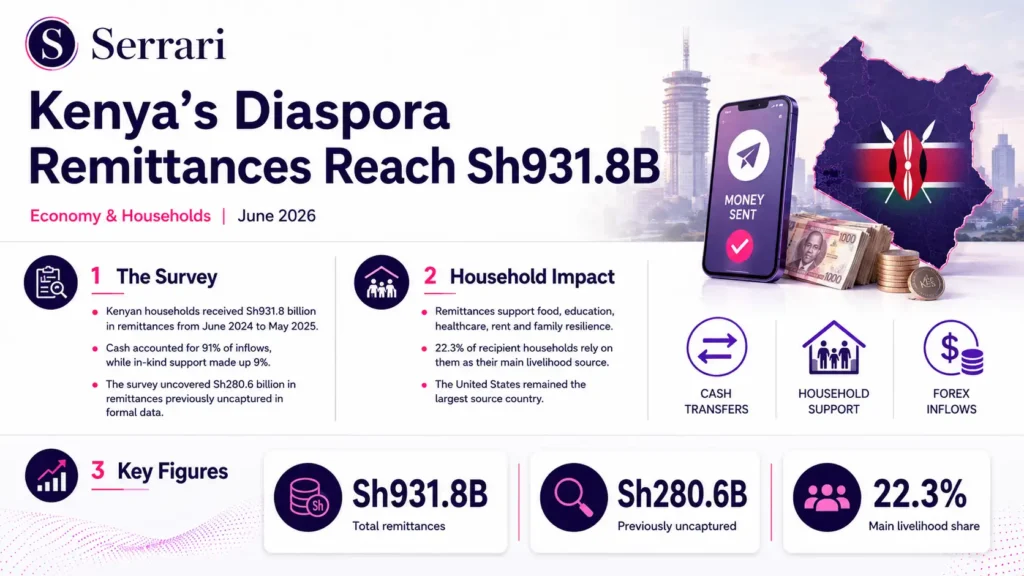
This is significantly higher than the Sh651.2 billion captured through formal channels over the same period. The difference of Sh280.6 billion highlights how much support had previously remained outside standard remittance statistics. The survey found that cash transfers stood at Sh848.4 billion, while in-kind flows such as clothing, footwear, electronics and other goods totalled Sh83.5 billion.
That broader measurement matters because remittances have become one of Kenya’s most reliable sources of external income. In an earlier press release, the Central Bank of Kenya said formal remittances reached a record Sh666.7 billion in 2024, equivalent to about 4% of GDP. The new household survey adds more detail by capturing flows that do not pass through official financial channels.
Context is everything. Stay ahead of shifting trends with today’s market updates, and uncover emerging opportunities using the Serrari Group Market Index and Marketplace. Then, take control of your own financial future by exploring our Money & Life Reset Transformation Blueprint ™ to build stronger habits, create better systems, and design a path toward lasting wealth.
Families Depend on Diaspora Support
The findings show that remittances are central to household survival. Among households receiving support, 42.3% described remittances as supplementary income, 36.4% said they were additional income, and 22.3% said they were their main source of livelihood.
Much of the money is used for basic needs. The survey found that 73.1% of recipient households spent a significant share of remittances on food and other consumer goods. Education accounted for 31.4%, medical expenses for 23.9%, clothing for 19.8%, rent for 9.3%, and ceremonies such as funerals and weddings for 8.8%.
This suggests that diaspora inflows are both a household safety net and a development resource. They help families manage daily costs, pay school fees, access healthcare and respond to emergencies. However, the heavy use of remittances for consumption also shows the pressure many households face from living costs, weak incomes and limited formal safety nets.
Source Countries and Hidden Channels
The United States remained Kenya’s largest remittance source, contributing Sh405.4 billion, or 43.5% of total flows. Germany followed with Sh85.98 billion, Australia with Sh62.6 billion and Saudi Arabia with Sh49.2 billion.
The appearance of Germany and Australia among the top sources is important because formal monthly CBK reporting has often shown the United States, the United Kingdom and Saudi Arabia as leading sources. The broader survey reveals previously undercounted flows from countries that have attracted more Kenyan students, professionals and skilled workers.
Informal channels also remain important. Some Kenyans abroad send money or goods through relatives, friends, personal travel, road transporters, Hawala networks or other non-bank routes. For in-kind remittances, many senders either deliver goods themselves when visiting Kenya or use travellers returning home. Along corridors from neighbouring countries such as Uganda and Tanzania, road transporters including buses, motorcycles and other local carriers also play a role.
Why Policy Must Catch Up
The survey gives policymakers a stronger evidence base for supporting diaspora inflows. If remittances are helping fund food, education, healthcare and household resilience, then reducing transfer costs and improving access to safe formal channels should be a priority.
It also shows the need to design better diaspora investment products. Although remittances are large, only a small share appears to flow into formal investment products such as securities, microfinance accounts or digital assets. This means Kenya has an opportunity to convert part of its diaspora income into longer-term savings, housing, enterprise finance and development investment.
For now, the main message is clear: Kenya’s diaspora contribution is bigger than formal monthly data previously showed. The challenge is to make these flows cheaper, safer and more productive while protecting the household support role that millions of families already depend on.
Sources used: Business Daily / The Star / Central Bank of Kenya / Kenya National Bureau of Statistics / Financial Sector Deepening Kenya
Your financial future isn’t something you wait for—it’s something you build.
The real question is: when do you begin?
Move beyond simply staying informed.
Navigate the markets with clarity—track trends through the Serrari Group Market Index, uncover opportunities in the Serrari Marketplace, and build practical knowledge with our Curated Wealth Builder Platform.
Stay connected to what truly matters.
Get daily insights on macro trends and financial movements across Kenya, Africa, and global markets—delivered through the Serrari Newsletter.
Growth opens doors.
Advance your career through professional programs including ACCA, HESI A2, ATI TEAS 7 , HESI EXIT , NCLEX – RN and NCLEX – PN, Financial Literacy!🌟—designed to move you forward with confidence.
See where money is flowing—clearly and in real time.
Track Money Market Funds, Treasury Bills, Treasury Bonds, Green Bonds, and Fixed Deposits, alongside global and African indexes, key economic indicators, and the evolving Crypto and stablecoin landscape—all within Serrari’s Market Index.