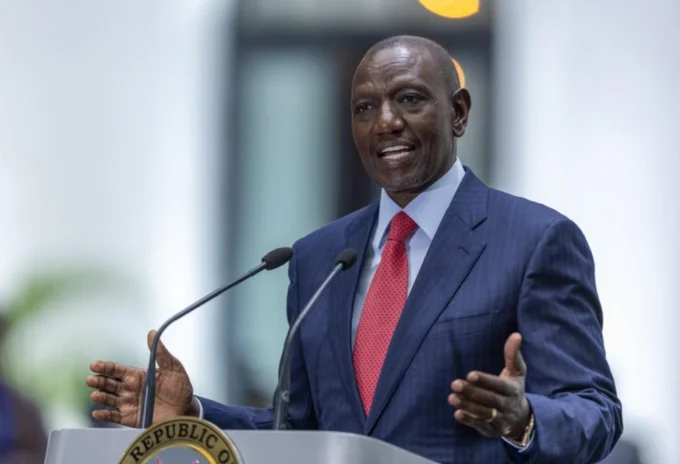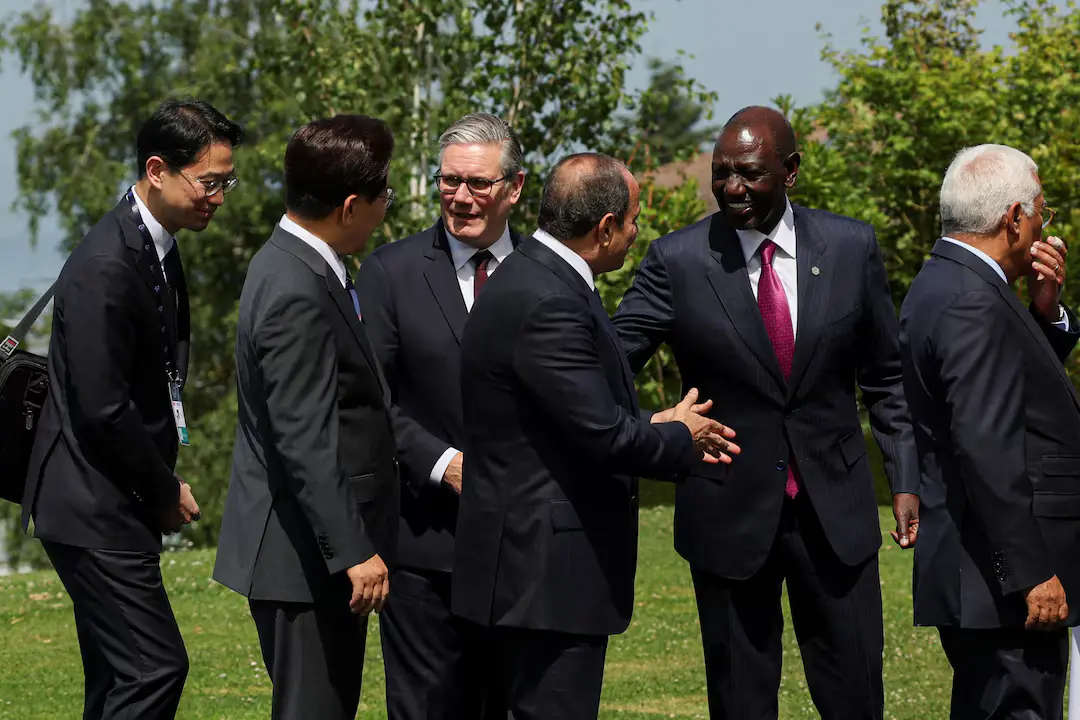
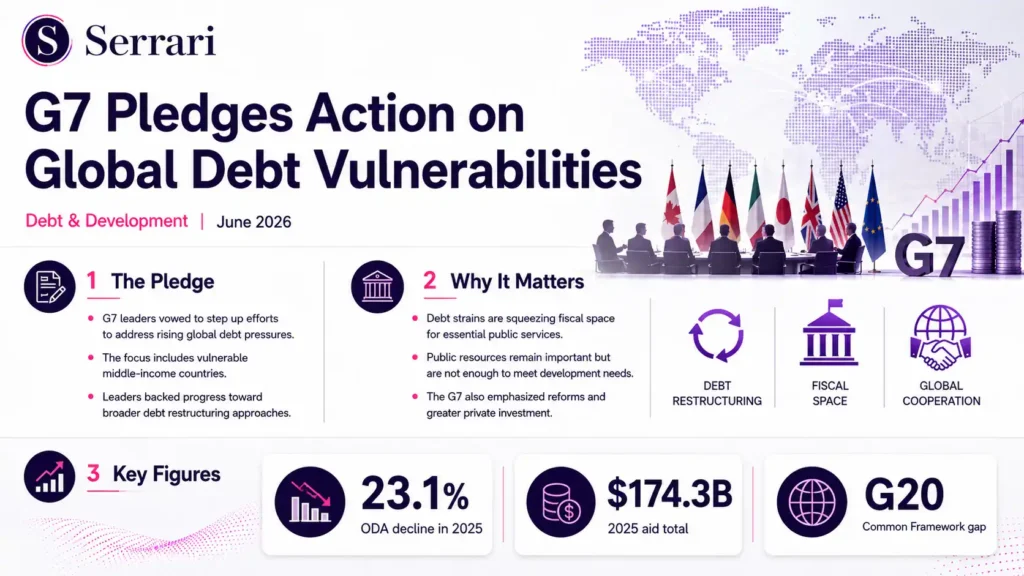
G7 leaders have pledged to strengthen efforts to address rising global debt vulnerabilities, with a sharper focus on developing countries and vulnerable middle-income economies that fall outside existing debt relief frameworks. The commitment was made during the G7 summit in Évian-les-Bains, France, after a session that included guest countries such as Kenya, Egypt, India, Brazil and South Korea.
The declaration comes at a difficult moment for global development finance. Many emerging and developing economies are facing higher borrowing costs, tighter fiscal space and rising demands for public spending, while official aid from wealthy countries has fallen sharply. According to preliminary OECD data, official development assistance dropped by 23.1% in real terms in 2025 to $174.3 billion, the largest annual contraction on record.
Key Overview
- G7 leaders pledged to intensify efforts to address global debt vulnerabilities.
- The statement focused partly on middle-income countries not covered by the G20 Common Framework.
- Leaders said public resources remain important but are not enough to meet global development needs.
- The G7 called for reforms, private investment and improved approaches to debt restructuring.
- Development groups warned that aid cuts could weaken public services and deepen inequality.
Why the Debt Pledge Matters
The G7 statement reflects growing concern that debt stress is no longer limited to the world’s poorest economies. Since the COVID-19 pandemic, many developing countries have faced higher interest rates, weaker currencies and heavier repayment schedules. Some middle-income countries are too wealthy to qualify for existing debt relief channels, but still vulnerable enough to face fiscal pressure.
The current global system is built around tools such as the G20 Common Framework, which was created during the pandemic to help low-income countries coordinate debt treatment with official creditors. However, the framework does not cover many middle-income economies that also face high debt burdens. That gap has become more urgent as financing costs rise and public budgets are squeezed.
According to Reuters, the G7 leaders said they would enhance efforts to address “escalating global debt vulnerabilities” that threaten economic stability and limit fiscal space for essential public services. The statement also backed progress toward a common approach for vulnerable middle-income countries that are currently outside the G20 framework.
Context is everything. Stay ahead of shifting trends with today’s market updates, and uncover emerging opportunities using the Serrari Group Market Index and Marketplace. Then, take control of your own financial future by exploring our Money & Life Reset Transformation Blueprint ™ to build stronger habits, create better systems, and design a path toward lasting wealth.
From Crisis Response to Pre-emptive Restructuring
One important shift in the G7 language is the idea of acting before debt distress becomes a full crisis. Development advocates described the statement as a move toward pre-emptive debt restructuring, meaning countries would receive support before payment problems spiral into default, austerity or emergency bailouts.
That approach could reduce the damage caused by late debt interventions. When restructuring is delayed, governments often cut investment, delay infrastructure projects or reduce social spending to preserve debt payments. Earlier action could protect public services while creating a more predictable process for borrowers and creditors.
However, the challenge will be implementation. Debt restructuring often involves official creditors, private bondholders, multilateral institutions and domestic political pressures. Without clear timelines, creditor coordination and fair burden-sharing, even strong declarations can struggle to produce quick relief.
Aid Cuts Raise the Stakes
The debt debate is becoming more urgent because public development finance is shrinking. The OECD reported that development assistance from donor countries fell to $174.3 billion in 2025, with sharp reductions from several major economies. This weakens one of the traditional tools used to support low-income and vulnerable states during periods of global stress.
G7 leaders acknowledged that public resources remain critical, but said they are insufficient to meet global development needs. The declaration therefore placed greater emphasis on reforms and private investment. That reflects a broader shift in development policy: using public money to reduce risk and attract private capital into infrastructure, climate, health, energy and food security projects.
But this approach is controversial. Oxfam International criticised the G7 position, urging leaders to return to the long-standing 0.7% of gross national income aid target. The organisation warned that using aid mainly to incentivise private investors could divert resources from public schools, hospitals and humanitarian needs.
Private Investment Cannot Replace Public Finance
Private capital can help close financing gaps, but it is unlikely to replace public development finance entirely. Investors typically seek returns, predictable regulation and manageable risk. Many of the countries facing the deepest debt pressures need funding for essential services, climate resilience and food security, areas where returns may be long-term or indirect.
That is why the G7’s debt pledge will be judged by whether it delivers practical tools rather than broad language. Vulnerable countries need lower borrowing costs, faster restructuring processes, emergency liquidity and long-term finance for development. Middle-income countries facing shocks from energy prices, food imports or climate disasters may also need support before they reach formal crisis levels.
The declaration marks an important acknowledgement that the debt architecture has gaps. The next test is whether G7 members can align public finance, private investment and debt restructuring reforms in a way that protects development rather than deepening dependency.
Sources used: Reuters / OECD / Oxfam International / Council of the European Union / G7-G20 Documents / International Monetary Fund
Your financial future isn’t something you wait for—it’s something you build.
The real question is: when do you begin?
Move beyond simply staying informed.
Navigate the markets with clarity—track trends through the Serrari Group Market Index, uncover opportunities in the Serrari Marketplace, and build practical knowledge with our Curated Wealth Builder Platform.
Stay connected to what truly matters.
Get daily insights on macro trends and financial movements across Kenya, Africa, and global markets—delivered through the Serrari Newsletter.
Growth opens doors.
Advance your career through professional programs including ACCA, HESI A2, ATI TEAS 7 , HESI EXIT , NCLEX – RN and NCLEX – PN, Financial Literacy!🌟—designed to move you forward with confidence.
See where money is flowing—clearly and in real time.
Track Money Market Funds, Treasury Bills, Treasury Bonds, Green Bonds, and Fixed Deposits, alongside global and African indexes, key economic indicators, and the evolving Crypto and stablecoin landscape—all within Serrari’s Market Index.