Growing institutional Ethereum adoption is pushing Ethereum beyond experimental projects and into mainstream financial infrastructure. According to Etherealize founder Vivek Raman, Wall Street firms are increasingly exploring tokenized assets and using public blockchains as production systems rather than proof-of-concept experiments.
Key Overview
- Wall Street institutions are increasingly adopting Ethereum infrastructure.
- Stablecoins were the first major institutional use case.
- Interest is expanding to stocks, bonds, real estate and investment funds.
- Ethereum adoption is moving from pilot programs to production systems.
- Institutional sales cycles remain lengthy.
- Tokenized assets are expected to drive future growth.
- Ethereum’s success may depend more on utility than price.
- Etherealize aims to bring Ethereum to traditional finance.
- Public blockchains are increasingly viewed as financial infrastructure.
- Asset tokenization continues gaining momentum.
Wall Street Ethereum Adoption Moves Into Production Phase
The latest developments in Wall Street Ethereum adoption suggest that traditional financial institutions are moving beyond limited cryptocurrency experiments and increasingly embracing blockchain technology as core infrastructure.
According to Vivek Raman, co-founder of Etherealize, institutional conversations surrounding Ethereum have shifted dramatically over the past 18 months.
What was previously viewed as a proof-of-concept exercise is now becoming a strategic priority for financial firms seeking to integrate public blockchain networks into their operations.
Raman believes institutions are no longer testing the waters cautiously. Instead, they are beginning to view Ethereum as a platform capable of supporting real-world financial applications.
The transition represents a significant evolution in how Wall Street perceives blockchain technology and digital assets.
Rather than focusing exclusively on cryptocurrency speculation, institutions are increasingly interested in practical use cases that can improve efficiency and expand investment opportunities.
Institutional Ethereum Adoption Gains Momentum
The acceleration of institutional Ethereum adoption reflects growing confidence in blockchain technology.
According to Raman, institutions are beginning to recognize that public blockchains can function in much the same way as the internet itself.
A year and a half ago, many firms were merely experimenting with small pilot programs.
Today, the conversation has shifted toward full-scale implementation.
This change indicates that institutions increasingly view blockchain technology as a permanent part of the financial landscape rather than a temporary trend.
Stablecoins have already demonstrated how digital assets can facilitate efficient transactions and cross-border payments.
These early successes have encouraged financial firms to explore additional applications built on Ethereum.
As confidence grows, institutional adoption is expected to accelerate further.
The trend highlights the growing convergence between traditional finance and decentralized technologies.
Ethereum Institutional Investors Expand Focus
Interest among Ethereum institutional investors is no longer limited to cryptocurrencies.
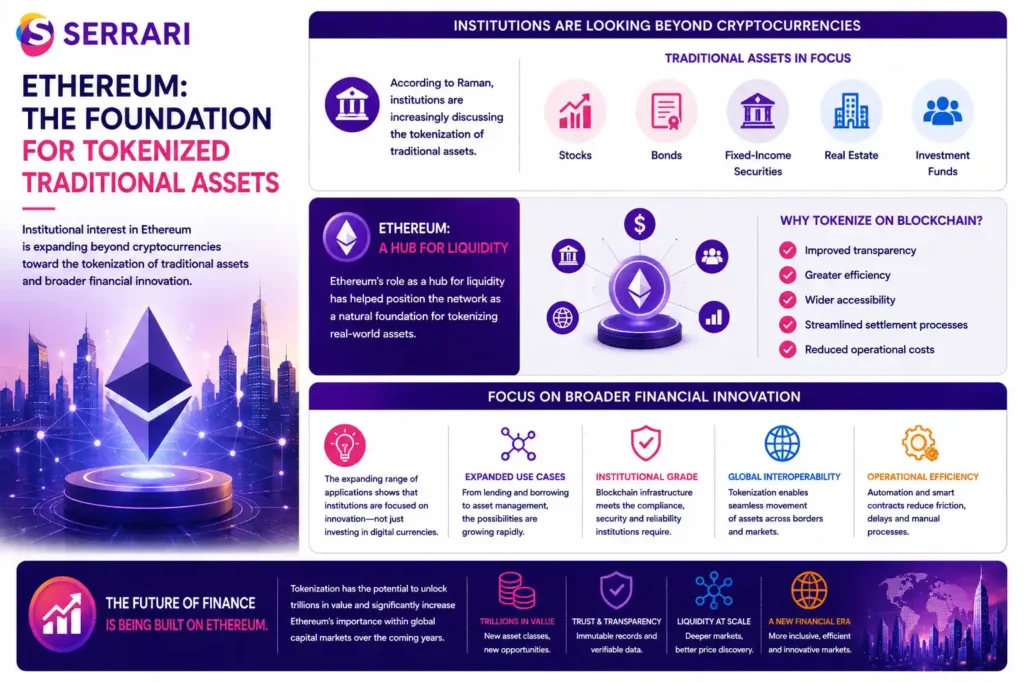
According to Raman, institutions are increasingly discussing the tokenization of traditional assets.
These assets include stocks, bonds, fixed-income securities, real estate and investment funds.
Ethereum’s role as a hub for liquidity has helped position the network as a natural foundation for these developments.
By bringing traditional assets onto blockchain networks, institutions hope to improve transparency, efficiency and accessibility.
Tokenization could also streamline settlement processes and reduce operational costs.
The expanding range of applications demonstrates that institutions are focusing on broader financial innovation rather than simply investing in digital currencies.
This evolution could significantly increase Ethereum’s importance within global capital markets over the coming years.
Context is everything. Stay ahead of shifting trends with today’s market updates, and uncover emerging opportunities using the Serrari Group Market Index and Marketplace. Then, take control of your own financial future by exploring our Money & Life Reset Transformation Blueprint ™ to build stronger habits, create better systems, and design a path toward lasting wealth.
Wall Street Crypto Adoption Enters a New Stage
The latest wave of Wall Street crypto adoption differs substantially from earlier phases.
Previous institutional interest largely focused on testing blockchain technology through isolated pilot programs.
Today, discussions are centered on production systems capable of supporting large-scale financial activity.
Raman noted that stablecoins represented the first major institutional use case.
Now, attention is shifting toward more complex financial products and services.
Traditional financial firms are beginning to explore how blockchain infrastructure can support a broader ecosystem of tokenized assets.
This progression suggests that blockchain technology is gradually becoming embedded within mainstream financial operations.
Although adoption remains in its early stages, the shift from experimentation to implementation marks an important milestone for the industry.
Blockchain Finance Continues to Evolve
The growth of blockchain finance is reshaping how institutions think about markets and infrastructure.
Public blockchain networks offer transparency, programmability and accessibility that traditional systems often struggle to provide.
Financial institutions are increasingly recognizing these advantages.
Ethereum, in particular, has emerged as one of the leading platforms supporting decentralized applications and digital assets.
Its established ecosystem and deep liquidity have made it attractive to both developers and institutional users.
As blockchain technology matures, its applications are expanding beyond cryptocurrencies.
From payments and settlements to asset management and securities issuance, blockchain finance is gradually influencing many areas of traditional finance.
The increasing involvement of major institutions suggests that this transformation is likely to continue.
Ethereum Ecosystem Positioned for Long-Term Growth
The expanding Ethereum ecosystem provides the foundation for many of these innovations.
Ethereum’s infrastructure supports decentralized finance applications, stablecoins and tokenized assets.
Its flexibility has enabled developers and institutions to create a wide range of financial products.
According to Raman, Ethereum’s success should ultimately be measured by usage and utility rather than short-term price movements.
The presence of sustainable assets and active users is more important than market speculation.
This perspective highlights the growing emphasis on practical applications.
As more institutions bring assets on-chain, the Ethereum ecosystem is expected to become increasingly important.
The development of real-world use cases could strengthen the network’s position within global finance.
Tokenized Assets Could Drive the Next Wave
Growing interest in tokenized assets may represent the next major stage of blockchain adoption.
Tokenization enables traditional assets to be represented digitally on blockchain networks.
This process can improve liquidity, reduce settlement times and increase accessibility for investors.
Institutions are increasingly evaluating how tokenized stocks, bonds and real estate can fit into existing financial frameworks.
Although many projects remain in development, the underlying infrastructure is already being established.
Raman noted that institutional adoption often progresses slowly because of lengthy sales cycles and regulatory considerations.
However, he believes the necessary infrastructure is already in place.
As more assets move on-chain, tokenization could become one of the most important drivers of blockchain adoption.
Institutional Adoption and Market Performance Remain Disconnected
Despite increasing institutional interest, Ethereum’s market performance has not always reflected these developments.
This disconnect has frustrated many investors expecting immediate price appreciation.
Raman attributes the gap primarily to timing.
Institutional adoption processes are often slow and require extensive planning and compliance procedures.
As a result, the infrastructure may be ready long before assets begin flowing into the system.
He believes that the foundations have already been built and that widespread adoption will gradually follow.
For investors, this suggests that long-term utility rather than short-term price movements may ultimately determine Ethereum’s success.
Conclusion
Wall Street Ethereum adoption is entering a new phase as institutions move beyond pilot programs and increasingly view blockchain networks as production infrastructure. Stablecoins have already demonstrated the practical value of blockchain technology, while interest is expanding toward tokenized stocks, bonds, real estate and investment funds.
Although institutional implementation takes time, the underlying infrastructure is largely in place. As more assets move on-chain and practical use cases expand, Ethereum’s role within the global financial system could continue growing, making utility and adoption more important than short-term price performance.
FAQs
1. Why are institutions adopting Ethereum?
Institutions are increasingly adopting Ethereum because it offers a flexible platform for digital assets and tokenized financial products. Ethereum’s established ecosystem and liquidity make it suitable for applications ranging from payments and stablecoins to tokenized securities and investment funds.
2. What assets are institutions planning to tokenize?
According to Etherealize co-founder Vivek Raman, institutions are exploring the tokenization of stocks, bonds, fixed-income instruments, real estate and investment funds. These assets could benefit from improved efficiency and greater accessibility through blockchain technology.
3. Why hasn’t Ethereum’s price reflected institutional adoption?
Institutional adoption often involves lengthy implementation processes and regulatory requirements. While infrastructure may already be in place, the actual movement of assets onto blockchain networks can take years, creating a delay between adoption and market performance.
4. What role do stablecoins play in institutional adoption?
Stablecoins have been the first major institutional use case for blockchain technology. Their success in facilitating efficient transactions and cross-border payments has encouraged financial firms to explore broader applications involving tokenized assets and decentralized infrastructure.
Sources: Mexc, Coin Desk, Binance Square
Your financial future isn’t something you wait for—it’s something you build.
The real question is: when do you begin?
Move beyond simply staying informed.
Navigate the markets with clarity—track trends through the Serrari Group Market Index, uncover opportunities in the Serrari Marketplace, and build practical knowledge with our Curated Wealth Builder Platform.
Stay connected to what truly matters.
Get daily insights on macro trends and financial movements across Kenya, Africa, and global markets—delivered through the Serrari Newsletter.
Growth opens doors.
Advance your career through professional programs including ACCA, HESI A2, ATI TEAS 7 , HESI EXIT , NCLEX – RN and NCLEX – PN, Financial Literacy!🌟—designed to move you forward with confidence.
See where money is flowing—clearly and in real time.
Track Money Market Funds, Treasury Bills, Treasury Bonds, Green Bonds, and Fixed Deposits, alongside global and African indexes, key economic indicators, and the evolving Crypto and stablecoin landscape—all within Serrari’s Market Index.