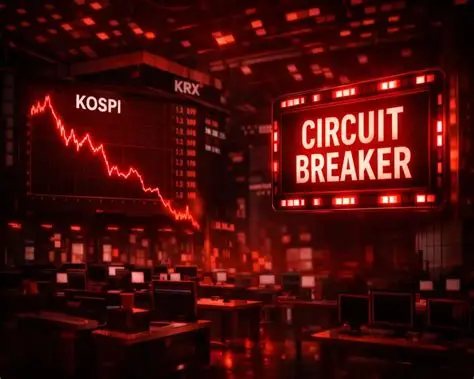
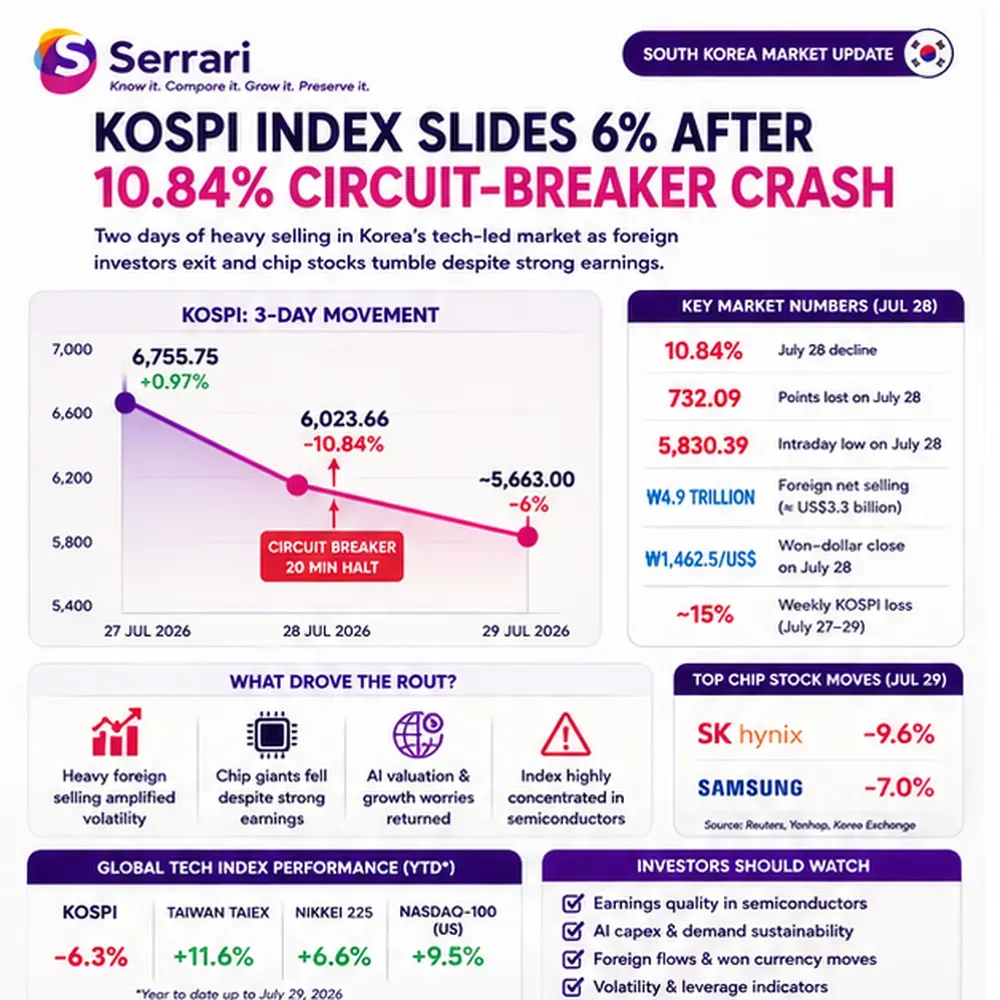
The KOSPI crash shows how a concentrated semiconductor rally can reverse quickly when investors question AI-linked valuations. Samsung Electronics and SK Hynix have an outsized influence on South Korea’s benchmark index, so selling in chip stocks can pull the whole market lower. A circuit breaker can pause trading, but it cannot remove valuation pressure, foreign selling, leverage risk or liquidity stress. The key investor lesson is that index exposure is not always as diversified as it appears.
Key Overview
- July 28 KOSPI close: 6,023.66.
- July 28 daily decline: 10.84%.
- Points lost: 732.09.
- Intraday low: 5,830.39.
- Circuit breaker triggered at 10:14 a.m. Korean time.
- Circuit-breaker halt: 20 minutes.
- Foreign net selling on July 28: about ₩4.9 trillion.
- July 29 decline: approximately 6%.
- SK Hynix fell sharply on July 29 despite record earnings.
- The selloff raises questions about index concentration, AI valuations and foreign-flow risk. (Yonhap News)
KOSPI Index Slides 6% After 10.84% Circuit-Breaker Crash
A Semiconductor Rally Turns Into a Rout
The KOSPI’s two-day decline is not simply an Asian-market selloff. It is a concentrated reversal in the same AI and semiconductor names that had powered earlier gains. Yonhap attributed the July 28 crash to heavy selling in technology shares as investors questioned large-scale AI infrastructure spending. (Yonhap News)
That matters because index investors may think they are buying broad South Korean market exposure, when in practice the index can be heavily influenced by a handful of major chip and technology names.
The Circuit Breaker Paused Trading, Not Risk
The Korea Exchange’s circuit-breaker framework is designed to slow disorderly selling. The official KRX rules state that a first-stage circuit breaker is triggered when the KOSPI remains at least 8% below the previous day’s closing level for one minute, after which trading is suspended for 20 minutes. (Global KRX)
That trading halt can reduce panic execution, but it does not change fundamentals. If investors still believe valuations are stretched after the halt, selling pressure can resume when trading reopens.
Foreign Selling Amplified the Move
Foreign investors were a major part of the pressure. Yonhap reported that foreign investors offloaded about ₩4.97 trillion worth of local shares on July 28, while individuals and institutions were net buyers. The won nevertheless strengthened, closing at ₩1,462.5 per US dollar, up ₩6 from the previous session. (Yonhap News)
This shows why foreign flow matters in emerging and developed-Asia equity markets. When global investors reduce risk in a concentrated sector, the effect can move the whole benchmark.
Context is everything. Stay ahead of shifting trends with today’s market updates, and uncover emerging opportunities using the Serrari Group Market Index and Marketplace. Then, take control of your own financial future by exploring our Money & Life Reset Transformation Blueprint ™ to build stronger habits, create better systems, and design a path toward lasting wealth
SK Hynix Shows the Earnings Trap
The July 29 leg of the rout sharpened the investor lesson. The Financial Times reported that SK Hynix’s shares fell sharply despite record quarterly earnings, as investors judged that strong profits were not enough to justify AI-linked valuations and future capital-expenditure expectations. (Financial Times)
This is the earnings trap in high-expectation markets: when valuations already price in exceptional growth, even strong earnings can disappoint if guidance, margins or future investment returns do not exceed expectations.
The Regional Selloff Spread Beyond Korea
The chip rout did not stop at Seoul. The Guardian reported that Asian chip firms continued to fall as the AI selloff spread across the region, with investors reassessing whether AI-related spending could justify the valuations built into semiconductor shares. (The Guardian)
This matters for global investors because South Korea is a major component of Asian semiconductor exposure, emerging-market ETFs and global AI supply-chain portfolios.
What Investors Should Watch
Investors should watch whether foreign selling slows, whether SK Hynix and Samsung stabilise, whether margin debt or leveraged retail trading becomes a concern, and whether the Korea Exchange or regulators issue additional market-stability measures.
They should also separate reported drivers from proven causes. AI-capex doubts, semiconductor valuations, Chinese competition and leveraged trading may all matter, but the exact weight of each factor remains uncertain.
Conclusion
The KOSPI Index rout is a clear reminder that index investing can carry hidden concentration risk. A benchmark can appear diversified while still being driven by a small number of semiconductor-heavy names.
For investors, the key lesson is not that South Korea’s long-term technology story has ended. It is that AI-linked index gains can reverse violently when expectations become too high, foreign flows turn negative and liquidity disappears quickly.
FAQs
1. What happened to the KOSPI Index?
The KOSPI crashed 10.84% on July 28, losing 732.09 points to close at 6,023.66, before falling another roughly 6% on July 29. (Yonhap News)
2. Why was a circuit breaker triggered?
KRX rules activate a first-stage market-wide circuit breaker when the KOSPI stays at least 8% below its previous close for one minute. Trading is then suspended for 20 minutes. (Global KRX)
3. Why did SK Hynix fall despite strong earnings?
Investors appeared to focus less on headline earnings and more on whether AI-related spending, valuations and future demand could keep justifying semiconductor prices. (Financial Times)
4. Why does foreign selling matter?
Foreign investors sold heavily on July 28, and concentrated foreign outflows can amplify benchmark volatility when large index-weighted technology stocks are under pressure. (Yonhap News)
5. What is the main investor lesson?
The main lesson is concentration risk. A broad index can still be vulnerable if recent gains depend heavily on a small group of high-valuation semiconductor companies.
Sources: Yonhap, Korea Exchange, Financial Times, Associated Press, Reuters, Investing.com, The Guardian, KOSPI Historical Prices
Your financial future isn’t something you wait for—it’s something you build.
The real question is: when do you begin?
Move beyond simply staying informed.
Navigate the markets with clarity—track trends through the Serrari Group Market Index, uncover opportunities in the Serrari Marketplace, and build practical knowledge with our Curated Wealth Builder Platform.
Stay connected to what truly matters.
Get daily insights on macro trends and financial movements across Kenya, Africa, and global markets—delivered through the Serrari Newsletter.
Growth opens doors.
Advance your career through professional programs including ACCA, HESI A2, ATI TEAS 7 , HESI EXIT , NCLEX – RN and NCLEX – PN, Financial Literacy!🌟—designed to move you forward with confidence.
See where money is flowing—clearly and in real time.
Track Money Market Funds, Treasury Bills, Treasury Bonds, Green Bonds, and Fixed Deposits, alongside global and African indexes, key economic indicators, and the evolving Crypto and stablecoin landscape—all within Serrari’s Market Index.