
Investment-grade bond funds recorded a historic $7.1 billion in weekly outflows as rising Treasury yields, widening credit spreads and renewed inflation concerns prompted investors to reduce exposure to long-duration corporate bond funds. The shift highlights changing preferences within the fixed income market as investors reposition portfolios amid expectations of higher interest rates.
Key Overview
- Investment-grade bond funds lose $7.1 billion.
- Largest weekly outflow on record.
- Rising Treasury yields pressure fixed income markets.
- Oil-driven inflation fears weigh on bond prices.
- High-yield bond funds attract fresh inflows.
- Credit spreads widen across corporate debt markets.
- Investors reassess Federal Reserve outlook.
- Bond market volatility increases.
Investment-Grade Bond Funds Record Historic $7.1 Billion Weekly Outflow
Investment-grade bond funds experienced their largest weekly withdrawal on record during the week ended July 22, as investors responded to rising Treasury yields and renewed inflation concerns by reducing exposure to long-duration corporate bond funds. According to LSEG Lipper, U.S. investment-grade bond funds and exchange-traded funds (ETFs) recorded $7.1 billion in net outflows, marking the biggest weekly withdrawal since records began.
The sharp reversal highlights growing caution across the fixed income market as higher oil prices and changing expectations for U.S. monetary policy increased pressure on investment-grade bonds and broader credit markets.
Investment-Grade Bond Funds Suffer Record Withdrawals
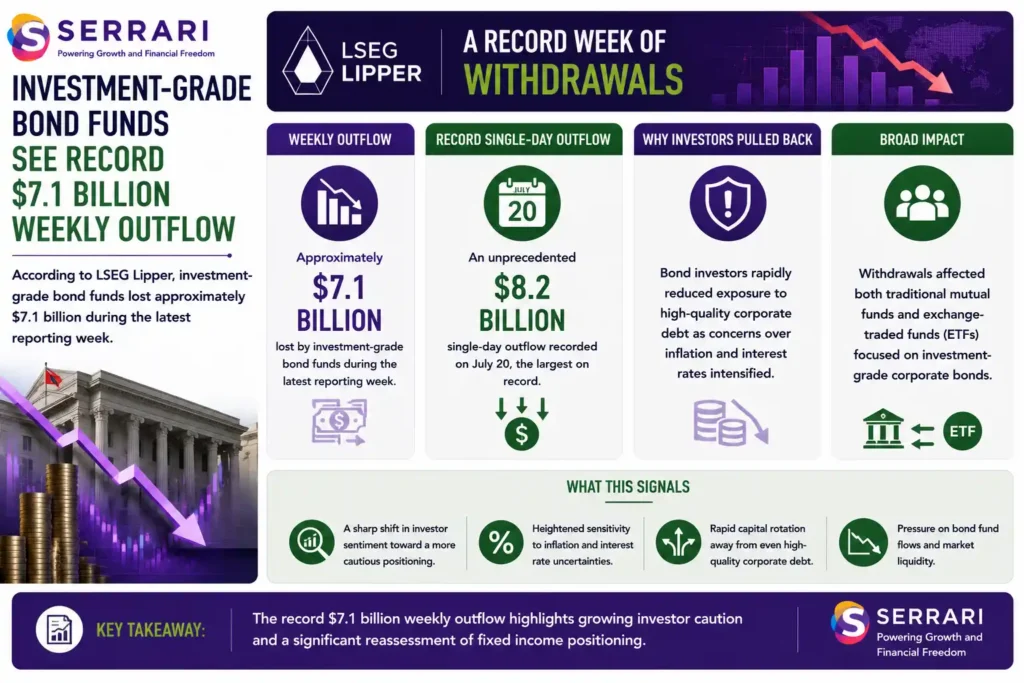
According to LSEG Lipper, investment-grade bond funds lost approximately $7.1 billion during the latest reporting week.
The record weekly withdrawal followed an unprecedented $8.2 billion single-day outflow recorded on July 20, underscoring the scale of investor repositioning.
The data suggests that bond investors rapidly reduced exposure to high-quality corporate debt as concerns over inflation and interest rates intensified.
The withdrawals affected both traditional mutual funds and exchange-traded funds (ETFs) focused on investment-grade corporate bonds.
Rising Treasury Yields Pressure Corporate Bond Funds
The latest outflows coincided with a sharp rise in U.S. Treasury yields.
The benchmark 10-year Treasury yield climbed to its highest level since January 2025, reflecting widespread selling across government bond markets.
As Treasury yields increase, existing fixed-rate bonds become less attractive because newly issued securities offer higher returns.
This effect is particularly significant for investment-grade bonds, which generally have:
- Longer maturities.
- Lower coupon rates.
- Greater sensitivity to changes in interest rates.
As a result, many corporate bond funds experienced heavier selling than higher-yielding segments of the bond market.
Oil Price Surge Revives Inflation Concerns
Market sentiment was also influenced by a sharp increase in global oil prices.
Oil prices climbed nearly 40% during the month, rising above $100 per barrel amid supply concerns linked to attacks on shipping in the Red Sea and fears of escalating geopolitical tensions involving Iran.
The increase in energy prices raised concerns that inflation could remain elevated for longer than previously expected.
Higher inflation expectations often lead investors to anticipate tighter monetary policy, reducing the appeal of longer-duration fixed income securities.
Federal Reserve Expectations Shift
The inflation outlook also affected expectations for U.S. interest rates.
According to market pricing monitored through the CME FedWatch Tool, traders more than doubled the implied probability of another Federal Reserve interest rate increase at the upcoming policy meeting, raising the likelihood to roughly one in three.
The changing outlook prompted investors to reassess interest-rate risk across their portfolios, contributing to widespread selling within investment-grade bond funds.
Credit Markets Experience Wider Spreads
Alongside rising Treasury yields, credit markets also experienced widening corporate bond spreads.
Credit spreads represent the additional yield investors demand for holding corporate debt instead of government securities.
When spreads widen, prices of outstanding corporate bonds generally decline.
The combination of:
- Higher Treasury yields.
- Wider credit spreads.
- Inflation concerns.
created a particularly challenging environment for investment-grade corporate debt during the reporting period.
Investors Shift Toward Higher-Yielding Assets
While investment-grade bond funds experienced record withdrawals, other segments of the bond market attracted fresh capital.
- High-yield bond funds received approximately $534 million in net inflows.
- Leveraged-loan funds also recorded modest inflows.
These asset classes tend to perform relatively better during periods of rising interest rates because they generally offer:
- Higher coupon payments.
- Shorter average maturities.
- Floating interest rates in the case of leveraged loans.
Their lower sensitivity to Treasury yield movements made them comparatively more attractive during the week.
Investment-Grade Bonds Underperform
The latest market movements were also reflected in bond fund performance.
The iShares iBoxx $ Investment Grade Corporate Bond ETF, which tracks the Markit iBoxx investment-grade benchmark, declined approximately 2.58% during the month.
By comparison, its high-yield counterpart fell only 0.93%, highlighting the relative resilience of lower-rated debt despite broader market volatility.
The performance gap illustrates how rising yields have had a greater impact on long-duration investment-grade securities than on higher-yielding alternatives.
Outlook for Investment-Grade Bond Funds
The record $7.1 billion withdrawal from investment-grade bond funds reflects growing caution among institutional investors and other market participants as inflation concerns and rising Treasury yields reshape the fixed income landscape. While higher-quality corporate debt remains an important component of diversified portfolios, longer-duration securities have become increasingly vulnerable to changing interest rate expectations.
Looking ahead, future fund flows will likely depend on inflation trends, Federal Reserve policy decisions and movements in Treasury yields. If borrowing costs stabilize, demand for investment-grade bonds could recover. However, continued volatility in capital markets may encourage investors to maintain a more selective approach across the bond market.
FAQs
Why did investment-grade bond funds experience record outflows?
Investors reduced exposure to investment-grade bond funds as rising Treasury yields, widening credit spreads and renewed inflation concerns made long-duration fixed-rate corporate bonds less attractive.
How much money left investment-grade bond funds?
According to LSEG Lipper, U.S. investment-grade bond funds and ETFs recorded $7.1 billion in net outflows during the week ended July 22, the largest weekly withdrawal on record.
Why did high-yield bond funds attract inflows?
High-yield bonds generally offer higher coupon payments and shorter maturities, making them less sensitive to rising interest rates. Leveraged loans also benefit from floating-rate structures that adjust as rates increase.
How do rising Treasury yields affect corporate bond funds?
When Treasury yields rise, existing fixed-rate bonds lose value because newly issued bonds offer higher returns. Investment-grade bonds, which typically have longer maturities and lower coupons, are particularly sensitive to these changes, resulting in price declines and investor outflows.
Sources: Reuters, The Economic Times, AOL, US News, Trading View
Your financial future isn’t something you wait for—it’s something you build.
The real question is: when do you begin?
Move beyond simply staying informed.
Navigate the markets with clarity—track trends through the Serrari Group Market Index, uncover opportunities in the Serrari Marketplace, and build practical knowledge with our Curated Wealth Builder Platform.
Stay connected to what truly matters.
Get daily insights on macro trends and financial movements across Kenya, Africa, and global markets—delivered through the Serrari Newsletter.
Growth opens doors.
Advance your career through professional programs including ACCA, HESI A2, ATI TEAS 7 , HESI EXIT , NCLEX – RN and NCLEX – PN, Financial Literacy!🌟—designed to move you forward with confidence.
See where money is flowing—clearly and in real time.
Track Money Market Funds, Treasury Bills, Treasury Bonds, Green Bonds, and Fixed Deposits, alongside global and African indexes, key economic indicators, and the evolving Crypto and stablecoin landscape—all within Serrari’s Market Index.