Kenya Treasury bill rates remain tightly clustered, but investor demand is not evenly distributed across maturities. In the latest CBK auction, the 364-day bill offered the highest accepted rate at 9.0415%, yet attracted the weakest demand at only 45.12% performance. The 91-day bill offered a lower accepted rate of 8.7986%, but drew more than three times the amount offered. This suggests investors may be prioritising flexibility, shorter reinvestment cycles and liquidity over locking money away for one year. The pattern does not prove that investors expect interest rates to rise, but it does show strong preference for short-term positioning.
LIVEKenya MMF rates: Average 9.15% across 27 funds · top fund 11.01% · 21 OctCompare funds →Key Overview
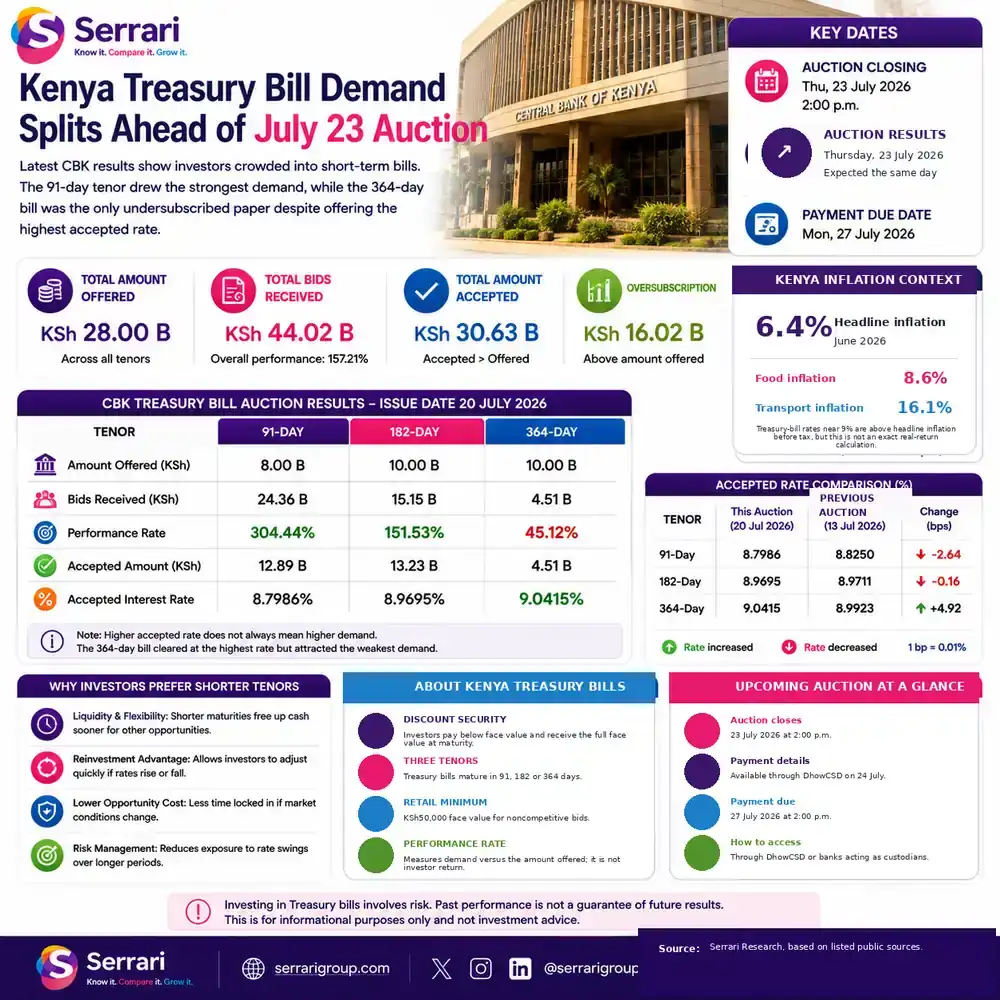
- CBK received KSh44.02 billion in bids against KSh28 billion offered.
- The 91-day bill attracted KSh24.36 billion in bids against KSh8 billion offered.
- The 182-day bill attracted KSh15.15 billion against KSh10 billion offered.
- The 364-day bill attracted only KSh4.51 billion against KSh10 billion offered.
- Accepted rates were 8.7986% for 91 days, 8.9695% for 182 days and 9.0415% for 364 days.
- The next Treasury bill auction closes at 2:00 p.m. on 23 July, with payment due by 27 July.
Kenya Treasury Bill Demand Splits Ahead of July 23 Auction
Short Bills Took the Demand
CBK’s auction results for Treasury bill issues dated 20 July show the 91-day paper was the clear demand leader. Investors submitted KSh24.36 billion against an offer of KSh8 billion, producing a 304.44% performance rate. CBK accepted KSh12.89 billion, meaning the government took more than the original 91-day offer size.
The 182-day bill also attracted solid demand. Bids reached KSh15.15 billion against KSh10 billion offered, giving a 151.53% performance rate. CBK accepted KSh13.23 billion, again above the offered amount.
One-Year Paper Was Left Behind
The weak point was the 364-day bill. CBK offered KSh10 billion, but investors submitted only KSh4.51 billion. That produced a 45.12% performance rate, making the one-year bill the only undersubscribed tenor in the auction. CBK accepted KSh4.51 billion, almost matching the bids received.
This is notable because the 364-day paper offered the highest accepted rate at 9.0415%. The 91-day bill cleared at 8.7986%, while the 182-day cleared at 8.9695%. In a simple yield ranking, the one-year bill looks best. In actual demand, investors preferred the shorter maturities.
Performance Rate Is Not Return
The performance rate should not be confused with investor return. In CBK’s auction table, performance rate measures bids received relative to the amount offered. It tells readers how strong or weak demand was for each tenor. It does not show the yield an investor earns.
The yield is reflected in the accepted interest rate and the discounted purchase price. CBK’s investor guide explains that Treasury bills are sold at a discount: investors choose the face value they will receive at maturity and pay less than that amount when buying the bill. (Central Bank of Kenya)
Why Investors May Prefer 91 Days
The 91-day preference may reflect liquidity management. A three-month Treasury bill gives investors a shorter holding period and faster reinvestment window. That can be useful when investors want flexibility around future auctions, inflation data, central-bank decisions or competing money-market opportunities.
The shorter tenor also reduces the opportunity cost of being locked in. If future Treasury bill rates rise, an investor in the 91-day bill can reinvest sooner. If rates fall, the investor still has preserved flexibility. This does not prove investors expect rates to rise, but it suggests they are not eager to commit heavily to one-year paper at current levels.
Rates Moved Only Slightly
The rate movement was modest but directionally different by tenor. CBK’s comparative table shows the 91-day accepted rate declined from 8.8250% to 8.7986%, while the 182-day rate eased only slightly from 8.9711% to 8.9695%. The 364-day rate rose from 8.9923% to 9.0415%.
That pattern matters. The shortest bill drew the strongest demand and its rate fell. The longest bill drew weak demand and its rate rose. This is consistent with investors demanding more compensation to hold the one-year paper, while still crowding into short-term bills.
Context is everything. Stay ahead of shifting trends with today’s market updates, and uncover emerging opportunities using the Serrari Group Market Index and Marketplace. Then, take control of your own financial future by exploring our Money & Life Reset Transformation Blueprint ™ to build stronger habits, create better systems, and design a path toward lasting wealth.
Inflation Still Matters
Kenya’s inflation backdrop remains relevant. KNBS reported annual consumer price inflation of 6.4% in June 2026, driven mainly by food inflation of 8.6%, transport inflation of 16.1%, and housing, water, electricity, gas and other fuels. (Kenya National Bureau of Statistics)
On the surface, Treasury bill rates near 9% sit above headline inflation. But investors should avoid a simplistic rate-minus-inflation conclusion. Tax, compounding, maturity, cash-flow timing and individual liquidity needs all affect realised returns.
The Next Auction Tests the Pattern
The next Treasury bill auction closes at 2:00 p.m. on Thursday, 23 July, with results expected the same day. CBK says payment details will be available through the DhowCSD investor portal or app on Friday, 24 July, and payments must reach CBK by 2:00 p.m. on Monday, 27 July.
The next auction again offers KSh28 billion, split across KSh8 billion for 91 days, KSh10 billion for 182 days and KSh10 billion for 364 days. Redemptions are listed at KSh25.122 billion, implying targeted net new borrowing of KSh2.878 billion before CBK’s acceptance decisions.
Retail Investors Can Still Participate
CBK’s investor guide says Treasury bills are auctioned weekly and mature in 91, 182 or 364 days. It also says investors can access Treasury bills through DhowCSD or through commercial banks and investment banks acting as custodians. (Central Bank of Kenya)
LIVET-bill rates: 91-day 8.76% · 182-day 8.87% · 364-day 9.04% · auction of 8 OctSee rates →The guide states that the minimum face value is KSh50,000 for noncompetitive bids and KSh2 million for competitive bids. The latest auction notice adds that noncompetitive bids are capped at KSh50 million per investor account per tenor, except for specified public-sector entities. (Central Bank of Kenya)
CBK Can Still Control the Final Outcome
Investors should not assume that strong demand automatically means full acceptance. CBK’s notice says the actual amount realised will depend on the National Treasury’s immediate liquidity requirements for the week. It also says CBK may accept or reject bids in part or in full, and may prorate allotments where several successful bidders quote a common rate.
That makes auction results more than a simple demand table. They reflect investor bidding, government cash needs and CBK’s auction-management decisions.
Debt Context Keeps T-Bills Important
Treasury bills remain important within Kenya’s domestic funding mix. The Public Debt Management Office dashboard places domestic public debt at KSh6.78 trillion as of March 2026 and identifies domestic debt as including Treasury bills, Treasury bonds and overdraft. The dashboard also shows KSh1.55 trillion of Treasury bills issued in the 2024/25 financial year. (Public Debt Management Office)
That context explains why weekly T-bill auctions matter for investors and the government. They are not just short-term investment products; they are also part of the domestic financing calendar.
Conclusion
Kenya Treasury Bill Demand is sending a clear short-term signal. Investors poured money into the 91-day bill, gave strong support to the 182-day bill, and largely avoided the 364-day paper despite its higher accepted rate.
The July 23 auction will test whether this maturity preference continues. For investors, the lesson is that yield is only one part of the decision. Liquidity, reinvestment flexibility, inflation, tax and auction-allocation risk all matter. The strongest headline rate may not be the preferred choice if investors want the ability to reprice cash sooner.
FAQs
1. What happened in the latest Kenya Treasury bill auction?
CBK received KSh44.02 billion in bids against KSh28 billion offered in the auction settling on 20 July 2026. Demand was strongest in the 91-day bill, which recorded a 304.44% performance rate. The 182-day bill recorded 151.53%, while the 364-day bill was undersubscribed at 45.12%.
2. Why did investors prefer the 91-day Treasury bill?
Investors may have preferred the 91-day bill because it preserves flexibility and allows faster reinvestment. Shorter maturities reduce the opportunity cost of locking in cash for a full year. However, strong 91-day demand does not prove that investors expect rates to rise; it only shows a clear preference for shorter maturity in this auction.
3. What were the accepted Treasury bill rates?
CBK accepted rates of 8.7986% for the 91-day bill, 8.9695% for the 182-day bill and 9.0415% for the 364-day bill. The 364-day bill had the highest accepted rate, but it attracted the weakest participation.
4. What does performance rate mean in a Treasury bill auction?
Performance rate measures the amount of bids received relative to the amount offered. For example, a 304.44% performance rate means bids were more than three times the offered amount. It is a demand measure, not an investor return or yield.
5. When is the next Kenya Treasury bill auction?
The next auction closes at 2:00 p.m. on 23 July 2026. Payment details become available through DhowCSD on 24 July, and payments are due by 2:00 p.m. on 27 July. The auction offers KSh28 billion across the 91-day, 182-day and 364-day tenors.
Sources: CBK, Kenya National Bureau of Statistics, Public Debt Management Office, CBK Bill Investor guide
Your financial future isn’t something you wait for—it’s something you build.
The real question is: when do you begin?
Move beyond simply staying informed.
Navigate the markets with clarity—track trends through the Serrari Group Market Index, uncover opportunities in the Serrari Marketplace, and build practical knowledge with our Curated Wealth Builder Platform.
Stay connected to what truly matters.
Get daily insights on macro trends and financial movements across Kenya, Africa, and global markets—delivered through the Serrari Newsletter.
Growth opens doors.
Advance your career through professional programs including ACCA, HESI A2, ATI TEAS 7 , HESI EXIT , NCLEX – RN and NCLEX – PN, Financial Literacy!🌟—designed to move you forward with confidence.
See where money is flowing—clearly and in real time.
Track Money Market Funds, Treasury Bills, Treasury Bonds, Green Bonds, and Fixed Deposits, alongside global and African indexes, key economic indicators, and the evolving Crypto and stablecoin landscape—all within Serrari’s Market Index.