South Africa savings rates remain attractive for income-focused investors, but the next SARB interest-rate decision creates a lock-or-wait problem. A saver who locks a fixed deposit today secures a known return but usually cannot benefit from later rate increases on the same deposit. A saver who waits may benefit if banks lift deposit pricing after the MPC decision, but could lose the current offer if rates stay unchanged, banks do not reprice, or market expectations shift lower. The best decision depends on cash-flow needs, tax position, deposit-insurance limits, early-withdrawal rules and whether the investor uses a fixed-deposit ladder rather than one large maturity.
Key Overview
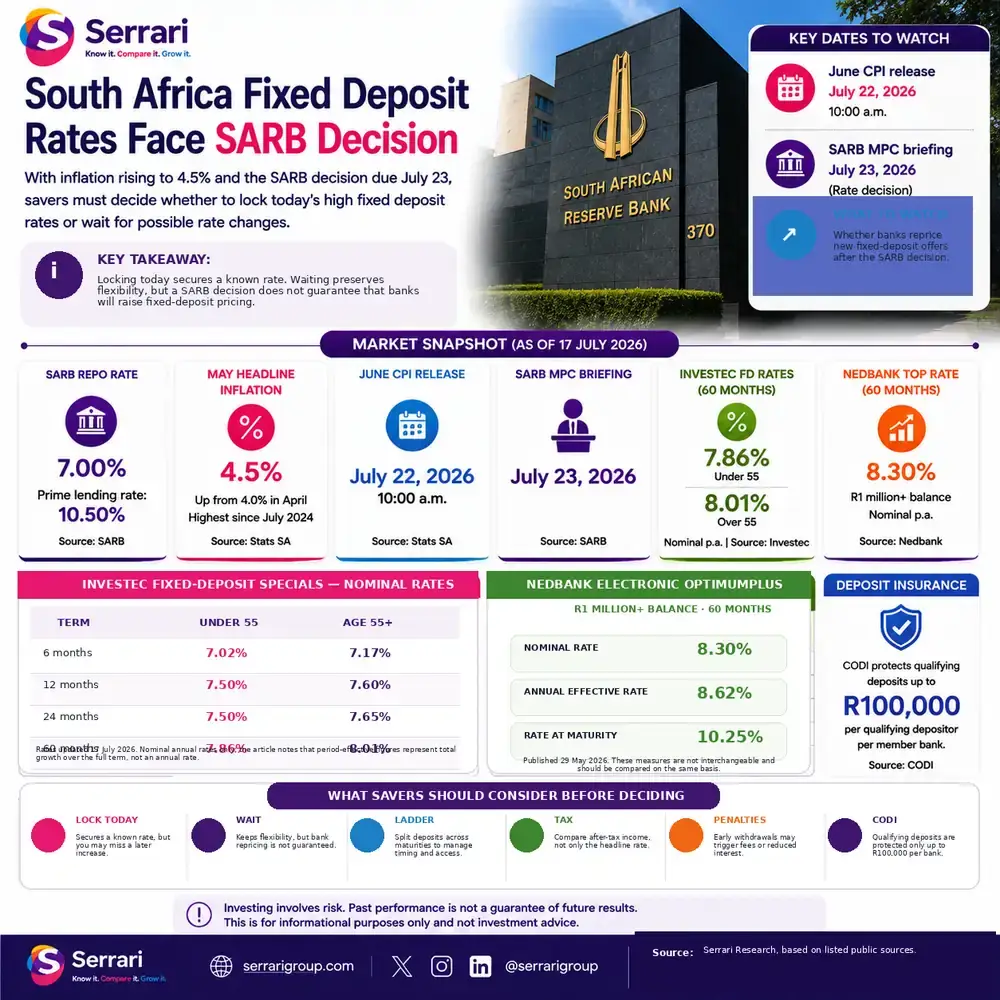
- SARB’s current policy rate is 7.00%, while the prime lending rate is 10.50%.
- Stats SA reported May headline inflation at 4.5%, up from 4.0% in April and the highest level since July 2024.
- June CPI is scheduled for release at 10:00 a.m. on 22 July.
- SARB’s next MPC briefing is scheduled for 23 July.
- Investec’s fixed-deposit specials, updated 17 July, show nominal rates of 7.02% to 8.01% depending on tenor and age category.
- Nedbank’s Electronic OptimumPlus table reaches 8.30% nominal for balances of R1 million or more over 60 months.
- CODI protects qualifying deposits up to R100,000 per qualifying depositor per member bank. (Statistics South Africa)
South Africa Fixed Deposit Rates Face SARB Decision
The Timing Question for Savers
Fixed-deposit investors face a different problem from borrowers. If the SARB raises rates, borrowers may feel the effect quickly through prime-linked debt. Depositors, however, only benefit if banks decide to raise deposit rates and the investor has not already locked money into a fixed term.
That makes the period before 23 July important. A retiree seeking predictable income may prefer certainty today. A business with short-term working capital may prefer flexibility. A cash investor with several months before funds are needed may split deposits across tenors to reduce timing risk.
Inflation Is Back in Focus
Stats SA reported that consumer inflation rose to 4.5% in May from 4.0% in April. It also said this was the highest inflation rate since July 2024, when the rate was 4.6%. The increase was driven partly by fuel prices, with the fuel index recording a large monthly rise. (Statistics South Africa)
The June inflation release is scheduled for 22 July at 10:00 a.m., one day before the SARB briefing. That creates a narrow decision window for savers. A higher CPI print could strengthen the argument for caution before locking; a softer print could make current longer-term rates look more appealing. (Statistics South Africa)
Investec Shows the Current Yield Menu
Investec’s fixed-deposit specials, last updated on 17 July, show why savers are paying attention. For individuals under 55, nominal rates are 7.02% for six months, 7.50% for 12 months, 7.50% for 24 months and 7.86% for 60 months. For individuals over 55, the corresponding nominal rates are 7.17%, 7.60%, 7.65% and 8.01%. (Investec)
Those rates are materially above May inflation, but the spread should not be treated as a guaranteed real return. Tax, compounding method, interest-payment choice and each household’s actual inflation experience can change the realised purchasing-power outcome.
Period-Effective Is Not the Annual Rate
Investec’s table also shows period-effective figures, such as 9.59% for the under-55 60-month special and 9.81% for the over-55 60-month special. Those figures reflect total growth over the full term, not the annual nominal rate. Presenting them as annual rates would overstate the return. (Investec)
This distinction matters across South Africa savings rates. A nominal annual rate, an annual effective rate and a maturity or period-effective figure can all look different. Investors comparing bank products should confirm exactly which measure is being quoted.
Standard Bank Highlights Access and Penalty Trade-Offs
Standard Bank’s fixed-deposit account allows customers to deposit at least R1,000 and choose an investment term from one month to five years. It says the rate is locked from the start, interest is calculated daily, and customers older than 55 with balances below R100,000 receive an additional 0.5 percentage point annually. (Standard Bank)
The same product page warns that early withdrawal fees apply. That is the core fixed-deposit trade-off: certainty in exchange for restricted flexibility. Savers who may need cash before maturity should be careful about locking the full balance at once.
Nedbank Shows Higher Long-Tenor Pricing
Nedbank’s Electronic OptimumPlus table, published on 29 May, shows nominal rates rising with balance and term. For balances of R1 million or more, the 60-month nominal rate is 8.30%, with an equivalent annual effective rate of 8.62% and a rate at maturity of 10.25%. (Nedbank)
That is useful for comparison, but it also shows why investors must read product tables carefully. A R1 million-plus, 60-month end-of-term deposit is not the same as a small retail deposit, a short-term cash reserve or a notice account.
Context is everything. Stay ahead of shifting trends with today’s market updates, and uncover emerging opportunities using the Serrari Group Market Index and Marketplace. Then, take control of your own financial future by exploring our Money & Life Reset Transformation Blueprint ™ to build stronger habits, create better systems, and design a path toward lasting wealth.
CODI Adds Protection, But Only Within Limits
South Africa’s Corporation for Deposit Insurance protects qualifying depositors if a member bank fails. SARB’s CODI FAQ says qualifying depositors have access to up to R100,000 of qualifying balances in qualifying products if a bank fails. (Reserve Bank of South Africa)
This protection matters for conservative savers, but it is not unlimited. Depositors placing amounts above the coverage limit still need to assess the strength of the bank, the product structure and whether splitting deposits across institutions fits their risk plan.
Three Scenarios Before the MPC
The first scenario is a rate increase. If SARB raises the repo rate, banks may lift new deposit offers, but the timing and size of any adjustment are not guaranteed. A saver who locked before the decision could miss a better later quote.
The second scenario is a hold. If SARB keeps rates unchanged, today’s offers may remain competitive, especially for savers who need certainty. The third scenario is a hold with softer guidance. If SARB signals that inflation risks are easing, longer-term fixed rates could become more valuable because future offers may not improve.
Ladders Can Reduce Timing Risk
A fixed-deposit ladder can reduce the pressure of making one perfect timing decision. Instead of placing all cash into a single 60-month deposit, a saver can divide money across shorter and longer maturities. That allows part of the portfolio to reprice sooner while another part locks current yields.
This approach can be useful for retirees, businesses and households holding emergency savings. It does not guarantee a better return, but it helps manage reinvestment risk, liquidity needs and the uncertainty around rate decisions.
What Investors Should Watch
Investors should watch the June CPI release, the SARB statement, Governor Lesetja Kganyago’s tone, and whether banks revise deposit pricing after the MPC briefing. They should also compare fixed deposits with notice accounts, money-market products and government bonds.
The key comparison is not only rate. Investors should compare access before maturity, tax, deposit-insurance protection, balance thresholds, age-based bonuses and whether the quoted return is nominal annual, annual effective or period-effective.
Conclusion
South Africa Fixed Deposit Rates remain attractive before the SARB’s 23 July decision, with selected bank products offering nominal rates above 7% and some longer-tenor rates above 8%. But the timing decision is not straightforward.
Locking today gives certainty and protects against the risk that future offers do not improve. Waiting preserves optionality if the SARB raises rates and banks respond. The practical solution for many savers may be a laddered approach that balances income, access and reinvestment flexibility rather than relying on a single rate call.
FAQs
1. What are South Africa Fixed Deposit Rates right now?
South Africa Fixed Deposit Rates vary by bank, term, balance and age group. Investec’s 17 July fixed-deposit specials show nominal rates from 7.02% to 8.01%, while Nedbank’s Electronic OptimumPlus table reaches 8.30% nominal for balances of R1 million or more over 60 months. These offers are product-specific and should not be treated as universal market rates. (Investec)
2. Should savers lock fixed deposits before the SARB decision?
There is no single answer. Locking before the SARB decision secures a known rate, but the saver may miss better offers if banks raise deposit pricing later. Waiting preserves flexibility, but rates may not improve. The right choice depends on income needs, maturity preference, liquidity and risk tolerance.
3. Does a SARB rate hike guarantee higher fixed-deposit rates?
No. Banks are not required to adjust fixed-deposit rates immediately or by the same amount as the repo rate. Deposit pricing depends on funding needs, liquidity, competition, customer segment and product strategy, not only the SARB policy rate.
4. What is CODI deposit insurance?
CODI is South Africa’s deposit-insurance scheme. SARB says qualifying depositors can access up to R100,000 of qualifying balances in qualifying products if a bank fails. This improves depositor protection, but balances above the limit remain exposed to additional bank-credit risk. (Reserve Bank of South Africa)
5. What is the difference between nominal and period-effective return?
The nominal rate is the annual stated interest rate. A period-effective or maturity figure reflects the total return over the full term, depending on how interest is paid or compounded. A 60-month period-effective figure should not be compared directly with a one-year nominal rate.
Sources: SARB, Statistics South Africa, Investec, Standard Bank, Nedbank, Reserve Bank of South Africa
Your financial future isn’t something you wait for—it’s something you build.
The real question is: when do you begin?
Move beyond simply staying informed.
Navigate the markets with clarity—track trends through the Serrari Group Market Index, uncover opportunities in the Serrari Marketplace, and build practical knowledge with our Curated Wealth Builder Platform.
Stay connected to what truly matters.
Get daily insights on macro trends and financial movements across Kenya, Africa, and global markets—delivered through the Serrari Newsletter.
Growth opens doors.
Advance your career through professional programs including ACCA, HESI A2, ATI TEAS 7 , HESI EXIT , NCLEX – RN and NCLEX – PN, Financial Literacy!🌟—designed to move you forward with confidence.
See where money is flowing—clearly and in real time.
Track Money Market Funds, Treasury Bills, Treasury Bonds, Green Bonds, and Fixed Deposits, alongside global and African indexes, key economic indicators, and the evolving Crypto and stablecoin landscape—all within Serrari’s Market Index.