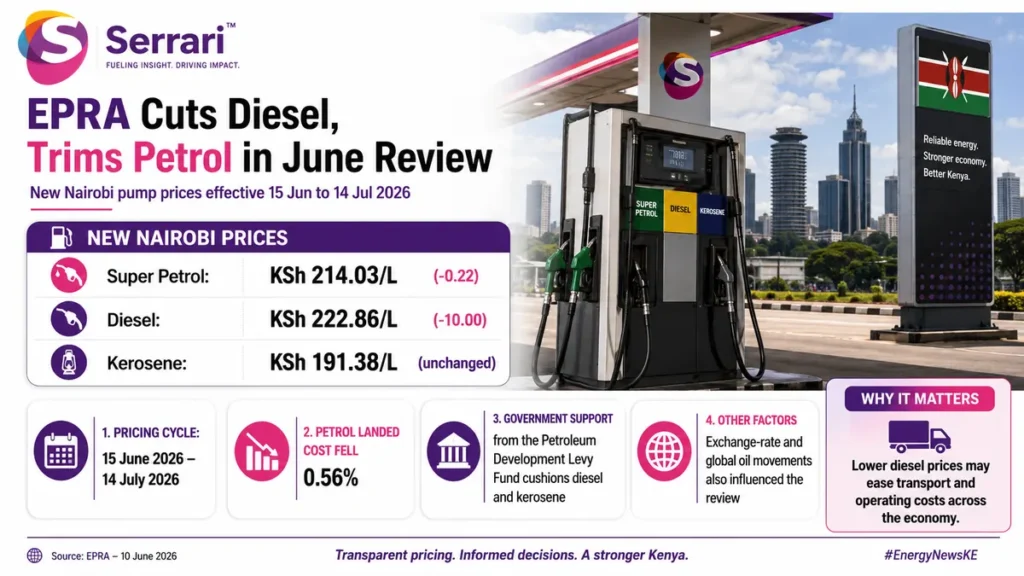
Kenya’s Energy and Petroleum Regulatory Authority has reduced the maximum pump prices for Super Petrol and Diesel for the June-July 2026 pricing cycle, offering motorists partial relief after recent pressure from high fuel costs. Under the new maximum retail prices, Super Petrol will retail at KSh214.03 per litre in Nairobi, Diesel at KSh222.86 and Kerosene at KSh191.38.
The changes apply from June 15 to July 14, 2026. Petrol has fallen by KSh0.22 per litre, Diesel by KSh10.00, while Kerosene remains unchanged. EPRA said the prices were calculated under the Petroleum Act, 2019 and Legal Notice No. 192 of 2022, which guide Kenya’s monthly petroleum pricing framework.
Key Overview
- Super Petrol in Nairobi falls by KSh0.22 to KSh214.03 per litre.
- Diesel drops by KSh10.00 to KSh222.86 per litre.
- Kerosene remains unchanged at KSh191.38 per litre.
- The new prices apply from June 15 to July 14, 2026.
- EPRA cited changes in landed import costs, exchange-rate movements and petroleum pricing regulations.
- The government will use the Petroleum Development Levy Fund to cushion consumers on Diesel and Kerosene.
Diesel Cut Offers the Biggest Relief
The largest change in the June review is the KSh10 reduction in Diesel, a key fuel for transport, logistics, agriculture, manufacturing and public service vehicles. Diesel’s decline to KSh222.86 per litre in Nairobi is likely to be welcomed by businesses and households that depend on road transport costs across the economy.
Super Petrol recorded a much smaller decline of KSh0.22 per litre, bringing the Nairobi price to KSh214.03. Kerosene, commonly used by lower-income households for cooking and lighting, remains unchanged at KSh191.38. According to EPRA’s June review, the new prices are inclusive of taxes and applicable statutory adjustments.
The regulator said the prices will remain in force for the next 30 days, meaning motorists and businesses will operate under the new caps until the next monthly review in mid-July.
Context is everything. Stay ahead of shifting trends with today’s market updates, and uncover emerging opportunities using the Serrari Group Market Index and Marketplace. Then, take control of your own financial future by exploring our Money & Life Reset Transformation Blueprint ™ to build stronger habits, create better systems, and design a path toward lasting wealth.
Import Costs and Exchange Rates Shape the Review
EPRA linked the new pump prices to movements in the landed cost of imported petroleum products. Super Petrol’s landed cost fell by 0.56%, from US$906.23 per cubic metre in April to US$901.16 in May. Kerosene also declined by 0.33%, from US$1,332.73 to US$1,328.36 per cubic metre.
Diesel’s landed cost, however, rose slightly by 0.21% to US$1,294.71 per cubic metre, making the KSh10 cut notable. Market reporting on the June-July review noted that the Petroleum Development Levy deployment helped support the larger reduction in Diesel prices.
The exchange rate also played a role in the pricing calculation. The shilling averaged about KSh129.82 to the US dollar in May, compared with KSh129.56 in the previous cycle. Because Kenya imports refined petroleum products, even small currency movements can affect local pump prices.
Levy Fund Used to Cushion Consumers
The government is expected to use approximately KSh10 billion from the Petroleum Development Levy Fund to subsidise Diesel and Kerosene during the June pricing cycle. This intervention is aimed at softening the impact of fuel costs on consumers and reducing pressure on transport and household expenses.
The levy fund has become an important tool in Kenya’s fuel-pricing framework, especially during periods when global oil prices, freight costs or exchange-rate pressures threaten to push pump prices higher. However, continued use of the fund also raises questions about fiscal sustainability if global fuel markets remain volatile.
For consumers, the Diesel cut may have the most practical impact because Diesel drives public transport, freight movement and food distribution costs. If sustained, lower Diesel prices could ease some operating costs for transporters and businesses, although the effect on final consumer prices may depend on competition and broader inflation trends.
Global Oil Volatility Remains a Risk
The June fuel adjustment comes as international oil markets remain sensitive to geopolitical developments, supply risks and currency conditions. Reports around the review period pointed to recent movements in global crude benchmarks, with Brent and US crude prices easing before renewed Middle East tensions complicated the outlook.
Kenya’s monthly fuel-pricing system means local pump prices respond with a lag to global market shifts, import costs, taxes, levies and foreign exchange changes. As a result, even when global crude prices fall, consumers may not immediately see a full pass-through at the pump.
The June review gives motorists some relief, especially on Diesel, but fuel remains expensive by historical standards. Businesses and households will now be watching the July review to see whether global oil prices, the shilling and government support allow further reductions.
Sources used: Energy and Petroleum Regulatory Authority / Citizen Digital / The Kenyan Wall Street / Kenyans.co.ke / People Daily
Your financial future isn’t something you wait for—it’s something you build.
The real question is: when do you begin?
Move beyond simply staying informed.
Navigate the markets with clarity—track trends through the Serrari Group Market Index, uncover opportunities in the Serrari Marketplace, and build practical knowledge with our Curated Wealth Builder Platform.
Stay connected to what truly matters.
Get daily insights on macro trends and financial movements across Kenya, Africa, and global markets—delivered through the Serrari Newsletter.
Growth opens doors.
Advance your career through professional programs including ACCA, HESI A2, ATI TEAS 7 , HESI EXIT , NCLEX – RN and NCLEX – PN, Financial Literacy!🌟—designed to move you forward with confidence.
See where money is flowing—clearly and in real time.
Track Money Market Funds, Treasury Bills, Treasury Bonds, Green Bonds, and Fixed Deposits, alongside global and African indexes, key economic indicators, and the evolving Crypto and stablecoin landscape—all within Serrari’s Market Index.