The latest Nvidia bond issuance highlights strong investor confidence in the artificial intelligence leader. Nvidia raised $25 billion through its first bond sale since 2021 after demand reached approximately $85 billion, allowing the company to increase the size of the offering and secure attractive borrowing costs.
Key Overview
- Nvidia raised $25 billion through a U.S. bond offering.
- Investor demand reached approximately $85 billion.
- The company initially planned to raise $20 billion.
- The issue consists of seven tranches maturing as late as 2056.
- The sale marks Nvidia’s first bond issuance since 2021.
- Nvidia previously raised $5 billion through bonds in 2021.
- Combined Big Tech AI spending is projected to exceed $700 billion in 2026.
- Nvidia had $13.24 billion in cash as of April 2026.
- The company has invested billions in OpenAI, Anthropic, and Intel.
- Nvidia shares rose more than 3% following the announcement.
Nvidia Corporate Bond Sale Attracts Massive Investor Interest
The latest Nvidia corporate bond sale has become one of the largest technology debt offerings of 2026, underscoring strong investor confidence in the artificial intelligence giant.
Nvidia announced plans to raise $25 billion through a U.S. bond issuance, marking its first return to the investment-grade debt market since 2021.
Originally, the company intended to raise approximately $20 billion. However, overwhelming investor demand allowed the semiconductor leader to increase the size of the transaction while simultaneously reducing borrowing costs.
Orders reportedly reached as much as $85 billion, more than three times the final issue size.
The success of the offering reflects the market’s continued enthusiasm for companies positioned at the center of the artificial intelligence boom.
It also highlights how major technology firms are increasingly relying on debt markets to finance strategic investments without diluting shareholders.
Context is everything. Stay ahead of shifting trends with today’s market updates, and uncover emerging opportunities using the Serrari Group Market Index and Marketplace. Then, take control of your own financial future by exploring our Money & Life Reset Transformation Blueprint ™ to build stronger habits, create better systems, and design a path toward lasting wealth.
Nvidia Bond Issuance Marks Return to Debt Markets
The latest Nvidia bond issuance represents the company’s first visit to the investment-grade bond market in five years.
Nvidia last raised debt in June 2021, when it issued $5 billion of bonds.
The current transaction is substantially larger and reflects the company’s expanded role within the global AI ecosystem.
According to the terms of the offering, the bonds are divided into seven tranches with maturities extending as far as 2056.
The diversified maturity profile allows Nvidia to spread refinancing obligations over several decades while securing long-term funding.
Management reportedly capped the size of the issue at $25 billion in order to preserve attractive credit spreads and maintain financial flexibility.
The strategy enabled the company to capitalize on extraordinary demand while avoiding excessive leverage.
Corporate Bond Market Continues Supporting Big Tech
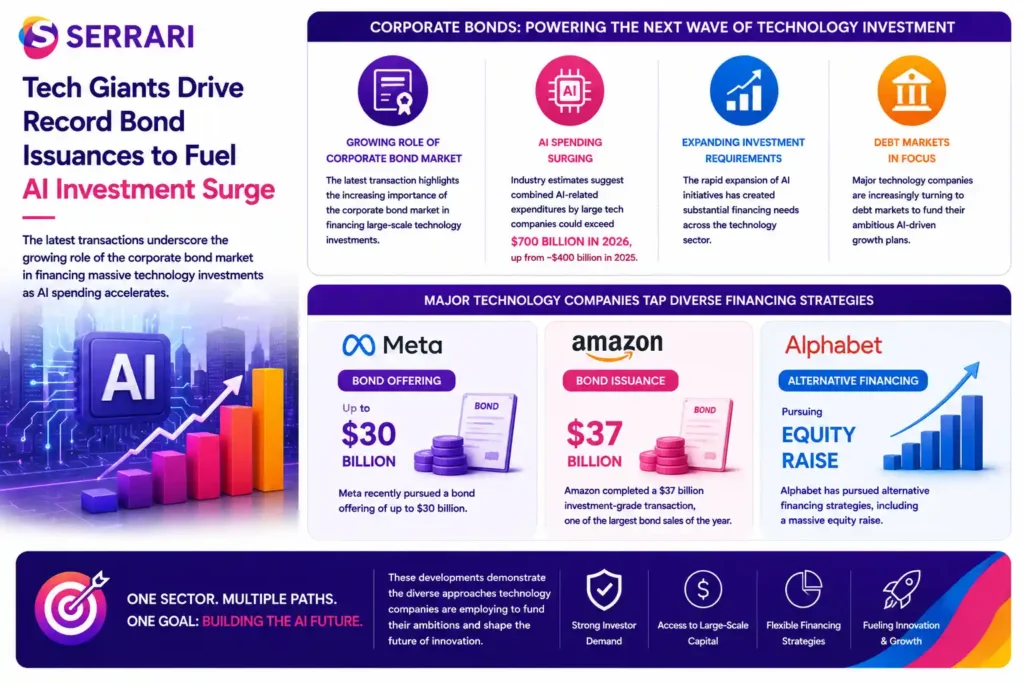
The latest transaction highlights the growing importance of the corporate bond market in financing large-scale technology investments.
Major technology companies have increasingly turned to debt markets as spending requirements associated with artificial intelligence continue expanding.
Industry estimates suggest that combined AI-related expenditures by large technology companies could exceed $700 billion during 2026, up from approximately $400 billion in 2025.
This surge in spending has created substantial financing needs across the sector.
Meta recently pursued a bond offering of up to $30 billion, while Amazon completed a $37 billion investment-grade transaction, one of the largest bond sales of the year.
Meanwhile, Alphabet has pursued alternative financing strategies, including a massive equity raise.
These developments demonstrate the diverse approaches technology companies are employing to fund their ambitions.
AI Infrastructure Financing Drives Capital Demand
The rise of AI infrastructure financing has transformed capital requirements across the technology sector.
Artificial intelligence development demands enormous investments in data centers, chips, cloud infrastructure, and strategic partnerships.
Nvidia has become one of the biggest beneficiaries of the AI boom, but maintaining its leadership position requires substantial financial resources.
The company has invested $5 billion in Intel, committed up to $10 billion to Anthropic, and participated in OpenAI’s latest funding round with a contribution reportedly valued at $30 billion.
These commitments illustrate the scale of investment required to compete within the rapidly evolving AI ecosystem.
Debt financing provides Nvidia with additional liquidity while preserving shareholder value.
The strategy allows the company to continue expanding without issuing new shares.
Semiconductor Industry Financing Enters New Phase
The growing importance of semiconductor industry financing reflects the strategic role chipmakers now play within the global economy.
Semiconductor companies are increasingly investing not only in manufacturing capacity but also in artificial intelligence platforms and strategic partnerships.
Nvidia’s dominant position in AI chips has elevated its capital requirements beyond traditional semiconductor business models.
Despite holding $13.24 billion in cash and cash equivalents as of April 2026, the company chose to strengthen its liquidity position further through the bond market.
Some analysts have questioned the move, particularly given Nvidia’s strong cash generation and substantial free cash flow.
However, management appears focused on maintaining maximum flexibility as AI-related investments continue expanding.
The approach mirrors broader trends across the technology industry.
Debt Capital Markets Reward Strong Credit Profiles
The response to Nvidia’s offering highlights the strength of today’s debt capital markets.
Demand of approximately $85 billion allowed the company to enlarge the transaction and secure favorable pricing.
Such levels of oversubscription are typically reserved for highly rated issuers with strong growth prospects.
Investors continue viewing Nvidia as one of the most strategically important companies in the technology sector.
The company’s dominant position in AI hardware, strong earnings growth, and significant market capitalization have contributed to exceptionally strong investor confidence.
Following the announcement, Nvidia shares rose more than 3%, pushing the company’s valuation above $5 trillion.
The performance demonstrates how debt investors and equity investors continue supporting the company’s long-term growth story.
Nvidia Debt Offering Avoids Share Dilution
One of the key advantages of the Nvidia debt offering is the ability to raise capital without diluting existing shareholders.
Equity issuance can reduce earnings per share and affect existing ownership structures.
Debt financing allows companies to access substantial amounts of capital while preserving shareholder value.
For Nvidia, the strategy provides flexibility as investment opportunities continue expanding.
The company has also authorized an $80 billion share repurchase program, reinforcing its commitment to shareholder returns.
At the same time, management must balance these initiatives with execution risks.
Nvidia’s supply commitments reportedly total approximately $119 billion, increasing exposure if demand growth moderates.
In addition, restrictions affecting the Chinese market have eliminated a significant source of data center revenue.
These factors underline the importance of maintaining a strong liquidity position.
Investor Confidence Remains Strong
Despite concerns surrounding valuation, geopolitical risks, and execution challenges, investor confidence in Nvidia remains exceptionally high.
The overwhelming response to the bond offering reflects expectations that artificial intelligence spending will continue expanding.
Investors appear willing to provide long-term capital to companies viewed as leaders within the AI ecosystem.
Nvidia’s ability to attract more than three times the amount initially sought demonstrates the depth of market demand.
As AI investments accelerate globally, financing requirements across the technology sector are likely to remain elevated.
Companies with strong competitive positions and attractive credit profiles are expected to continue benefiting from favorable access to capital markets.
Conclusion
The Nvidia corporate bond sale represents one of the largest and most closely watched debt offerings of 2026. The company successfully raised $25 billion after attracting approximately $85 billion in investor demand, demonstrating extraordinary confidence in its long-term growth prospects.
As artificial intelligence spending accelerates and capital requirements increase, debt markets are becoming an increasingly important source of financing for technology leaders. For Nvidia, the transaction provides additional liquidity and strategic flexibility while preserving shareholder value, reinforcing its position at the center of the global AI revolution.
FAQs
1. Why did Nvidia issue bonds?
Nvidia issued bonds to strengthen liquidity and support its growing investment commitments in artificial intelligence. Debt financing allows the company to raise capital without issuing additional shares and diluting existing shareholders.
2. How much money did Nvidia raise?
Nvidia raised $25 billion through a seven-tranche bond offering. The company originally planned to raise around $20 billion but increased the size of the issue after receiving exceptionally strong investor demand.
3. How strong was investor demand for the bond sale?
Investor demand reached approximately $85 billion, more than three times the size of the final offering. The strong response enabled Nvidia to enlarge the transaction and secure attractive borrowing costs.
4. What will Nvidia use the funds for?
The additional capital is expected to support strategic investments related to artificial intelligence, including partnerships and investments in companies such as OpenAI, Anthropic, and Intel. The funds also provide greater financial flexibility as AI infrastructure spending continues to grow.
Sources: Reuters, Euro News, Yahoo Finance, China Daily
Your financial future isn’t something you wait for—it’s something you build.
The real question is: when do you begin?
Move beyond simply staying informed.
Navigate the markets with clarity—track trends through the Serrari Group Market Index, uncover opportunities in the Serrari Marketplace, and build practical knowledge with our Curated Wealth Builder Platform.
Stay connected to what truly matters.
Get daily insights on macro trends and financial movements across Kenya, Africa, and global markets—delivered through the Serrari Newsletter.
Growth opens doors.
Advance your career through professional programs including ACCA, HESI A2, ATI TEAS 7 , HESI EXIT , NCLEX – RN and NCLEX – PN, Financial Literacy!🌟—designed to move you forward with confidence.
See where money is flowing—clearly and in real time.
Track Money Market Funds, Treasury Bills, Treasury Bonds, Green Bonds, and Fixed Deposits, alongside global and African indexes, key economic indicators, and the evolving Crypto and stablecoin landscape—all within Serrari’s Market Index.