
The stablecoin market experienced its first meaningful contraction in nearly three years during the second quarter of 2026, with total market capitalization declining even as transaction activity reached record highs. While circulating supply fell across major stablecoins, on-chain payments continued to accelerate, highlighting growing institutional adoption, expanding blockchain usage, and increasing capital flows into tokenized real-world assets.
Key Overview
- Stablecoin market capitalization declined for the first time in nearly three years.
- Total market value fell by approximately $7.7 billion in June.
- USDC processed over twice the transaction volume of USDT.
- USDT remained the largest stablecoin with roughly 60% market share.
- Stablecoin transaction volume reached a record $1.79 trillion.
- Tokenized Treasury funds attracted increasing institutional capital.
- No major stablecoin depeg accompanied the market contraction.
- Regulatory developments continue reshaping issuer competition.
Stablecoin Market Contracts as Record Transaction Volume Signals Changing Capital Flows
The stablecoin market experienced an unusual shift during the second quarter of 2026, recording its first sustained decline in market capitalization after nearly three years of uninterrupted expansion. Although the total supply of stablecoins fell, blockchain transaction activity accelerated to record levels, suggesting that digital dollars continue to play an increasingly important role in payments, decentralized finance, and institutional settlement.
Rather than indicating weakening demand for digital assets, the decline appears to reflect changing capital allocation strategies as investors increasingly move funds into tokenized real-world assets while continuing to use stablecoins for payments and liquidity management.
Stablecoin Market Records First Quarterly Decline
According to CoinGecko’s second-quarter industry report, the stablecoin market declined by approximately 1.6%, reducing total capitalization by roughly $4.8 billion to $305.1 billion. Separately, CoinDesk Data reported that June alone saw market capitalization fall by approximately $7.7 billion, representing the largest monthly dollar decline since the Terra-Luna collapse in 2022.
By late July, DefiLlama estimated total stablecoin capitalization at approximately $309.9 billion, confirming that circulating supply remained below the record levels recorded during April and May.
Despite the reduction, the market remained significantly larger than it had been a year earlier, reflecting continued long-term growth across the digital asset ecosystem.
Record Transaction Volume Defies Supply Decline
While circulating supply contracted, blockchain activity moved in the opposite direction.
Visa’s Allium-powered dashboard reported adjusted crypto trading volume and payment activity totaling approximately $1.79 trillion during June, representing a 63% increase compared with May and more than 125% growth from June 2025.
The divergence between declining supply and rising transaction volume suggests stablecoins are being used more efficiently, with existing tokens circulating more frequently across payment networks, exchanges, and decentralized finance protocols rather than simply remaining idle in wallets.
The trend highlights growing real-world utility beyond speculative cryptocurrency trading.
Context is everything. Stay ahead of shifting trends with today’s market updates, and uncover emerging opportunities using the Serrari Group Market Index and Marketplace. Then, take control of your own financial future by exploring our Money & Life Reset Transformation Blueprint ™ to build stronger habits, create better systems, and design a path toward lasting wealth.
USDC Outpaces USDT in Transaction Activity
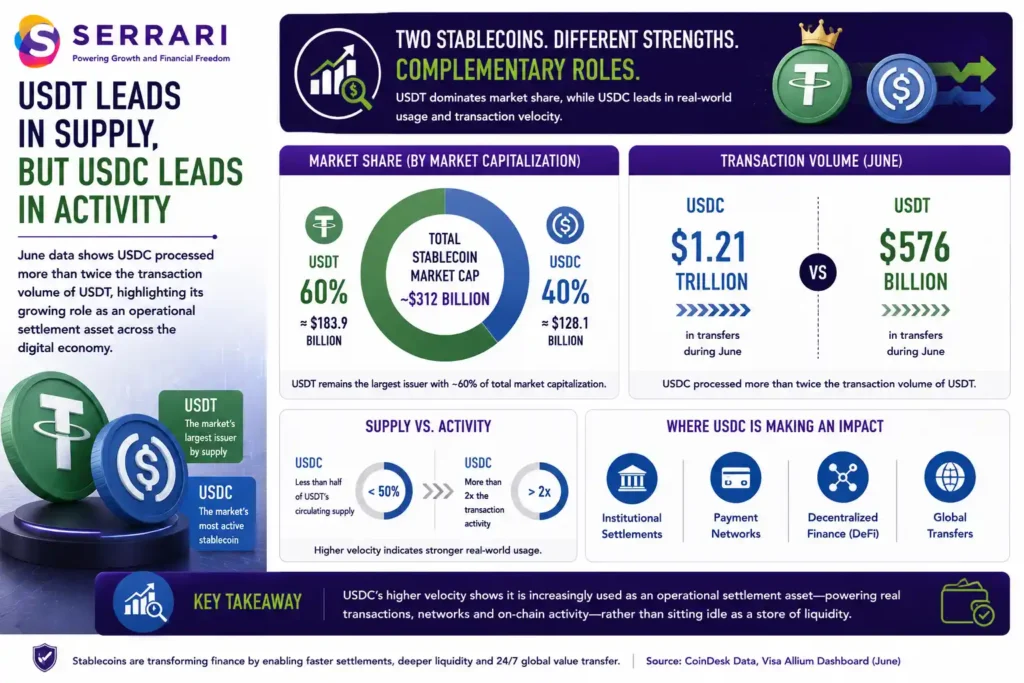
One of the most notable developments involved the changing balance between the market’s two largest stablecoins.
Although USDT retained its position as the largest issuer with approximately 60% of total market capitalization and circulating supply of roughly $183.9 billion, USDC processed substantially higher transaction volumes.
During June, USDC facilitated approximately $1.21 trillion in transfers compared with roughly $576 billion processed through USDT.
Despite maintaining less than half of USDT’s circulating supply, USDC generated more than twice the transaction activity, indicating considerably higher token turnover across institutional settlements, payment networks and decentralized finance (DeFi) applications.
This higher velocity suggests USDC is increasingly serving as an operational settlement asset rather than simply a store of liquidity.
No Major Depeg Despite Market Contraction
Unlike previous market declines, particularly the Terra-Luna collapse, the latest contraction did not involve widespread loss of confidence in stablecoin price stability.
Both USDT and USDC continued trading close to their intended $1 peg throughout the period, according to DefiLlama data.
The decline therefore reflected lower circulating supply rather than collapsing token values, indicating a fundamentally different market dynamic compared with earlier crypto market crises.
This stability has helped preserve confidence in stablecoins as reliable digital payment instruments despite the decline in overall capitalization.
Tokenized Assets Attract Institutional Capital
A growing share of capital appears to be shifting from traditional stablecoins into tokenized financial products.
By late July, tokenized Treasury funds had expanded to nearly $16 billion, while total tokenized real-world asset capitalization reached approximately $30.1 billion.
Circle’s USYC fund approached $3 billion in assets, while BlackRock’s BUIDL fund reached approximately $2.64 billion.
The simultaneous growth of tokenized investment products alongside declining stablecoin supply suggests institutional investors are increasingly deploying digital dollars into yield-generating blockchain-based financial assets instead of holding idle stablecoin balances.
New Issuers Increase Market Competition
Although Tether continues to dominate the stablecoin market, competition among issuers is gradually increasing.
Paxos’ USDG expanded beyond $3.2 billion in circulating supply during the quarter, while Anchorage’s USDGO nearly doubled its market share.
The emergence of new regulated issuers has been supported by evolving regulatory frameworks, including the United States’ GENIUS Act, which is reshaping how stablecoin providers operate and how institutional investors assess counterparty risk.
A broader issuer base could improve market resilience by reducing dependence on a single dominant provider while encouraging greater innovation across blockchain-based payment infrastructure.
Stablecoin Market Enters a New Phase
Although the decline in market capitalization attracted attention, underlying activity suggests the stablecoin market continues to mature rather than weaken.
Record transaction volumes, growing institutional adoption, expanding tokenized asset markets and stronger regulatory oversight indicate digital dollars are becoming increasingly integrated into mainstream financial infrastructure.
Rather than signalling reduced demand, the contraction may represent a transition toward more productive uses of blockchain-based liquidity as capital flows into tokenized securities, payment networks and decentralized financial services.
FAQs
Why did the stablecoin market decline?
The stablecoin market contracted because circulating supply fell after several months of continuous growth. However, the decline occurred without major price depegs and appears linked to capital shifting into tokenized financial assets rather than weakening demand.
Which stablecoin processed the most transaction volume?
USDC processed approximately $1.21 trillion in transaction volume during June, more than double USDT’s roughly $576 billion, despite having a much smaller circulating supply.
Does USDT still dominate the stablecoin market?
Yes. USDT remains the largest stablecoin, accounting for approximately 60% of total market capitalization with circulating supply approaching $184 billion.
Why are tokenized Treasury funds growing?
Institutional investors are increasingly allocating digital assets to tokenized Treasury funds because they offer blockchain-based exposure to government securities while generating yield, making them an attractive alternative to holding idle stablecoin balances.
Sources: Kucoin, Bidget, Crypto News, Crypto Citizens Network, Crypto Briefing
Your financial future isn’t something you wait for—it’s something you build.
The real question is: when do you begin?
Move beyond simply staying informed.
Navigate the markets with clarity—track trends through the Serrari Group Market Index, uncover opportunities in the Serrari Marketplace, and build practical knowledge with our Curated Wealth Builder Platform.
Stay connected to what truly matters.
Get daily insights on macro trends and financial movements across Kenya, Africa, and global markets—delivered through the Serrari Newsletter.
Growth opens doors.
Advance your career through professional programs including ACCA, HESI A2, ATI TEAS 7 , HESI EXIT , NCLEX – RN and NCLEX – PN, Financial Literacy!🌟—designed to move you forward with confidence.
See where money is flowing—clearly and in real time.
Track Money Market Funds, Treasury Bills, Treasury Bonds, Green Bonds, and Fixed Deposits, alongside global and African indexes, key economic indicators, and the evolving Crypto and stablecoin landscape—all within Serrari’s Market Index.