AI corporate bonds are becoming a larger force in U.S. capital markets as technology companies raise unprecedented amounts of debt to finance artificial intelligence infrastructure. U.S. corporate bond issuance reached about $1.68 trillion from January through mid-August 2026, nearly 27% above the same period last year. AI and major technology-related borrowing has already exceeded $220 billion, increasing the supply of long-duration debt as companies fund data centers, computing capacity and other expensive infrastructure.
Key Overview
U.S. companies issued approximately $1.68 trillion of bonds through mid-August 2026, while August issuance alone had already reached $153.2 billion. Technology accounts for 12.8% of issuance compared with 45.2% for financial companies, but tech borrowing is expanding rapidly. AI-related financing has surpassed $220 billion, roughly twice the amount raised during all of 2025, highlighting how the artificial intelligence investment boom is reshaping corporate debt markets.
AI Corporate Bonds Become a Major Funding Source
The race to build artificial intelligence infrastructure is transforming how America’s largest technology companies finance investment.
Building AI models requires far more than software development. Companies are spending heavily on data centers, advanced semiconductor systems, networking equipment, power infrastructure and computing capacity.
Although major technology companies generate substantial cash flows, the extraordinary scale of these investments means that debt financing has become increasingly attractive.
As a result, AI corporate bonds are emerging as an important source of capital for the industry’s infrastructure expansion.
From January through mid-August 2026, total U.S. corporate bond issuance reached approximately $1.68 trillion, nearly 27% higher than during the corresponding period in 2025.
The pace remained particularly strong in August. Companies had already raised approximately $153.2 billion during part of the month, exceeding the $147.7 billion issued throughout July.
Technology Companies Accelerate Bond Issuance
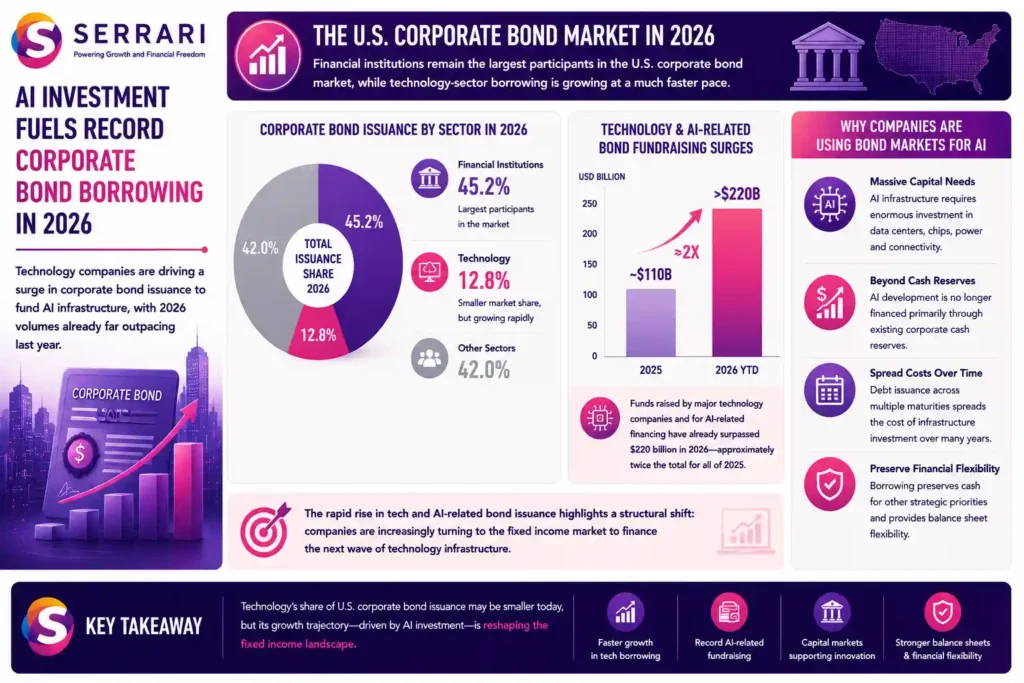
Financial institutions remain the largest participants in the U.S. corporate bonds market, accounting for approximately 45.2% of issuance in 2026.
Technology represents a considerably smaller 12.8%.
However, focusing only on market share risks understating the significance of what is happening. Technology-sector borrowing is expanding at a much faster pace as companies seek capital for AI investment.
Funds raised by major technology companies and for AI-related financing have already surpassed $220 billion in 2026, approximately twice the total recorded throughout last year.
This suggests AI development is no longer being financed primarily through existing corporate cash reserves.
Instead, companies are increasingly spreading infrastructure costs across their balance sheets and the fixed income market.
For cash-rich technology groups, borrowing can also preserve financial flexibility. Rather than using enormous amounts of available cash immediately, companies can issue debt across different maturities and distribute the cost of infrastructure investment over many years.
Context is everything. Stay ahead of shifting trends with today’s market updates, and uncover emerging opportunities using the Serrari Group Market Index and Marketplace. Then, take control of your own financial future by exploring our Money & Life Reset Transformation Blueprint ™ to build stronger habits, create better systems, and design a path toward lasting wealth.
AI Infrastructure Creates Long-Term Financing Needs
The nature of AI investment helps explain why companies are issuing longer-term debt.
Unlike many traditional technology investments, major AI infrastructure can involve assets expected to operate for years. Data centers, electricity infrastructure and networking systems require enormous upfront capital.
Companies can therefore attempt to align the financing period with the useful life of those assets.
Some recent bond issuance has included maturities extending 20 or 30 years.
That creates an important consequence for bond investors: increased duration.
Duration measures how sensitive a bond’s price is to changes in interest rates. Generally, longer-dated bonds experience larger price movements when market yields change.
As technology companies issue more long-term investment-grade bonds, investors gain access to additional high-quality corporate debt but also assume greater exposure to changes in long-term interest rates.
Does AI Borrowing Explain Treasury Market Pressure?
The surge in technology borrowing has raised questions about whether enormous corporate bond supply is contributing to pressure in the U.S. Treasury market.
There is some logic behind the argument.
Corporate bonds and Treasury securities compete for investor capital. If companies flood the market with attractive investment-grade debt, investors may demand higher yields to absorb the additional supply.
But attributing rising Treasury yields primarily to AI corporate bonds would oversimplify the situation.
The Treasury market is vastly influenced by expectations surrounding inflation, Federal Reserve policy, government borrowing requirements, fiscal deficits and economic growth.
AI-related corporate issuance can affect market positioning and increase competition for fixed-income capital, particularly at longer maturities, but it is only one factor within a much larger market.
Inflation Adds to Duration Risk
The expansion in long-term corporate borrowing comes while investors remain highly sensitive to inflation and monetary policy.
Inflation has remained above the Federal Reserve’s 2% target, increasing uncertainty about how quickly policymakers can sustainably reduce interest rates.
That matters for companies issuing 20- and 30-year debt and investors purchasing those securities.
If long-term yields remain elevated or rise further, existing long-duration bonds can lose value. Conversely, falling yields can produce stronger price gains for investors holding longer maturities.
The rapid growth of AI financing therefore intersects with a broader debate about interest rates.
Technology companies may want to secure capital today to continue building infrastructure, while investors must determine whether current yields adequately compensate them for decades of interest-rate and credit risk.
AI Boom Reshapes Capital Markets
The growth of AI corporate bonds shows that the artificial intelligence boom is spreading beyond technology stocks and venture capital.
It is increasingly becoming a major theme within global capital markets.
Bond investors are effectively helping finance the physical infrastructure behind AI development, while technology companies are using their strong credit profiles to access enormous pools of institutional capital.
The critical question is whether these investments eventually generate sufficient revenue and cash flow to justify the scale of spending.
For highly rated technology companies, near-term credit risk may remain relatively contained. But persistent increases in debt combined with exceptionally high capital expenditure could eventually alter leverage ratios and credit assessments.
The AI investment cycle is therefore becoming as relevant to bond investors as it already is to equity investors.
FAQs
What are AI corporate bonds?
AI corporate bonds are debt securities issued by companies raising capital partly to finance artificial intelligence investments. The proceeds can support data centers, computing infrastructure, semiconductor equipment, networking capacity and other technology required to develop and operate AI systems.
How much corporate debt has been issued in the U.S. in 2026?
U.S. corporate bond issuance reached approximately $1.68 trillion from January through mid-August 2026, nearly 27% higher than during the same period in 2025. Technology and AI-related financing has become an increasingly important contributor to that growth.
Why are technology companies borrowing money for AI infrastructure?
AI infrastructure requires enormous upfront investment in data centers, chips, energy and computing capacity. Issuing bonds allows technology companies to finance these long-lived assets over extended periods while preserving cash and maintaining greater financial flexibility.
Are AI corporate bonds pushing U.S. Treasury yields higher?
They may contribute to competition for investor capital, particularly because significant issuance is occurring at longer maturities. However, AI corporate bond supply should not be treated as the primary driver of Treasury yields. Inflation expectations, Federal Reserve policy, government borrowing, fiscal conditions and economic growth remain much larger influences on the Treasury market.
Your financial future isn’t something you wait for—it’s something you build.
The real question is: when do you begin?
Move beyond simply staying informed.
Navigate the markets with clarity—track trends through the Serrari Group Market Index, uncover opportunities in the Serrari Marketplace, and build practical knowledge with our Curated Wealth Builder Platform.
Stay connected to what truly matters.
Get daily insights on macro trends and financial movements across Kenya, Africa, and global markets—delivered through the Serrari Newsletter.
Growth opens doors.
Advance your career through professional programs including ACCA, HESI A2, ATI TEAS 7 , HESI EXIT , NCLEX – RN and NCLEX – PN, Financial Literacy!🌟—designed to move you forward with confidence.
See where money is flowing—clearly and in real time.
Track Money Market Funds, Treasury Bills, Treasury Bonds, Green Bonds, and Fixed Deposits, alongside global and African indexes, key economic indicators, and the evolving Crypto and stablecoin landscape—all within Serrari’s Market Index.