Kenya’s private sector is warning that declining confidence in public institutions, businesses and regulatory systems is becoming a measurable economic risk, increasing operating costs and making the country less attractive to investors. Business leaders and policy experts say companies operating in low-trust environments must spend more on contracts, audits, compliance, security and other safeguards against uncertainty.
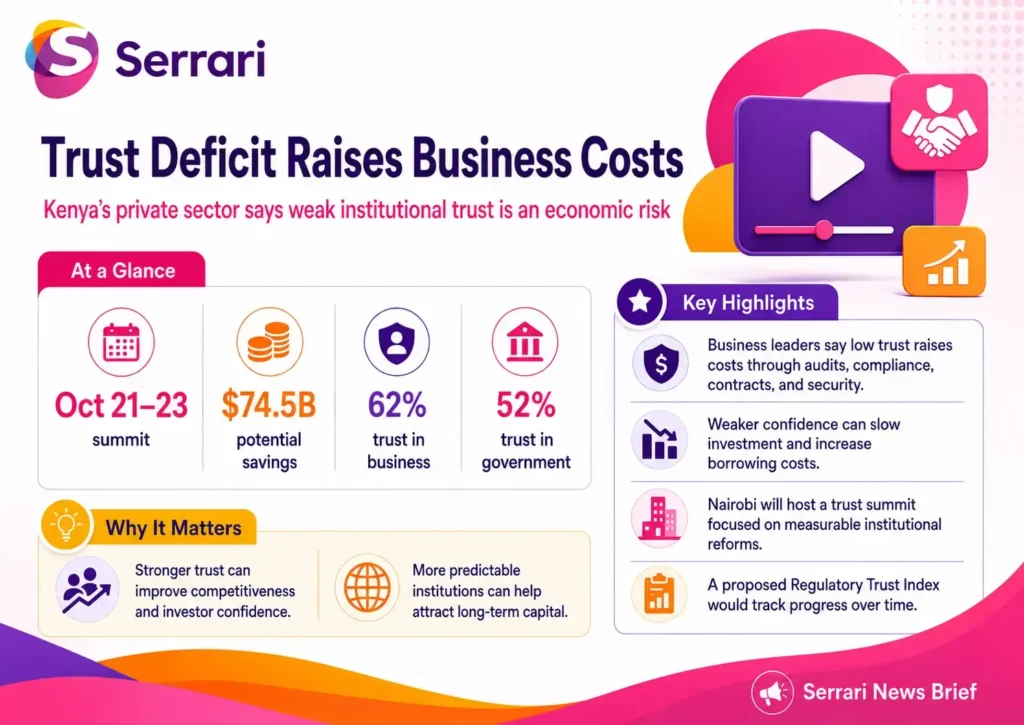
The warning comes ahead of the inaugural Global Trust Summit in Nairobi, scheduled for October 21–23, 2026. The gathering is expected to examine how stronger institutional confidence can support investment, regional trade, digital commerce and economic resilience while developing mechanisms to track progress over time.
Key Overview
- Kenya’s private sector says weak institutional trust is raising the cost of doing business.
- Businesses face additional spending on contracts, audits, compliance and security when confidence is low.
- Lower institutional trust can contribute to higher borrowing costs and slower investment flows.
- Africa could potentially save up to $74.5 billion through more objective sovereign credit assessments.
- The Global Trust Summit will be held in Nairobi from October 21–23, 2026.
- Organisers plan to develop a Regional Regulatory Trust Index to monitor confidence and institutional commitments.
- Global trust in business stood at 62% in 2025, compared with 52% for government.
- Kenya’s private sector is calling for greater policy predictability, corporate governance and institutional accountability.
Weak Trust Creates Real Costs for Businesses
Institutional trust increasingly has direct implications for how companies allocate capital and manage risk. University of Nairobi professor XN Iraki argued that when businesses cannot rely on institutions, counterparties or predictable enforcement, they compensate by introducing additional safeguards.
Businesses can therefore spend more on legal agreements, verification, auditing and security, raising transaction costs that ultimately affect investment and pricing. The private-sector warning is that this trust deficit is becoming an economic risk rather than simply a governance concern.
For investors, predictability is especially important. Frequent regulatory changes, uncertainty over contract enforcement or doubts about institutional independence can increase perceived risk. Investors may respond by demanding higher returns, delaying projects or redirecting capital toward markets viewed as more stable.
The consequences extend beyond large corporations. Smaller businesses operating with limited financial resources can be disproportionately affected by compliance expenses, delayed transactions and higher financing costs.
Africa’s Risk Premium Raises the Financing Burden
The debate has wider implications across Africa, where governments and companies frequently pay higher borrowing costs than comparable borrowers elsewhere.
Research into sovereign credit ratings has estimated that African countries could save as much as $74.5 billion through more objective credit assessments. That estimate incorporates both excess interest expenses and financing opportunities lost when ratings do not fully reflect underlying economic fundamentals.
The issue is particularly significant as developing economies compete for limited international capital. Global foreign direct investment reached approximately $1.6 trillion in 2025, yet least-developed countries received only 2.7% of total flows despite inflows to that group increasing during the year.
Stronger governance and predictable institutions cannot eliminate every investment risk, but they can improve investor confidence and reduce some of the uncertainty incorporated into financing decisions.
Context is everything. Stay ahead of shifting trends with today’s market updates, and uncover emerging opportunities using the Serrari Group Market Index and Marketplace. Then, take control of your own financial future by exploring our Money & Life Reset Transformation Blueprint ™ to build stronger habits, create better systems, and design a path toward lasting wealth.
Nairobi Summit Targets Measurable Trust Reforms
Kenya is seeking to turn the trust debate into a broader policy agenda through the Global Trust Summit. The Nairobi gathering will bring together governments, businesses, academia, development institutions and other stakeholders around institutional confidence and economic resilience.
Among its proposed initiatives is a Regional Regulatory Trust Index designed to track regulatory confidence and monitor time-bound institutional commitments publicly.
Plans also include mechanisms for monitoring commitments made at the summit and a Nairobi Statement on Global Trust covering governance, international cooperation, economic confidence and information integrity.
The approach reflects growing recognition that trust must be measurable if policymakers want to understand whether reforms are improving institutional confidence over time.
Kenya Faces a Wider Confidence Challenge
The debate comes against a broader global decline in confidence toward institutions. The 2025 global trust findings placed trust in business at 62%, making it the only institution classified as trusted globally, while trust in government averaged 52%.
Kenya faces an even sharper government-confidence challenge. Separate 2025 findings placed trust in Kenya’s government at 38%, compared with 72% for business.
For the private sector, rebuilding confidence will require more than communication. Businesses are calling for stable regulation, consistent enforcement and transparent public institutions, while companies themselves face pressure to strengthen corporate governance and ethical leadership.
The economic argument is straightforward: when rules are predictable and institutions are trusted, businesses can devote more capital to investment and expansion rather than protecting themselves against uncertainty. For Kenya, improving institutional trust could therefore become an important part of strengthening competitiveness, reducing perceived investment risk and attracting long-term capital.
Sources: Citizen Digital / Global Trust Summit / UNDP / UN Trade and Development / Edelman
Your financial future isn’t something you wait for—it’s something you build.
The real question is: when do you begin?
Move beyond simply staying informed.
Navigate the markets with clarity—track trends through the Serrari Group Market Index, uncover opportunities in the Serrari Marketplace, and build practical knowledge with our Curated Wealth Builder Platform.
Stay connected to what truly matters.
Get daily insights on macro trends and financial movements across Kenya, Africa, and global markets—delivered through the Serrari Newsletter.
Growth opens doors.
Advance your career through professional programs including ACCA, HESI A2, ATI TEAS 7 , HESI EXIT , NCLEX – RN and NCLEX – PN, Financial Literacy!🌟—designed to move you forward with confidence.
See where money is flowing—clearly and in real time.
Track Money Market Funds, Treasury Bills, Treasury Bonds, Green Bonds, and Fixed Deposits, alongside global and African indexes, key economic indicators, and the evolving Crypto and stablecoin landscape—all within Serrari’s Market Index.