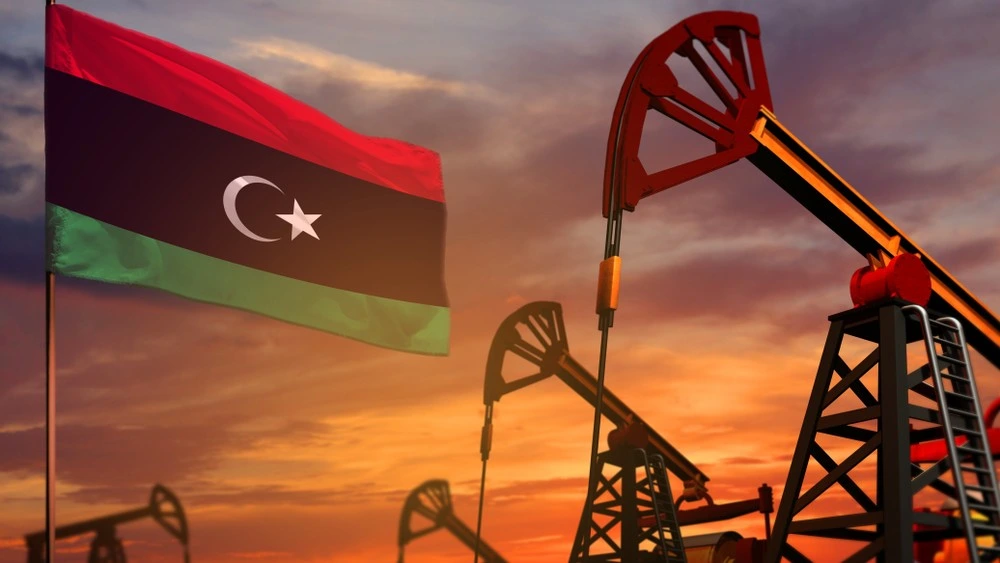
Libya is seeking $36 billion–$40 billion in foreign investment to expand its oil industry and raise crude production from around 1.4 million barrels per day to 2 million barrels per day by 2030. The National Oil Corporation is seeking international partners as Libya resumes licensing activity after years of disruption. More than 60 discovered oil and gas fields remain undeveloped, creating opportunities for exploration, production and infrastructure investment.
Key Overview
- $36–$40 billion: Estimated foreign investment Libya needs to expand its oil industry.
- 2 million bpd: Libya’s target for crude oil production by 2030.
- 1.4 million bpd: Approximate current crude production.
- $2 billion: Funding allocated to the National Oil Corporation under Libya’s 2026 budget.
- 60+ fields: Discovered oil and gas fields that remain undeveloped.
- Major investors: Repsol, Turkish Petroleum, Eni, QatarEnergy and MOL have signed agreements following Libya’s 2025 bid round.
- Regional trade: Libyan crude has entered Nigeria’s Dangote Refinery, expanding Libya’s role in African energy markets.
Libya Targets Major Oil Production Expansion
Libya is seeking between $36 billion and $40 billion in foreign investment to expand its oil industry and increase production to 2 million barrels daily by the early 2030s, according to the Financial Times, citing National Oil Corporation (NOC) chairman Masoud Suleman.
The investment drive comes as Libya seeks to rebuild its energy sector after years of political instability and conflict disrupted investment and forced several international oil companies to scale back operations.
Oil remains central to Libya’s economy, making higher production a key government priority. The country currently produces around 1.4 million barrels per day, meaning it would need to add roughly 600,000 barrels per day to reach its target.
The NOC believes international investment will be essential to achieving that increase, particularly in exploration, field development and supporting infrastructure.
$2 Billion Budget Boost for NOC
Libya has already taken steps to strengthen the NOC’s ability to pursue its production ambitions.
The country’s newly approved budget includes a $2 billion allocation to the National Oil Corporation, providing additional funding for its operations and development plans.
The funding is particularly significant after years of delays in government financing created uncertainty for the NOC and its international partners.
Suleman has indicated that improved access to funding could strengthen the corporation’s ability to attract international investors and provide greater confidence to companies considering long-term projects in Libya.
For investors, reliable government funding and predictable payments will be important considerations as international energy companies evaluate opportunities in the country.
International Oil Companies Return to Libya
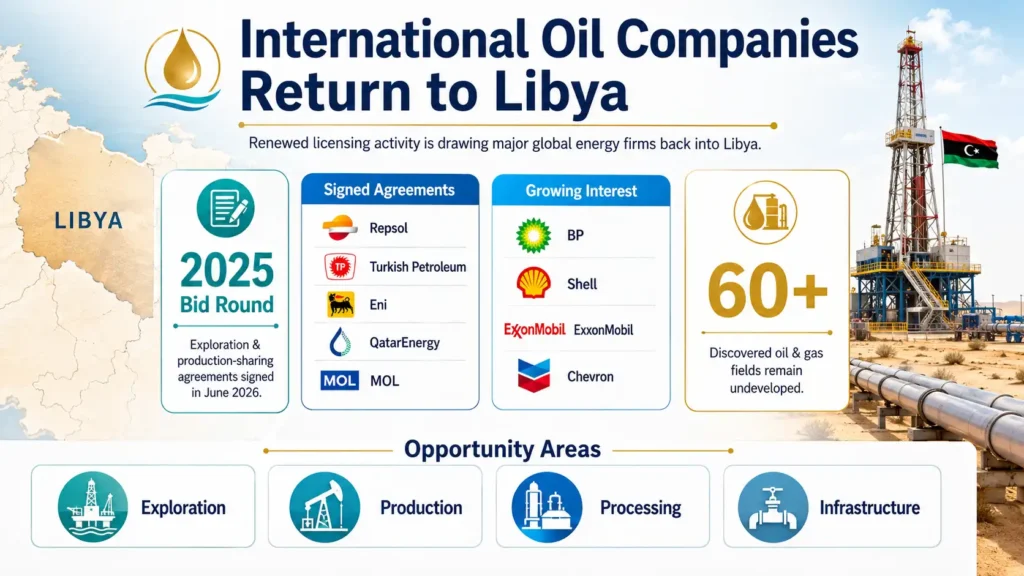
Libya’s investment push is already attracting major international energy companies.
The NOC resumed oil licensing activity last year after nearly two decades without a major tender process. In June, the corporation formally signed exploration and production-sharing agreements resulting from its 2025 bid round.
Companies involved include Repsol, Turkish Petroleum, Eni, QatarEnergy and MOL.
Other major oil companies are also returning or increasing their interest in Libya, including BP, Shell, ExxonMobil and Chevron.
The renewed interest reflects the scale of Libya’s undeveloped hydrocarbon resources. The country is estimated to hold some of Africa’s largest oil reserves, while the NOC says more than 60 discovered oil and gas fields remain undeveloped.
These fields could provide opportunities for international companies across exploration, production, processing and infrastructure development.
Libya Considers Investment Reforms
Attracting the required capital will depend partly on whether Libya can make its investment framework more attractive to international companies.
The government is considering changes to its production-sharing agreements, under which the state oil company currently contributes to part of development costs.
Under proposed reforms, international investors could assume more upfront financing responsibilities. This could allow projects to move forward more quickly while reducing the immediate financial burden on the NOC.
Such changes could make Libya more attractive to international investors, particularly companies with the financial capacity to fund large exploration and development projects.
However, investors are likely to continue assessing political, security and contractual risks before committing substantial long-term capital.
Context is everything. Stay ahead of shifting trends with today’s market updates, and uncover emerging opportunities using the Serrari Group Market Index and Marketplace. Then, take control of your own financial future by exploring our Money & Life Reset Transformation Blueprint ™ to build stronger habits, create better systems, and design a path toward lasting wealth.
Security Remains a Major Investment Risk
Libya’s oil expansion plans are taking place against a challenging security backdrop.
Although political and security conditions have improved in some areas, oil fields and infrastructure remain vulnerable to disruption.
The NOC recently declared force majeure on an oil export terminal following drone strikes, highlighting the risks that energy companies continue to face.
The country’s political institutions also remain divided, creating uncertainty over whether agreements signed with international companies can be implemented consistently over the long term.
For international investors, stability will therefore be just as important as the availability of oil reserves.
A sustained improvement in security could unlock significant investment, while renewed instability could delay projects and disrupt production.
Libya Expands Regional Oil Trade
Libya’s energy ambitions are also increasingly connected to Africa’s growing regional energy market.
In 2026, Libyan crude entered Nigeria’s Dangote Petroleum Refinery, Africa’s largest refining facility.
Nigeria imported approximately 64,500 barrels per day of Libyan crude in May 2026, equivalent to around 2 million barrels during the month. This was reportedly the first recorded import of Libyan crude into Nigeria based on available trade data.
The development provides Libya with an additional outlet for its crude and highlights the potential for stronger energy trade between African oil producers and refiners.
For Nigeria, importing Libyan crude can help diversify supplies for the Dangote refinery, while Libya gains access to a major new regional customer.
Natural Gas Offers Another Investment Opportunity
Libya’s investment opportunity extends beyond crude oil.
The country’s natural gas resources could become increasingly important for both domestic energy supply and exports.
Higher gas production could help supply Libya’s power plants while reducing gas flaring, allowing more of the country’s resources to be commercially utilized.
Libya could also potentially increase gas exports to Europe, where countries continue to seek alternatives to Russian pipeline gas.
However, developing this opportunity will require substantial investment in gas production, processing and transportation infrastructure.
The commercial potential of Libya’s gas resources will also depend on stable contracts, reliable payment mechanisms and a predictable investment environment.
Outlook
Libya’s plan to attract $36 billion–$40 billion in foreign investment represents one of the country’s most ambitious efforts to expand its energy industry in years.
The combination of undeveloped oil and gas fields, renewed licensing activity, international energy company interest and additional NOC funding creates significant potential for production growth.
However, reaching 2 million barrels per day by 2030 will depend on more than available reserves. Libya must also provide investors with greater security, predictable contracts, reliable financing and a stable regulatory environment.
If those conditions improve, international investment could accelerate oil and gas development while strengthening Libya’s position in regional energy markets.
FAQs
1. How much investment does Libya need to expand oil production?
Libya is estimated to need between $36 billion and $40 billion in foreign investment to expand its oil industry and increase production.
2. What is Libya’s oil production target?
Libya currently produces around 1.4 million barrels per day and aims to increase output to 2 million barrels per day by 2030.
3. Which international companies are investing in Libya?
Companies involved in recent agreements include Repsol, Turkish Petroleum, Eni, QatarEnergy and MOL, while BP, Shell, ExxonMobil and Chevron are also returning or increasing their interest.
4. Why is natural gas important to Libya?
Greater natural gas production could supply domestic power plants, reduce gas flaring and potentially increase exports to European markets seeking alternative gas supplies.
Sources: Crude Oil Prices Today, Business Insider Africa, Ecofin Agency
Your financial future isn’t something you wait for—it’s something you build.
The real question is: when do you begin?
Move beyond simply staying informed.
Navigate the markets with clarity—track trends through the Serrari Group Market Index, uncover opportunities in the Serrari Marketplace, and build practical knowledge with our Curated Wealth Builder Platform.
Stay connected to what truly matters.
Get daily insights on macro trends and financial movements across Kenya, Africa, and global markets—delivered through the Serrari Newsletter.
Growth opens doors.
Advance your career through professional programs including ACCA, HESI A2, ATI TEAS 7 , HESI EXIT , NCLEX – RN and NCLEX – PN, Financial Literacy!🌟—designed to move you forward with confidence.
See where money is flowing—clearly and in real time.
Track Money Market Funds, Treasury Bills, Treasury Bonds, Green Bonds, and Fixed Deposits, alongside global and African indexes, key economic indicators, and the evolving Crypto and stablecoin landscape—all within Serrari’s Market Index.