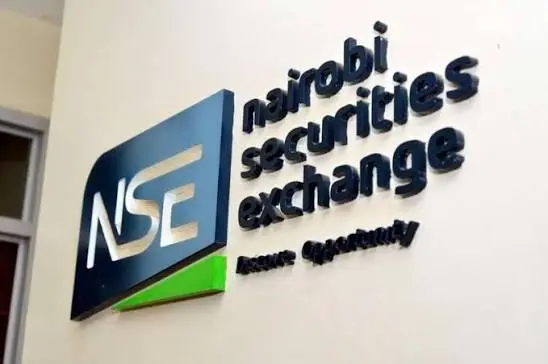
Tokenized securities Kenya moved a step closer to reality after Tether and the Nairobi Securities Exchange (NSE) signed a memorandum of understanding to explore blockchain-powered capital markets. The agreement focuses on research, investor education, tokenization, and settlement innovation, positioning Kenya as one of Africa’s emerging hubs for digital asset innovation while stopping short of launching any tokenized products.
LIVENSE market summarySee NSE data →Key Overview
- Tether and the NSE signed an MoU to study tokenized securities.
- The agreement focuses on research, education and pilot projects.
- No tokenized products or USDT listing have been approved.
- Training will target brokers, investors and capital market participants.
- The partnership will explore blockchain-based settlement systems.
- Kenya’s growing crypto market supports digital innovation.
- The initiative aligns with the NSE’s 2025–2029 strategic plan.
- Tokenization could improve market accessibility and efficiency.
Tether and NSE Explore Tokenized Securities to Advance Kenya’s Digital Capital Markets
The development of tokenized securities Kenya has gathered momentum following the signing of a memorandum of understanding (MoU) between Tether and the Nairobi Securities Exchange (NSE). The agreement establishes a framework for both organisations to study how blockchain technology and digital assets can modernise Kenya’s capital markets through research, education, pilot programmes and technological collaboration.
Importantly, the agreement does not introduce tokenized securities or approve the use of Tether’s USDT stablecoin on the exchange. Instead, it provides a roadmap for exploring how blockchain-based financial infrastructure could improve market operations while maintaining regulatory oversight and investor protection.
Partnership Focuses on Research and Education
The agreement centres on knowledge sharing and technical exploration rather than immediate commercial deployment.
Under the memorandum, Tether and the NSE will jointly organise workshops, educational programmes and training sessions for brokers, institutional participants and retail investors. These programmes will explain how digital assets, blockchain technology and tokenization could integrate with existing capital market infrastructure.
By increasing understanding of blockchain-based finance, both organisations aim to prepare market participants for future innovations without committing to any immediate product launches.
The educational focus also reflects growing interest in digital assets among investors seeking to better understand emerging financial technologies.
Exploring Blockchain-Based Market Infrastructure
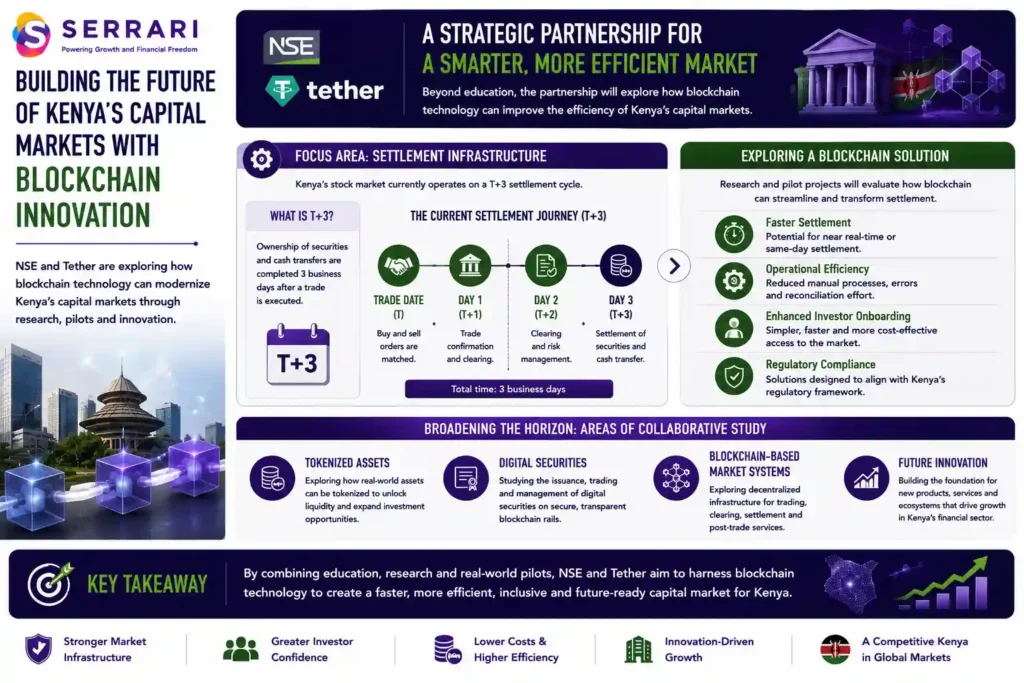
Beyond education, the partnership will examine how blockchain technology could improve the efficiency of Kenya’s capital markets.
One area under consideration is settlement infrastructure. Kenya’s stock market currently operates using a T+3 settlement cycle, meaning ownership of securities and cash transfers are completed three business days after a trade is executed.
Through research and pilot projects, the partners intend to evaluate whether blockchain technology could streamline settlement processes, improve operational efficiency and enhance investor onboarding while maintaining regulatory compliance.
The agreement also includes broader studies into tokenized assets, digital securities and blockchain-based market systems that could support future innovation within Kenya’s financial sector.
Context is everything. Stay ahead of shifting trends with today’s market updates, and uncover emerging opportunities using the Serrari Group Market Index and Marketplace. Then, take control of your own financial future by exploring our Money & Life Reset Transformation Blueprint ™ to build stronger habits, create better systems, and design a path toward lasting wealth.
No Immediate Launch of Tokenized Securities
Although the announcement generated considerable interest, the memorandum remains exploratory.
Neither the Nairobi Securities Exchange nor Tether has announced plans to issue tokenized securities, launch blockchain-based trading platforms or introduce USDT for settlement on the exchange.
Instead, the agreement establishes a collaborative framework for conducting research, testing new concepts and assessing the practical application of blockchain technologies within regulated capital markets.
This cautious approach allows both organisations to evaluate technological opportunities while working alongside regulators and maintaining market integrity.
NSE’s Digital Transformation Strategy
The collaboration aligns closely with the NSE’s 2025–2029 Strategic Plan, which prioritises technology adoption, broader investor participation and improved access to investment opportunities.
Chief Executive Officer Frank Mwiti described the partnership as another milestone in the exchange’s broader digital transformation programme. According to the NSE, exploring innovative technologies has the potential to modernise market infrastructure, improve operational efficiency and strengthen Kenya’s competitiveness within global capital markets.
The initiative reflects the exchange’s ongoing efforts to diversify investment products while embracing emerging financial technologies.
Kenya’s Growing Digital Asset Ecosystem
The partnership also builds upon Kenya’s expanding digital asset industry.
Kenya has become one of the fastest-growing cryptocurrency markets in Sub-Saharan Africa, supported by widespread mobile money adoption, an active fintech ecosystem and increasing interest in blockchain-based financial services.
LIVENSE market summarySee NSE data →Regulatory progress has also contributed to this growth. The approval of the Virtual Asset Service Providers (VASP) Bill established a legal framework for cryptocurrency businesses, providing greater regulatory certainty for digital asset innovation.
This evolving regulatory environment makes Kenya an increasingly attractive market for exploring institutional blockchain applications.
Tether Sees Institutional Opportunity
Tether views the partnership as part of the broader evolution of blockchain technology beyond cryptocurrency trading.
Chief Executive Officer Paolo Ardoino said digital assets are increasingly moving beyond traditional crypto markets into practical financial applications, including cross-border institutional finance and capital market infrastructure.
Rather than focusing solely on stablecoin payments, the collaboration aims to examine how blockchain technology could support financial institutions, exchanges and regulated investment markets through improved efficiency and expanded access.
The emphasis on institutional adoption reflects a broader shift across global financial markets toward tokenization and digital securities.
Tokenization Could Transform Capital Markets
The exploration of tokenized securities Kenya highlights the growing interest in using blockchain technology to modernise financial markets.
Tokenization enables traditional financial assets such as shares, bonds or investment funds to be represented digitally on blockchain networks, potentially improving settlement speed, transparency, accessibility and operational efficiency.
While the NSE-Tether agreement remains in its early stages, it positions Kenya among a growing number of markets evaluating how blockchain technology can complement existing financial infrastructure without replacing established regulatory frameworks.
As research, pilot projects and educational initiatives progress, the partnership could help shape the future direction of Kenya’s digital capital markets.
FAQs
What are tokenized securities?
Tokenized securities are traditional financial assets, such as shares or bonds, that are digitally represented on a blockchain while remaining subject to applicable securities regulations.
Has the NSE launched tokenized securities?
No. The agreement between Tether and the Nairobi Securities Exchange is exploratory and focuses on research, education and pilot projects. No tokenized products have been launched.
Will USDT be used on the Nairobi Securities Exchange?
No. The memorandum does not approve the use of USDT or any other Tether product for trading or settlement on the NSE.
Why is tokenization important for Kenya?
Tokenization has the potential to improve settlement efficiency, expand investor access, enhance transparency and support innovation in Kenya’s capital markets while complementing the country’s growing digital asset ecosystem.
Sources: Daba Finance, African Business, Kucoin, Bidget, Binance Square
Your financial future isn’t something you wait for—it’s something you build.
The real question is: when do you begin?
Move beyond simply staying informed.
Navigate the markets with clarity—track trends through the Serrari Group Market Index, uncover opportunities in the Serrari Marketplace, and build practical knowledge with our Curated Wealth Builder Platform.
Stay connected to what truly matters.
Get daily insights on macro trends and financial movements across Kenya, Africa, and global markets—delivered through the Serrari Newsletter.
Growth opens doors.
Advance your career through professional programs including ACCA, HESI A2, ATI TEAS 7 , HESI EXIT , NCLEX – RN and NCLEX – PN, Financial Literacy!🌟—designed to move you forward with confidence.
See where money is flowing—clearly and in real time.
Track Money Market Funds, Treasury Bills, Treasury Bonds, Green Bonds, and Fixed Deposits, alongside global and African indexes, key economic indicators, and the evolving Crypto and stablecoin landscape—all within Serrari’s Market Index.