Nigeria’s money market assets are becoming increasingly attractive as falling inflation combines with elevated yields on Treasury bills and Open Market Operation securities. Headline inflation eased to 15.43% in July 2026, while recent short-term government securities offered yields ranging from 16.30% to above 20%. This creates the possibility of positive real returns for investors seeking to preserve the purchasing power of their naira holdings. However, the actual return depends on investment maturity, taxes, fees and whether inflation continues to decline.
Key Overview
Nigeria’s inflation rate declined to 15.43% in July from 15.91% in June. At the August 12 Treasury bills auction, yields ranged from 16.30% on the 91-day instrument to 17.59% on the 364-day bill. OMO securities offered even higher yields, with the 103-day instrument clearing at 20.39%. The combination of lower inflation and elevated short-term yields is strengthening investor interest in fixed-income and money-market investments.
Nigeria Inflation Falls to 15.43%
Nigeria’s declining inflation rate is changing the investment environment for savers and institutional investors looking for ways to protect the real value of their capital.
Headline inflation slowed to 15.43% in July 2026 from 15.91% in June, representing a decline of 0.48 percentage points.
The moderation is significant for investors because inflation determines how much purchasing power is lost over time. An investment may produce a positive nominal return but still leave an investor worse off in real terms if its return is below inflation.
As inflation falls while yields remain relatively elevated, the gap between the two can become more favourable for investors.
That is strengthening the case for short-term fixed-income instruments capable of generating returns that compete with or exceed the prevailing inflation rate.
Treasury Bills Offer Attractive Yields
Recent Treasury bill auction results illustrate the changing environment.
At the auction conducted on August 12, the 91-day Treasury bills cleared at 16.30%, while the 182-day instrument recorded 16.50%.
The longest instrument offered at the auction, the 364-day Treasury bill, cleared at 17.59%.
These headline annualised yields sit above the latest 15.43% inflation reading, potentially improving the attractiveness of government securities for investors prioritising capital preservation and income.
The spread is particularly important because Treasury bills are generally considered lower-risk investments compared with equities and many corporate securities.
Investors therefore face a different allocation decision when relatively low-risk government securities can offer competitive nominal yields.
OMO Securities Push Returns Above 20%
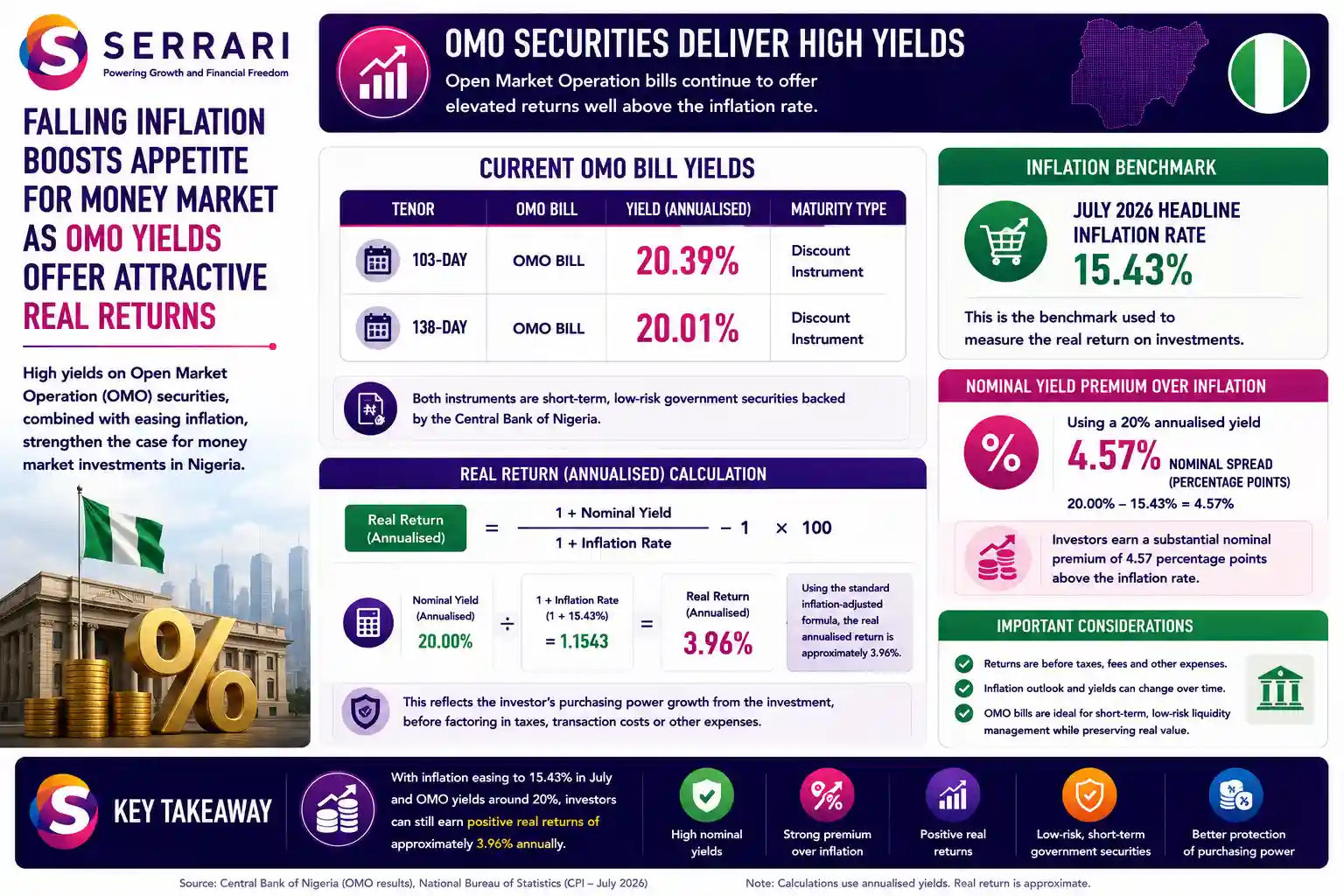
Open Market Operation securities offered even higher yields.
The 103-day OMO bill cleared at 20.39%, while the 138-day instrument recorded a yield of 20.01%.
Compared with July’s 15.43% inflation rate, those levels provide a substantial nominal spread.
A 20% annualised return compared with inflation of 15.43%, for example, represents a nominal yield premium of 4.57 percentage points.
Using the standard real-return relationship rather than simply subtracting inflation from the investment return gives a real annualised rate of approximately 3.96%, before accounting for taxes, transaction costs or other expenses.
That distinction matters. A yield being higher than the current annual inflation rate does not automatically mean an investor earns that full spread in real terms, particularly on instruments with maturities substantially shorter than one year.
Why Money Market Assets Could Attract More Investors
The combination of falling inflation and elevated interest rates can create favourable conditions for money-market investors.
For investors primarily concerned with preserving capital, the ability to earn competitive returns through short-duration securities can reduce the incentive to move aggressively into riskier investments.
This is particularly relevant when financial markets remain uncertain.
Money-market instruments generally provide shorter maturities than conventional longer-term bonds, reducing investors’ exposure to some of the price volatility associated with changes in longer-term interest rates.
Short maturities can also allow investors to reinvest relatively quickly as monetary policy and market conditions change.
Chukwunonso Iheoma, a former central banker, noted that government securities data from the Central Bank of Nigeria provides an important benchmark for investors comparing inflation with fixed-income yields.
According to Iheoma, easing inflation combined with elevated short-term yields could create favourable near-term conditions for fixed-income investors while increasing competition for capital across different asset classes.
Context is everything. Stay ahead of shifting trends with today’s market updates, and uncover emerging opportunities using the Serrari Group Market Index and Marketplace. Then, take control of your own financial future by exploring our Money & Life Reset Transformation Blueprint ™ to build stronger habits, create better systems, and design a path toward lasting wealth.
Fixed Income Could Compete With Equities
Attractive yields on short-term securities could also influence Nigeria’s equity market.
Investors typically demand compensation for accepting additional risk.
If an investor can earn a relatively attractive yield from government-backed securities, equities and other risk assets may need to offer sufficiently compelling potential returns to justify their additional volatility.
This does not necessarily mean investors will abandon equities.
Stocks can provide capital appreciation and dividend income that significantly outperform fixed-income investments over certain periods. Their returns, however, are uncertain and can fluctuate considerably.
Money-market investments therefore compete most strongly for capital from investors prioritising liquidity, income and lower volatility rather than aggressive long-term growth.
Institutional investors may similarly adjust allocations depending on the relative attractiveness of equities, government securities and other fixed income products.
Inflation Remains the Critical Variable
The sustainability of positive real returns depends heavily on what happens to inflation.
If Nigeria’s inflation rate continues declining while Treasury bill and OMO yields remain elevated, the real-return environment could become even more favourable.
If inflation accelerates again, however, the advantage could narrow quickly.
Interest rates could also decline if policymakers become more confident that inflationary pressures are under control.
Investors therefore should not assume today’s relationship between inflation and money-market yields will remain unchanged throughout the year.
The current figures instead provide a snapshot of an unusually important spread between short-term government yields and inflation.
Outlook for Money Market Assets
Nigeria’s money market assets are entering a potentially favourable period as inflation moderates without a corresponding collapse in short-term yields.
Treasury bill rates between 16.30% and 17.59%, alongside OMO yields above 20%, provide investors with opportunities to seek returns above the latest inflation rate.
For investors concerned about preserving purchasing power, that relationship could strengthen investor demand for government securities and other short-duration investments.
The key question is whether inflation continues declining faster than yields.
If it does, real returns could improve further and make money-market investments increasingly competitive with other Nigerian asset classes.
FAQs
What are money market assets?
Money market assets are short-term financial instruments designed primarily for liquidity and capital preservation. They can include Treasury bills, short-term government securities, commercial paper and other instruments generally carrying relatively short maturities.
Why does falling inflation make money market assets more attractive?
Falling inflation can increase the real value of investment returns when yields remain elevated. If an investment’s return exceeds inflation, investors have a better chance of increasing their purchasing power rather than simply maintaining the nominal value of their money.
What were Nigeria’s latest Treasury bill yields?
At the August 12, 2026 auction, Nigeria’s 91-day Treasury bill cleared at 16.30%, the 182-day bill at 16.50% and the 364-day instrument at 17.59%. These rates were above July’s headline inflation rate of 15.43%.
Are money market returns guaranteed to beat inflation?
No. Inflation and market yields change over time, while taxes, fees and investment maturity can affect actual returns. A security offering an annualised yield above today’s inflation rate does not guarantee that an investor’s realised return will remain above inflation throughout the investment period.
Your financial future isn’t something you wait for—it’s something you build.
The real question is: when do you begin?
Move beyond simply staying informed.
Navigate the markets with clarity—track trends through the Serrari Group Market Index, uncover opportunities in the Serrari Marketplace, and build practical knowledge with our Curated Wealth Builder Platform.
Stay connected to what truly matters.
Get daily insights on macro trends and financial movements across Kenya, Africa, and global markets—delivered through the Serrari Newsletter.
Growth opens doors.
Advance your career through professional programs including ACCA, HESI A2, ATI TEAS 7 , HESI EXIT , NCLEX – RN and NCLEX – PN, Financial Literacy!🌟—designed to move you forward with confidence.
See where money is flowing—clearly and in real time.
Track Money Market Funds, Treasury Bills, Treasury Bonds, Green Bonds, and Fixed Deposits, alongside global and African indexes, key economic indicators, and the evolving Crypto and stablecoin landscape—all within Serrari’s Market Index.