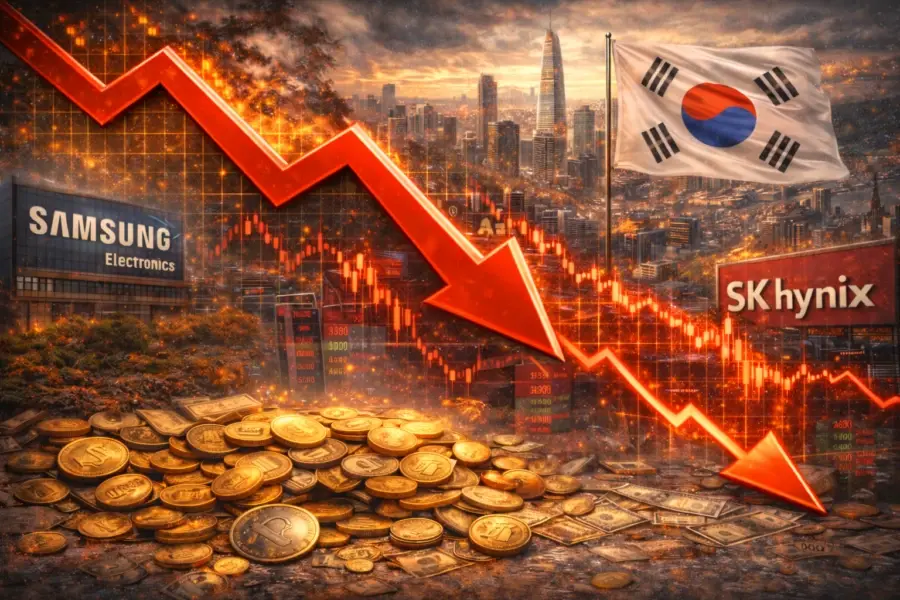
The sharp reversal in South Korea AI stocks has left many rookie investors facing substantial losses after a technology-driven rally encouraged greater participation in the country’s equity market. South Korea’s KOSPI surged during the first half of 2026 as enthusiasm around artificial intelligence, memory chips and technology companies accelerated, but the rally reversed sharply from its June peak. Heavy margin borrowing and leveraged investment products have magnified losses for some retail investors, prompting regulators to tighten requirements for leveraged single-stock exchange-traded funds.
Key Overview
South Korea’s KOSPI remains about 50% higher in 2026 despite falling roughly 30% from its record high. The index reached an intraday peak of 9,385.59 on June 19 before a severe correction. Margin loans peaked at 38.6 trillion won in June before falling to 28.9 trillion won by the end of July as brokerages liquidated positions held by investors unable to meet margin requirements.
Rookie Investors Caught in South Korea AI Stocks Reversal
South Korea’s extraordinary stock market rally attracted thousands of inexperienced investors hoping to benefit from the country’s growing exposure to artificial intelligence and semiconductor demand.
Many entered the market as President Lee Jae Myung promoted greater public participation in Korean equities while pledging reforms aimed at improving the performance of a market that has historically traded at lower valuations than many international peers.
For several months, that strategy appeared well timed.
Technology and semiconductor companies benefited from enthusiasm surrounding AI infrastructure and rapidly growing demand for advanced memory chips.
But the subsequent reversal has demonstrated the risks facing investors who entered near the top of a rapidly appreciating market, particularly those who used borrowed money or leveraged investment products.
KOSPI Falls Sharply After Record High
The scale of the market’s rise and fall has been extraordinary.
The KOSPI moved above 5,000 points in January before surpassing 8,000 in May. It eventually reached an intraday record of 9,385.59 on June 19.
By July 30, however, the index had fallen below 5,595, reversing a substantial portion of its earlier gains.
The volatility has continued into August.
The benchmark recently plunged almost 6% in a single session after declining 1.55% during the preceding trading day.
Despite those losses, the KOSPI has remained approximately 50% higher since the beginning of 2026. At the same time, it is around 30% below its record high.
That contrast demonstrates why headline year-to-date stock market performance does not necessarily reflect the experience of individual investors.
Someone who entered early in the rally may still hold significant gains, while an investor who bought close to the June peak could be sitting on substantial losses.
Artificial Intelligence Fuels Technology Stock Boom
Artificial intelligence was an important force behind the rally.
South Korea occupies a strategically important position within the global semiconductor supply chain, particularly through companies such as Samsung Electronics and SK Hynix.
Growing demand for advanced memory used in AI servers and data centres helped strengthen expectations for semiconductor earnings and encouraged investors to increase exposure to technology stocks.
The momentum increasingly attracted individual investors.
However, strong underlying demand for AI-related technology does not guarantee that every AI-exposed stock will continue rising.
When valuations increase rapidly, share prices can become increasingly sensitive to earnings expectations, global technology sentiment, interest rates and changes in investor positioning.
The correction therefore highlights the difference between a compelling long-term investment theme and the price investors pay to gain exposure to it.
Margin Loans Magnify Stock Market Losses
Borrowing has made the downturn particularly painful for some rookie investors.
Margin loans used to finance stock purchases reached 38.6 trillion won, approximately $27.6 billion, at their June peak.
By the end of July, outstanding margin borrowing had declined to 28.9 trillion won, or approximately $20.7 billion.
Part of that decline came as brokerages liquidated securities belonging to investors who could no longer meet requirements on leveraged positions.
This illustrates one of the fundamental dangers of speculative trading using borrowed money.
An investor purchasing ordinary shares without leverage can suffer a substantial paper loss and potentially wait for a recovery. An investor using margin faces an additional risk: the broker may require more collateral or sell the position when its value falls.
Leverage therefore magnifies both gains and losses.
A rapidly falling market can create a feedback loop in which declining prices trigger margin calls, forced selling adds further downward pressure and additional investors are subsequently forced out of their positions.
Regulators Tighten Leveraged ETF Requirements
South Korean authorities have responded by tightening rules around leveraged single-stock ETFs.
On July 31, regulators tripled the minimum cash balance required for trading these products to 30 million won, equivalent to roughly $21,450.
The stricter requirement had originally been scheduled to begin on August 5 but was brought forward as concerns about speculative activity intensified.
The intervention suggests regulators are particularly concerned about inexperienced investors using products capable of multiplying movements in individual shares.
Leveraged ETFs can produce significant gains when the underlying security moves in the expected direction, but they can also generate rapid losses during sharp reversals.
For first-time investors, the complexity of leverage, daily resets and volatility can make actual outcomes very different from simply owning the underlying stock.
Context is everything. Stay ahead of shifting trends with today’s market updates, and uncover emerging opportunities using the Serrari Group Market Index and Marketplace. Then, take control of your own financial future by exploring our Money & Life Reset Transformation Blueprint ™ to build stronger habits, create better systems, and design a path toward lasting wealth.
Investor Sentiment Turns More Cautious
The correction has also changed investor sentiment surrounding South Korean equities.
The extraordinary first-half rally encouraged expectations that the country’s historically discounted stock market could undergo a lasting revaluation.
The subsequent decline does not necessarily invalidate that argument.
Corporate governance reforms, stronger semiconductor earnings and sustained global demand for AI infrastructure could still provide longer-term support for Korean equities.
However, the correction shows that structural improvements do not eliminate market cycles.
Investors must distinguish between the long-term prospects of an industry and short-term movements driven by momentum, leverage and speculative positioning.
Political Consequences of Market Turbulence
The market downturn has also developed a political dimension because President Lee encouraged broader participation in the stock market.
His approval rating declined for five consecutive weeks to 43% in a Realmeter survey conducted from August 10 to 14, its lowest level since he took office.
It would be too simplistic, however, to attribute the decline solely to stock market losses. Presidential approval can be influenced by numerous economic and political developments.
The market turbulence nevertheless creates an uncomfortable backdrop for an administration that promoted greater citizen participation in equities.
It also demonstrates the risk of treating stock-market appreciation as a policy outcome that can be reliably sustained.
Outlook for South Korean Stocks
The outlook for South Korea AI stocks will depend partly on whether enthusiasm for artificial intelligence translates into sustained corporate earnings.
South Korea remains deeply connected to the semiconductor supply chain, giving its largest technology companies exposure to continued investment in AI computing infrastructure.
But recent volatility demonstrates that even attractive structural themes can experience severe corrections.
For retail investors, particularly those entering the market for the first time, the biggest lesson may therefore concern leverage rather than artificial intelligence itself.
AI may remain an important long-term investment theme, but borrowing heavily to chase rapidly appreciating stocks can transform an ordinary market correction into permanent financial losses.
FAQs
Why are South Korea AI stocks falling?
South Korean stocks have experienced a sharp correction following an extraordinary first-half rally driven partly by enthusiasm around artificial intelligence and semiconductor demand. High valuations, profit-taking, leveraged positions and changing investor sentiment have contributed to increased volatility.
How much has the KOSPI fallen from its record high?
The KOSPI reached an intraday record of 9,385.59 on June 19, 2026. Despite remaining approximately 50% higher for the year, the index is now around 30% below its all-time high, showing how sharply the market has reversed from its peak.
Why have rookie investors suffered large losses?
Many first-time investors entered the market during the rally, while some used margin loans or leveraged investment products. When stocks declined, leverage amplified losses and some investors faced forced liquidation because they could not provide additional collateral.
What is South Korea doing about leveraged stock trading?
South Korean authorities have tightened requirements for leveraged single-stock ETFs. The minimum cash balance required to trade these products was tripled to 30 million won, approximately $21,450, as regulators sought to reduce risks associated with highly leveraged speculative trading.
Your financial future isn’t something you wait for—it’s something you build.
The real question is: when do you begin?
Move beyond simply staying informed.
Navigate the markets with clarity—track trends through the Serrari Group Market Index, uncover opportunities in the Serrari Marketplace, and build practical knowledge with our Curated Wealth Builder Platform.
Stay connected to what truly matters.
Get daily insights on macro trends and financial movements across Kenya, Africa, and global markets—delivered through the Serrari Newsletter.
Growth opens doors.
Advance your career through professional programs including ACCA, HESI A2, ATI TEAS 7 , HESI EXIT , NCLEX – RN and NCLEX – PN, Financial Literacy!🌟—designed to move you forward with confidence.
See where money is flowing—clearly and in real time.
Track Money Market Funds, Treasury Bills, Treasury Bonds, Green Bonds, and Fixed Deposits, alongside global and African indexes, key economic indicators, and the evolving Crypto and stablecoin landscape—all within Serrari’s Market Index.