Stablecoin payments facilitated by Rain are already reaching more than 100,000 merchants, often without merchants knowing that stablecoins are involved in the underlying transaction, according to CEO Farooq Malik. Rain connects stablecoin-funded products with established payment networks such as Visa and Mastercard, allowing consumers to spend digital assets while merchants receive payments through familiar infrastructure. Malik said transactions using the existing Visa settlement process can take about three days, while direct stablecoin settlement could potentially reduce that period to the same day. Rain’s expansion comes as global stablecoin supply exceeds $290 billion and demand grows for blockchain-based payment infrastructure.
Key Overview
Rain says its stablecoin payments infrastructure reaches more than 100,000 merchants and supports card and wallet programmes for more than 200 partners. The company processes over $3 billion in annualised transactions and raised $250 million in January 2026 at a $1.95 billion valuation. Rain also became a Mastercard principal member in May, expanding its ability to provide stablecoin-powered cards across more than 210 countries and regions.
Rain Brings Stablecoin Payments to Traditional Merchants
Stablecoins are increasingly moving beyond cryptocurrency exchanges and cross-border transfers into everyday payment infrastructure.
Rain CEO Farooq Malik said at the Wyoming Blockchain Symposium 2026 that payments facilitated by the company are reaching more than 100,000 merchants, even though many of those businesses may not realise stablecoins are involved.
That distinction is important for the development of digital payments.
Rather than requiring every merchant to create a cryptocurrency wallet or install specialised blockchain technology, companies such as Rain are connecting stablecoins with established card networks.
Consumers can therefore use stablecoin-backed payment products while merchants continue interacting with familiar payment systems.
This approach could remove one of the biggest barriers to widespread cryptocurrency adoption: requiring merchants to understand or directly manage digital assets.
How Rain’s Stablecoin Payment Infrastructure Works
Rain’s model connects stablecoins with conventional card-payment infrastructure.
A consumer can hold or spend value through a stablecoin-powered card programme, while the merchant experiences a transaction resembling an ordinary card payment.
The blockchain component largely operates behind the scenes.
This means merchants do not necessarily need to change their checkout systems or directly accept cryptocurrency.
Instead, Rain works with existing financial networks to connect blockchain-based funds with conventional payment rails.
Malik said transactions conducted through Visa’s existing network currently settle in approximately three days.
Direct stablecoin settlement could potentially shorten that process considerably, allowing merchants that choose the option to receive funds on the same day.
Same-Day Settlement Could Be a Major Advantage
Settlement speed is one of the strongest potential arguments for using blockchain technology in merchant payments.
Traditional payment systems involve multiple intermediaries responsible for authorisation, clearing and settlement. Although consumers often see transactions confirmed almost instantly, the movement of money between financial institutions can take considerably longer.
Stablecoins can potentially change that process by transferring value directly through blockchain networks.
For merchants, faster settlement could improve access to working capital.
A business receiving funds on the same day rather than waiting several days could potentially use the money sooner for inventory, salaries or other operating expenses.
However, faster blockchain settlement does not automatically eliminate all costs or risks. Merchants and payment providers still need appropriate compliance systems, liquidity management and mechanisms for converting between stablecoins and traditional currencies where necessary.
Global Stablecoin Supply Exceeds $290 Billion
Rain’s expansion comes as the global stablecoin market continues to grow.
Total stablecoin supply has exceeded $290 billion, according to data cited by The Block.
Tether’s USDT represents more than $183 billion of that amount, while Circle’s USDC accounts for nearly $72 billion.
Together, the two assets dominate the market.
Stablecoins are designed to maintain a relatively stable value, typically by being pegged to conventional currencies such as the U.S. dollar.
That makes them more practical for digital payments than cryptocurrencies whose prices can fluctuate significantly within short periods.
The growth of stablecoins has therefore increasingly shifted industry attention from speculative trading toward payments, settlement, remittances and treasury management.
Rain Raises $250 Million to Expand
Rain has also attracted substantial investor funding as it expands its payment infrastructure.
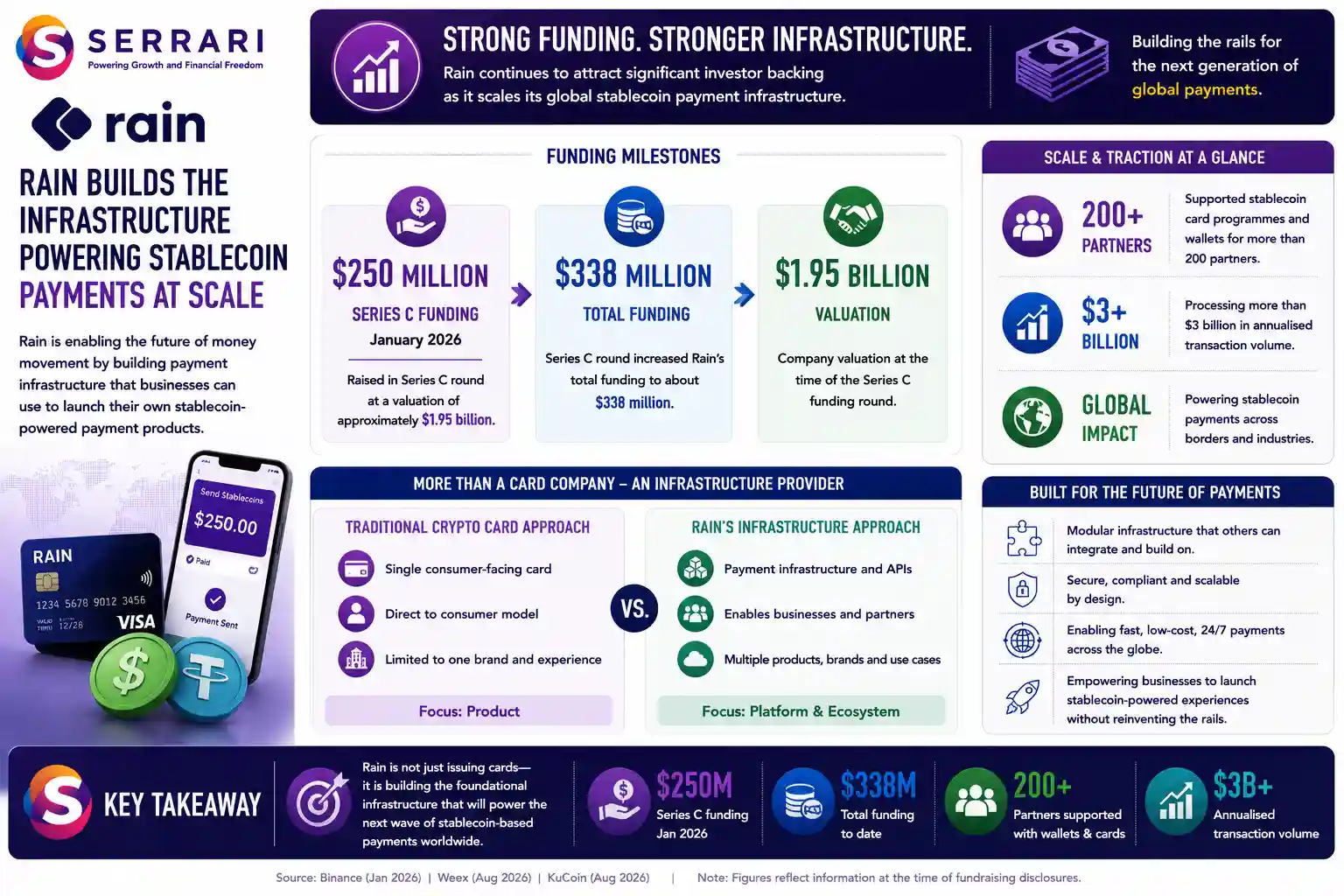
The company raised $250 million in a Series C funding round in January 2026 at a valuation of approximately $1.95 billion.
That transaction increased Rain’s total funding to about $338 million.
At the time of the fundraising, the company said it supported stablecoin card programmes and wallets for more than 200 partners.
Rain was also processing more than $3 billion in annualised transaction volume.
The figures indicate that the company’s strategy extends beyond issuing a single consumer-facing crypto card. Instead, Rain is building infrastructure that other businesses can use to launch their own stablecoin-powered payment products.
Context is everything. Stay ahead of shifting trends with today’s market updates, and uncover emerging opportunities using the Serrari Group Market Index and Marketplace. Then, take control of your own financial future by exploring our Money & Life Reset Transformation Blueprint ™ to build stronger habits, create better systems, and design a path toward lasting wealth.
Mastercard Membership Expands Rain’s Reach
Rain took another major step in May when it became a principal member of Mastercard.
The membership allows the company to offer stablecoin-powered credit and prepaid card products across more than 210 countries and regions.
Rain also maintains a relationship with Visa.
Working with the world’s established card networks provides an important bridge between cryptocurrency infrastructure and traditional commerce.
Visa and Mastercard already connect millions of businesses globally, meaning stablecoin companies do not necessarily need to build an entirely separate merchant acceptance network.
Instead, they can integrate digital assets into payment infrastructure consumers and businesses already use.
Onchain Settlement Could Change Payment Processing
Rain is also exploring the settlement of selected programme flows directly onchain using regulated stablecoins.
That could become a more consequential development than simply allowing consumers to spend stablecoins through cards.
Cards provide the familiar consumer interface, but blockchain settlement potentially changes how money moves behind that interface.
If stablecoin settlement proves cheaper or faster than traditional processes, payment companies could use blockchain technology without requiring consumers or merchants to interact directly with it.
This is why Malik’s claim that merchants may be accepting stablecoin-funded transactions without knowing it is significant.
Mainstream adoption of blockchain payments may not require users to consciously choose blockchain technology. Instead, the technology could increasingly operate as infrastructure underneath familiar financial products.
Rain Explores AI-Powered Payments
Rain is also exploring what Malik described as agentic payments.
The concept involves allowing artificial intelligence agents to execute transactions on behalf of users within predetermined limits.
For example, an AI system could potentially receive a payment card with restrictions governing where, when and how much it is permitted to spend.
Such systems could create another use case for programmable digital assets, although agentic payments remain an emerging area and will require strong security and authorisation controls.
The immediate opportunity for Rain remains connecting stablecoins with conventional payment networks.
Stablecoin Payments Move Closer to Mainstream Finance
The growth of Rain illustrates a broader transformation underway in the stablecoin industry.
Early stablecoin adoption was concentrated heavily within cryptocurrency trading, where dollar-pegged tokens provided a convenient way to move between digital assets.
Today, companies are increasingly developing stablecoins for payments, cross-border settlement and financial infrastructure.
Rain’s reach to more than 100,000 merchants demonstrates how this transition can occur without requiring every business to become a direct participant in the crypto ecosystem.
The next stage will depend on whether stablecoin payments can consistently deliver advantages such as faster settlement, lower costs and greater international accessibility while meeting regulatory and consumer-protection requirements.
FAQs
What are stablecoin payments?
Stablecoin payments involve transferring digital tokens designed to maintain a stable value, usually relative to currencies such as the U.S. dollar. They can be used for purchases, transfers and settlement through blockchain networks.
How many merchants does Rain reach?
Rain CEO Farooq Malik said the company’s stablecoin payment infrastructure is already reaching more than 100,000 merchants. Many merchants may not realise stablecoins are involved because transactions can be processed through established card networks.
How quickly can stablecoin transactions settle?
Malik said transactions processed through Visa’s conventional payment infrastructure can currently take around three days to settle. Merchants choosing direct stablecoin settlement could potentially receive funds on the same day.
How large is Rain’s payments business?
Rain says it supports stablecoin card programmes and wallets for more than 200 partners and processes more than $3 billion in annualised transactions. The company raised $250 million in January 2026 at a valuation of approximately $1.95 billion.
Sources: Kucoin, Binance, Weex, Pymnts, The Block
Your financial future isn’t something you wait for—it’s something you build.
The real question is: when do you begin?
Move beyond simply staying informed.
Navigate the markets with clarity—track trends through the Serrari Group Market Index, uncover opportunities in the Serrari Marketplace, and build practical knowledge with our Curated Wealth Builder Platform.
Stay connected to what truly matters.
Get daily insights on macro trends and financial movements across Kenya, Africa, and global markets—delivered through the Serrari Newsletter.
Growth opens doors.
Advance your career through professional programs including ACCA, HESI A2, ATI TEAS 7 , HESI EXIT , NCLEX – RN and NCLEX – PN, Financial Literacy!🌟—designed to move you forward with confidence.
See where money is flowing—clearly and in real time.
Track Money Market Funds, Treasury Bills, Treasury Bonds, Green Bonds, and Fixed Deposits, alongside global and African indexes, key economic indicators, and the evolving Crypto and stablecoin landscape—all within Serrari’s Market Index.