The U.S. stock market posted strong gains on August 3, 2026, as easing geopolitical tensions between the United States and Iran pushed oil prices sharply lower and boosted investor confidence. The S&P 500, Dow Jones, and Nasdaq all advanced, with technology stocks leading the rally as Wall Street welcomed reduced inflation risks and improving market sentiment ahead of major corporate earnings.
Key Overview
The U.S. stock market climbed after oil prices fell more than 6% following signs of easing U.S.-Iran tensions. The Nasdaq led gains, driven by technology stocks, while the Dow Jones surged to a record high and the S&P 500 finished just below its all-time closing record. Investors also reacted positively to corporate developments, including Boeing’s aircraft certification and JPMorgan’s long-term housing investment initiative.
U.S. Stock Market Surges as Oil Prices Retreat
The U.S. stock market delivered a broad-based rally after investors responded positively to falling energy prices and reduced geopolitical risks in the Middle East.
The S&P 500 rose 110.78 points to close at 7,600.50, finishing only marginally below its all-time closing high of 7,609.78. Meanwhile, the Dow Jones Industrial Average climbed 693.38 points to 53,178.41, reaching a new record high, while the Nasdaq Composite surged 540.04 points to 25,913.90.
The gains reflected renewed confidence across Wall Street, with investors shifting back into growth-oriented assets as concerns over escalating conflict eased.
Falling Oil Prices Boost Investor Sentiment
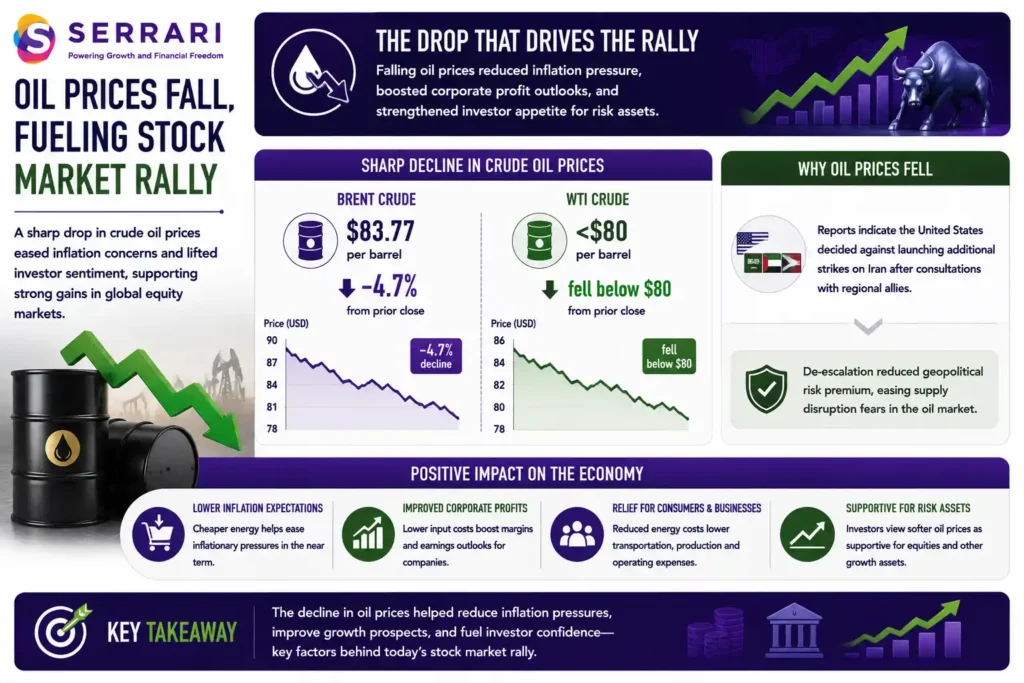
A major driver behind the rally was the sharp decline in crude oil prices.
Brent crude fell roughly 4.7% to around $83.77 per barrel, while West Texas Intermediate (WTI) dropped below $80. The decline followed reports that the United States had held back from launching additional strikes on Iran after consultations with regional allies.
Lower energy prices eased immediate inflation concerns, improving expectations for corporate profitability while reducing pressure on consumers and businesses. As a result, investors viewed the softer oil market as supportive for risk assets.
Context is everything. Stay ahead of shifting trends with today’s market updates, and uncover emerging opportunities using the Serrari Group Market Index and Marketplace. Then, take control of your own financial future by exploring our Money & Life Reset Transformation Blueprint ™ to build stronger habits, create better systems, and design a path toward lasting wealth.
Nasdaq Leads Gains as Technology Stocks Rally
Technology companies led the market higher, helping the Nasdaq outperform other major indices.
The Nasdaq Composite gained 2.3%, while the Nasdaq-100 rose 2%, reflecting renewed investor demand for large-cap technology stocks.
Among the strongest performers were CoreWeave, which surged 17.1%, followed by Nebius Group, up 16.2%. Lumentum Holdings gained 9.7%, while Sandisk advanced 7.8%.
The rebound demonstrated investors’ willingness to rotate back into growth stocks as geopolitical uncertainty eased and inflation fears moderated.
Boeing and Corporate Earnings Support Market Rally
Corporate developments also provided additional support for equities.
Boeing shares climbed 8% after U.S. regulators certified its 737 MAX-7 aircraft, clearing the model for commercial operations and removing a significant regulatory hurdle.
Tyson Foods gained 2.8% after reporting quarterly earnings that exceeded analyst expectations. Management highlighted continued strength in its chicken and prepared foods businesses, reinforcing confidence in consumer demand despite broader economic uncertainty.
Strong corporate performance helped offset lingering concerns surrounding economic growth and supported broader market momentum.
JPMorgan Announces Major Housing Investment
Financial stocks also attracted attention after JPMorgan Chase unveiled a long-term housing initiative.
The bank announced plans to deploy more than $750 billion through 2035 to expand housing supply and improve homeownership opportunities across the United States.
The programme includes financing one million affordable housing units, assisting 500,000 homebuyers, including 200,000 first-time buyers, and increasing mortgage lending by more than 40%.
The announcement reinforced optimism surrounding long-term investment in the U.S. housing market while highlighting continued strength within the financial sector.
Global Markets Deliver Mixed Performance
While U.S. markets rallied, performance across international markets remained mixed.
South Korea’s Kospi Index declined 5.1%, giving back part of the historic 17.9% gain recorded during the previous session as technology shares experienced significant volatility.
Japan’s Nikkei 225 slipped 0.9% after authorities in Japan and the United States confirmed coordinated intervention to support the Japanese yen. Although a stronger yen helps curb imported inflation, it can weigh on Japanese exporters by reducing overseas earnings when converted back into local currency.
The contrasting performances highlighted how regional developments continued to influence investor positioning globally.
Investors Focus on Inflation and the Federal Reserve
Despite the strong rally, investors remain focused on inflation trends and future monetary policy decisions by the Federal Reserve.
Lower oil prices have reduced some immediate inflation concerns, but markets continue to monitor geopolitical developments, economic data and corporate earnings for clues about the outlook for interest rates.
Technology earnings, movements in energy markets and inflation indicators are likely to remain the primary drivers of U.S. equities over the coming weeks as investors assess whether the current market rally can extend further.
FAQs
Why did the U.S. stock market rise?
The U.S. stock market gained as oil prices fell following signs of easing tensions between the United States and Iran, improving investor sentiment and reducing immediate inflation concerns.
Which index performed the best?
The Nasdaq Composite led the rally, rising 2.3%, supported by strong gains in major technology companies.
How did oil prices affect the market?
Lower oil prices reduced concerns about inflation and helped improve expectations for corporate earnings, encouraging investors to buy equities.
What will investors watch next?
Markets will closely monitor Federal Reserve policy expectations, inflation data, corporate earnings and geopolitical developments, all of which could influence the direction of the S&P 500, Dow Jones, and Nasdaq.
Sources: Eurasia Business News, Boston News, Sunsentinel, Stocks Down Under
Your financial future isn’t something you wait for—it’s something you build.
The real question is: when do you begin?
Move beyond simply staying informed.
Navigate the markets with clarity—track trends through the Serrari Group Market Index, uncover opportunities in the Serrari Marketplace, and build practical knowledge with our Curated Wealth Builder Platform.
Stay connected to what truly matters.
Get daily insights on macro trends and financial movements across Kenya, Africa, and global markets—delivered through the Serrari Newsletter.
Growth opens doors.
Advance your career through professional programs including ACCA, HESI A2, ATI TEAS 7 , HESI EXIT , NCLEX – RN and NCLEX – PN, Financial Literacy!🌟—designed to move you forward with confidence.
See where money is flowing—clearly and in real time.
Track Money Market Funds, Treasury Bills, Treasury Bonds, Green Bonds, and Fixed Deposits, alongside global and African indexes, key economic indicators, and the evolving Crypto and stablecoin landscape—all within Serrari’s Market Index.