


















Japan FX intervention intensified after authorities were estimated to have spent up to $36.58 billion purchasing yen to counter its sharp depreciation against the U.S. dollar. The coordinated action between Japan and the United States highlights growing concerns over excessive currency volatility, rising import costs, and inflationary pressures as policymakers seek to stabilize the foreign exchange market.
Key Overview
- Japan may have spent up to $36.58 billion buying yen.
- The intervention followed coordinated action with the United States.
- The Japanese yen strengthened sharply against the U.S. dollar.
- Authorities aim to counter excessive currency weakness.
- Rising import costs and inflation remain key concerns.
- The Bank of Japan maintained its policy interest rate at 1%.
- Traders anticipate further intervention if yen weakness returns.
- Currency markets remain focused on official support for the yen.
Japan FX Intervention Signals Stronger Effort to Support the Japanese Yen
Japan FX intervention has intensified as authorities continue efforts to stabilize the Japanese yen after months of significant depreciation against the U.S. dollar. Central bank liquidity data indicates Japan may have spent as much as $36.58 billion purchasing its currency in the latest intervention, reinforcing government efforts to restore confidence in the foreign exchange market.
The latest operation follows an earlier intervention that market participants estimate involved almost $59 billion, making the recent actions among the largest currency support operations undertaken by Japanese authorities in decades.
Authorities Continue Currency Intervention
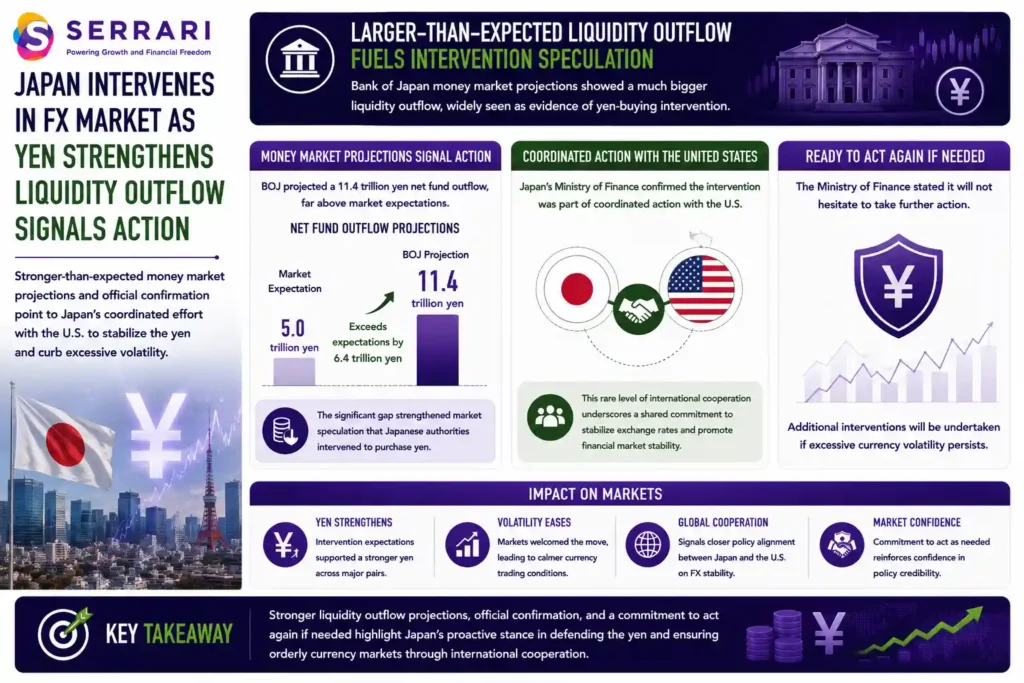
Money market projections released by the Bank of Japan (BOJ) pointed to a substantially larger-than-expected liquidity outflow, a signal widely interpreted by market participants as evidence of fresh currency intervention.
The projected 11.4 trillion yen net fund outflow exceeded market expectations by a considerable margin, strengthening speculation that Japanese authorities had entered the market to purchase yen.
Later, Japan’s Ministry of Finance confirmed that the intervention formed part of coordinated action with the United States, demonstrating a rare level of international cooperation aimed at stabilizing exchange rates.
The ministry also stated that it would not hesitate to undertake additional interventions should excessive currency volatility continue.
Context is everything. Stay ahead of shifting trends with today’s market updates, and uncover emerging opportunities using the Serrari Group Market Index and Marketplace. Then, take control of your own financial future by exploring our Money & Life Reset Transformation Blueprint ™ to build stronger habits, create better systems, and design a path toward lasting wealth.
Yen Strengthens After Official Action
The intervention triggered significant movements in the USD/JPY exchange rate.
The Japanese yen initially appreciated by as much as 1.4% against the U.S. dollar before surrendering part of those gains as trading progressed. Despite the partial reversal, the currency remained noticeably stronger than before the intervention.
Against the Singapore dollar, the yen also strengthened by approximately 1% during early trading before settling higher later in the session.
Since the initial intervention at the end of July, the Japanese currency has appreciated by more than 3% against the Singapore dollar, highlighting the immediate impact official market operations can have on exchange rates.
Weak Yen Continues to Pressure the Economy
Japan’s intervention reflects broader concerns about the economic consequences of prolonged yen weakness.
A depreciating currency increases the cost of imported goods, particularly energy and food, placing additional pressure on household budgets while contributing to higher inflation.
Although inflation has gradually returned after years of deflation, policymakers remain concerned that excessive import-driven price increases could weaken consumer spending and slow economic growth.
The weaker yen has also become an increasingly sensitive political issue as rising living costs affect households across the country.
Bank of Japan Maintains Monetary Policy
Despite intervening in the currency market, the Bank of Japan (BOJ) maintained its benchmark policy interest rate at 1%.
The decision reflects the BOJ’s continued effort to balance domestic economic support with financial market stability.
While interest rate policy remains unchanged, currency intervention allows authorities to influence exchange rates directly without altering broader monetary policy settings.
This separation enables policymakers to respond to excessive currency volatility while maintaining their longer-term economic objectives.
Coordinated Action Strengthens Market Confidence
The confirmation of joint intervention by Japan and the United States added credibility to the government’s efforts.
Currency interventions conducted with international cooperation often carry greater influence because they demonstrate broader policy alignment among major economies.
Market participants interpreted the coordinated approach as a signal that authorities are prepared to act decisively if speculative pressure continues driving the yen lower.
Analysts noted that breaking key technical levels on the USD/JPY chart could discourage speculative positioning against the Japanese currency.
Traders Watch for Further Intervention
Attention is now shifting toward whether Japanese authorities will intervene again.
Under the International Monetary Fund’s framework, a freely floating currency may still experience limited official intervention provided such actions remain infrequent and short-lived.
Following interventions on July 30 and July 31, market participants believe Japanese authorities retain room for additional operations should exchange rate volatility intensify.
Rabobank also noted that speculative short positions against the yen had reached their highest levels since 2024 immediately before the coordinated intervention, suggesting authorities acted as market positioning became increasingly one-sided.
Japan FX Intervention Remains Central to Currency Markets
The latest Japan FX intervention demonstrates that authorities remain committed to limiting excessive depreciation in the Japanese yen despite challenging global financial conditions.
With inflation concerns, geopolitical tensions and diverging interest rate expectations continuing to influence currency markets, investors are likely to remain focused on both official intervention activity and future policy decisions from the Bank of Japan and the Ministry of Finance.
As long as the yen remains under pressure, expectations of further central bank intervention are likely to remain an important driver of the forex market.
FAQs
Why is Japan intervening in the foreign exchange market?
Japan FX intervention is intended to strengthen the Japanese yen and reduce excessive currency volatility that increases import costs and contributes to inflation.
How much may Japan have spent supporting the yen?
Central bank data suggests Japanese authorities may have spent up to $36.58 billion purchasing yen during the latest intervention.
Did the Bank of Japan change interest rates?
No. The Bank of Japan (BOJ) maintained its policy interest rate at 1%, using currency intervention rather than monetary policy changes to support the yen.
Could Japan intervene again?
Yes. Japanese officials have stated they are prepared to take further action if excessive volatility returns to the foreign exchange market, and traders continue to monitor the possibility of additional interventions.
Sources: Yahoo Finance, Reuters, Fx Street, The Straits Times, Market Screener
Your financial future isn’t something you wait for—it’s something you build.
The real question is: when do you begin?
Move beyond simply staying informed.
Navigate the markets with clarity—track trends through the Serrari Group Market Index, uncover opportunities in the Serrari Marketplace, and build practical knowledge with our Curated Wealth Builder Platform.
Stay connected to what truly matters.
Get daily insights on macro trends and financial movements across Kenya, Africa, and global markets—delivered through the Serrari Newsletter.
Growth opens doors.
Advance your career through professional programs including ACCA, HESI A2, ATI TEAS 7 , HESI EXIT , NCLEX – RN and NCLEX – PN, Financial Literacy!🌟—designed to move you forward with confidence.
See where money is flowing—clearly and in real time.
Track Money Market Funds, Treasury Bills, Treasury Bonds, Green Bonds, and Fixed Deposits, alongside global and African indexes, key economic indicators, and the evolving Crypto and stablecoin landscape—all within Serrari’s Market Index.