The Airtel Africa share buyback programme has been expanded after the telecommunications group increased the maximum value of discretionary repurchases from $50 million to $65 million. The company has been buying its shares through Barclays Capital Securities Limited and cancelling them after purchase. Since the programme began on May 22, 2026, Airtel Africa has repurchased more than 18 million ordinary shares, demonstrating an increasingly active approach to capital allocation and shareholder returns.
Key Overview
Airtel Africa increased the discretionary component of its share repurchase programme by $15 million, raising the maximum from $50 million to $65 million. The programme operates alongside a non-discretionary component of up to $60 million. During the week ended August 14, the company continued purchasing shares across several European trading venues, with transactions executed through Barclays Capital Securities Limited.
Airtel Africa Expands Share Buyback Programme
Airtel Africa has increased the maximum aggregate amount available for discretionary share repurchases, extending a programme that has already resulted in millions of shares being removed from circulation.
Under its amended agreement with Barclays Capital Securities Limited, the discretionary purchase limit has increased by $15 million, from $50 million to $65 million.
The company also has a non-discretionary element of up to $60 million, giving Airtel Africa additional capacity to continue repurchasing shares under the broader programme.
The decision represents another significant capital allocation move by one of Africa’s largest telecommunications companies.
More Than 18 Million Shares Repurchased
The Airtel Africa share buyback began on May 22, 2026.
Since then, the company has repurchased approximately 18.34 million ordinary shares at an overall volume-weighted average price of around 337.11 pence per share, according to the figures provided.
Shares acquired through the programme are intended to be cancelled rather than retained as treasury shares.
Cancellation reduces the number of ordinary shares outstanding, meaning the ownership represented by each remaining share increases slightly, assuming other factors remain unchanged.
This can potentially support measures such as earnings per share because future profits are distributed across fewer outstanding shares. However, buybacks do not automatically create shareholder value—the outcome ultimately depends on the price paid for the shares and the company’s alternative uses for that capital.
Airtel Africa Continues Buying in August
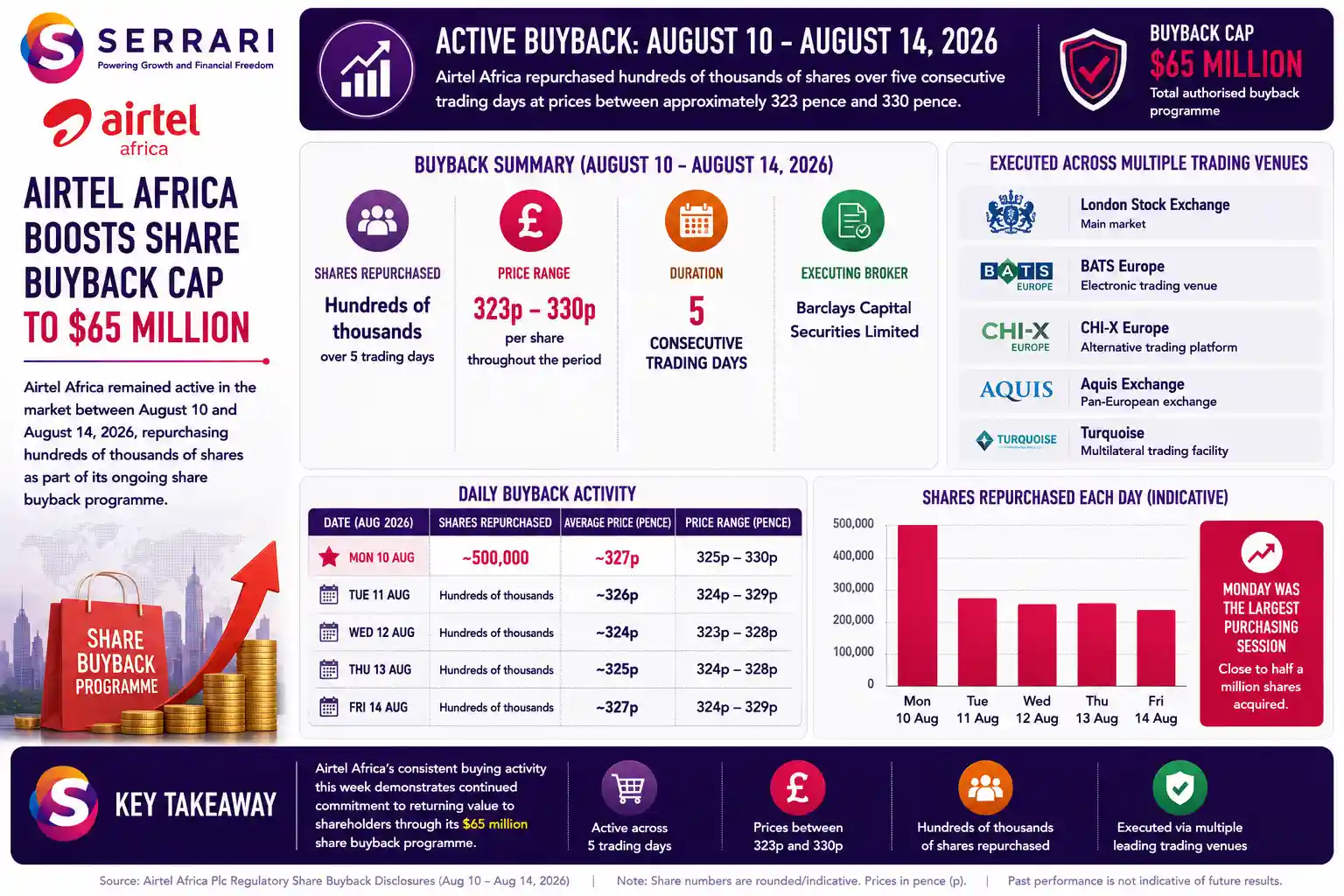
Airtel Africa remained active in the market between August 10 and August 14.
The company’s disclosures indicate that hundreds of thousands of shares were purchased during the five-day period, with prices generally ranging between approximately 323 pence and 330 pence.
Transactions were executed through Barclays Capital Securities Limited across multiple trading venues, including the London Stock Exchange, BATS Europe, CHI-X Europe, Aquis Exchange and Turquoise.
Monday represented the largest purchasing session of the period, with close to half a million shares acquired.
Purchases continued throughout the remainder of the week at average prices generally around 324 pence to 327 pence.
Why Airtel Africa Is Cancelling Its Shares
The cancellation component is particularly important for investors assessing the programme.
When a company repurchases and cancels its own company shares, the total number of outstanding shares falls permanently unless new shares are subsequently issued.
Suppose a company generates the same level of earnings after reducing its share count. In that case, earnings per share can rise because those earnings are divided among fewer shares.
The same principle can potentially apply to dividends per share if the company maintains the same overall dividend expenditure.
However, investors should distinguish between improvements in per-share financial metrics caused by a declining share count and improvements generated through underlying business growth.
For Airtel Africa, the effectiveness of the programme will therefore depend partly on whether the company is purchasing shares below what management considers their long-term intrinsic value.
Context is everything. Stay ahead of shifting trends with today’s market updates, and uncover emerging opportunities using the Serrari Group Market Index and Marketplace. Then, take control of your own financial future by exploring our Money & Life Reset Transformation Blueprint ™ to build stronger habits, create better systems, and design a path toward lasting wealth.
$65 Million Cap Signals Capital Allocation Confidence
Increasing the discretionary limit from $50 million to $65 million suggests Airtel Africa remains willing to deploy additional capital into its own stock.
For shareholders, the decision can be interpreted as a signal that management considers repurchases an attractive use of available capital alongside other priorities.
Telecommunications companies typically face significant demands on cash, including network expansion, spectrum purchases, technology upgrades, debt servicing and dividends.
Consequently, capital allocation decisions require management to balance shareholder distributions against investment needed to maintain and expand operations.
A larger buyback therefore needs to be assessed within Airtel Africa’s wider financial position rather than viewed in isolation.
What the Buyback Means for Shareholder Returns
Share repurchases are one of several mechanisms companies use to return capital to investors.
Unlike dividends, which distribute cash directly to shareholders, buybacks return capital primarily to investors who sell their shares into the market.
Remaining shareholders potentially benefit from owning a larger proportional interest in the company.
Buybacks can also provide additional market demand for a company’s shares, although this does not guarantee that the share price will rise.
For investors in African telecom stocks, Airtel Africa’s programme may nevertheless provide an additional factor when evaluating shareholder returns alongside earnings growth, dividends and operating performance.
Investor Sentiment and Airtel Africa Shares
The expansion also comes at a time when investors continue to assess telecommunications companies against changing economic conditions across African markets.
Currency movements, inflation, interest rates and consumer spending can all affect telecom operators operating across multiple jurisdictions.
Against that backdrop, an expanded Airtel Africa share buyback may support investor sentiment by demonstrating confidence in the group’s financial capacity to return capital.
Still, investors should avoid interpreting a buyback alone as proof that shares are undervalued.
Management may have several motivations for repurchases, and the long-term impact depends heavily on operating performance, valuation and financial discipline.
Buyback Strengthens Airtel Africa’s Capital Return Strategy
Airtel Africa’s decision to raise its discretionary repurchase ceiling provides the company with greater flexibility to continue buying shares.
With more than 18 million shares already repurchased since May, the programme has become a meaningful part of the group’s approach to shareholder capital.
Cancellation of the acquired shares should gradually reduce the outstanding share count as the programme progresses.
The expanded $65 million discretionary limit also indicates that management remains prepared to commit additional resources to repurchases.
For investors, the key question will be whether the Airtel Africa share buyback ultimately complements sustainable earnings growth and dividends while allowing the company to maintain sufficient investment in its telecommunications operations.
FAQs
What is the Airtel Africa share buyback?
The Airtel Africa share buyback is a programme under which the telecommunications company purchases its own ordinary shares from the market. The repurchased shares are subsequently cancelled, reducing the company’s total number of outstanding shares.
How much has Airtel Africa allocated to its share buyback?
Airtel Africa increased the maximum aggregate amount for discretionary purchase orders by $15 million, raising the limit from $50 million to $65 million. This operates alongside a non-discretionary component of up to $60 million.
How many shares has Airtel Africa repurchased?
Since launching the programme on May 22, 2026, Airtel Africa has repurchased more than 18 million ordinary shares. The shares were acquired through Barclays Capital Securities Limited and are intended to be cancelled.
Why do companies conduct share buybacks?
Companies may repurchase shares to return excess capital to shareholders, reduce the number of shares outstanding or take advantage of a share price management believes undervalues the business. Buybacks can improve per-share financial measures when earnings remain stable or grow, but their effectiveness depends on the purchase price and the company’s underlying financial performance.
Sources: Punch Ng, Investegate, Boss fm Nigeria
Your financial future isn’t something you wait for—it’s something you build.
The real question is: when do you begin?
Move beyond simply staying informed.
Navigate the markets with clarity—track trends through the Serrari Group Market Index, uncover opportunities in the Serrari Marketplace, and build practical knowledge with our Curated Wealth Builder Platform.
Stay connected to what truly matters.
Get daily insights on macro trends and financial movements across Kenya, Africa, and global markets—delivered through the Serrari Newsletter.
Growth opens doors.
Advance your career through professional programs including ACCA, HESI A2, ATI TEAS 7 , HESI EXIT , NCLEX – RN and NCLEX – PN, Financial Literacy!🌟—designed to move you forward with confidence.
See where money is flowing—clearly and in real time.
Track Money Market Funds, Treasury Bills, Treasury Bonds, Green Bonds, and Fixed Deposits, alongside global and African indexes, key economic indicators, and the evolving Crypto and stablecoin landscape—all within Serrari’s Market Index.