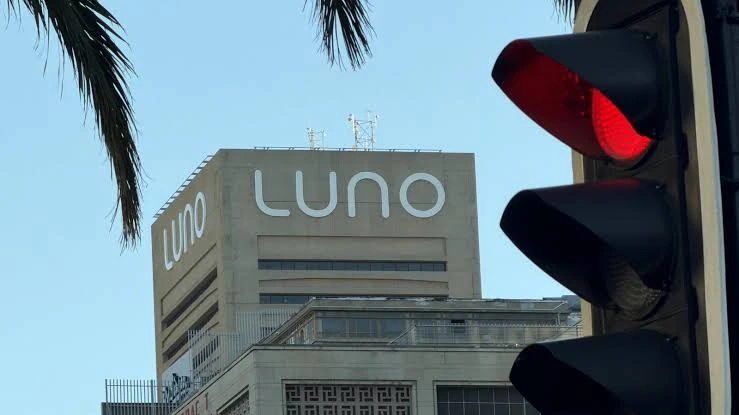
The Luno workforce reduction marks another phase of restructuring for the cryptocurrency exchange as it adapts to lower trading activity and changing market conditions. The company is shifting its strategy toward serving institutional investors while reducing costs amid a broader slowdown across the crypto industry.
Key Overview
- Luno to reduce approximately 20% of its global workforce.
- Company restructures to strengthen institutional business.
- South African crypto trading volumes have fallen sharply.
- Retail crypto activity remains below 2021 peak levels.
- Luno continues operating under South Africa’s crypto regulations.
- Exchange serves approximately 16 million users globally.
- Industry-wide restructuring continues across digital asset firms.
- Cost efficiency replaces rapid expansion as the sector matures.
Luno Workforce Reduction Reflects Crypto Industry’s Shift Toward Institutional Growth
The Luno workforce reduction highlights the continued transformation taking place across the global crypto industry, as companies prioritize profitability and institutional services over aggressive expansion. The cryptocurrency exchange, which originated in South Africa and now operates internationally, has announced plans to reduce approximately 20% of its global workforce as part of a broader business restructuring programme.
According to Chief Executive Officer James Lanigan, the restructuring is intended to better align the business with current market conditions while accelerating the company’s focus on its business-to-business operations. The latest move comes as cryptocurrency trading volumes remain significantly below the highs recorded during the digital asset boom of 2021.
Luno Announces Global Workforce Reduction
Leading cryptocurrency exchange Luno confirmed that it will reduce around 20% of its global workforce as it reorganises its operations.
Chief Executive Officer James Lanigan said the restructuring is designed to improve operational efficiency by reducing costs while expanding the company’s institutional and enterprise-focused business. Although the exchange did not disclose the exact number of employees affected, the workforce reduction represents one of the company’s most significant organisational changes since its earlier restructuring in 2023.
The latest decision reflects a broader trend across the crypto market, where companies are increasingly prioritising sustainable profitability rather than rapid customer acquisition.
Institutional Business Becomes Strategic Priority
A key objective of the Luno workforce reduction is strengthening the company’s business-to-business division.
Rather than focusing primarily on retail cryptocurrency trading, Luno intends to expand services for institutional investors, corporate clients and professional market participants. This strategic shift mirrors broader developments across the digital asset industry, where institutional demand continues to grow despite weaker retail trading activity.
Serving institutional clients typically generates more predictable revenue through custody, trading infrastructure and liquidity services, providing exchanges with greater resilience during periods of lower retail market activity.
South African Crypto Trading Volumes Decline
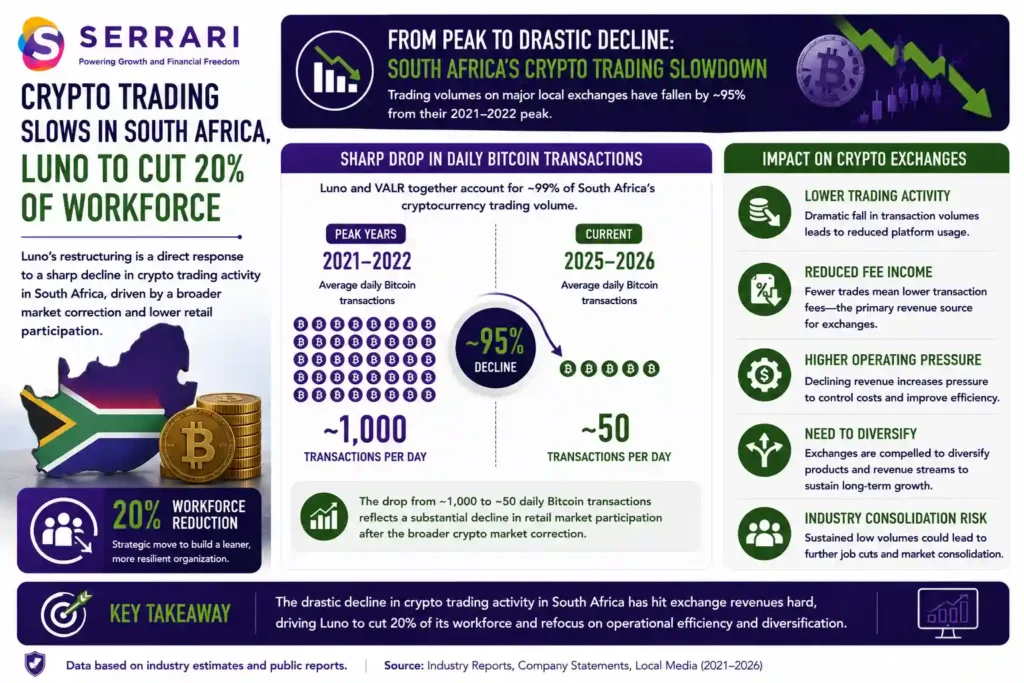
The restructuring follows a significant slowdown in cryptocurrency trading activity within South Africa.
According to industry estimates, Luno and fellow exchange VALR, which together account for approximately 99% of South Africa’s cryptocurrency trading volume, previously processed an average of around 1,000 Bitcoin transactions per day during the peak years of 2021 and 2022.
Current daily trading volumes have reportedly fallen to approximately 50 Bitcoin transactions, illustrating the substantial decline in retail market participation following the broader cryptocurrency market correction.
Lower trading activity has reduced transaction fee income, increasing pressure on exchanges to streamline operations and diversify their business models.
Context is everything. Stay ahead of shifting trends with today’s market updates, and uncover emerging opportunities using the Serrari Group Market Index and Marketplace. Then, take control of your own financial future by exploring our Money & Life Reset Transformation Blueprint ™ to build stronger habits, create better systems, and design a path toward lasting wealth.
Regulatory Leadership Continues Despite Restructuring
Despite the workforce reduction, Luno remains an important participant in South Africa’s regulated digital asset ecosystem.
The exchange became the first cryptocurrency platform to receive licensing under South Africa’s Financial Advisory and Intermediary Services (FAIS) Act, following the classification of crypto assets as regulated financial products.
The regulatory approval strengthened Luno’s position within one of Africa’s most advanced cryptocurrency markets and provided a solid foundation for expanding institutional financial services under an established regulatory framework.
Industry Continues Cost-Cutting Measures
The Luno workforce reduction forms part of a wider restructuring trend across the global crypto industry.
Following the cryptocurrency boom of 2021 and the subsequent market downturn in 2022, many digital asset companies have shifted their priorities from aggressive hiring to operational efficiency. Exchanges, blockchain firms and cryptocurrency service providers have increasingly focused on controlling costs while seeking more stable revenue streams.
Luno itself previously reduced approximately 35% of its workforce in January 2023, eliminating nearly 330 positions after the collapse of several high-profile cryptocurrency businesses, including FTX. The latest restructuring differs in that it reflects a strategic repositioning rather than an immediate response to market turmoil.
Industry employment tracker CryptoJobsList reports thousands of layoffs and restructurings across cryptocurrency and related fintech companies during 2026, illustrating the continued adjustment taking place throughout the sector.
Luno Maintains Global Presence
Although founded in South Africa, Luno has evolved into an international digital assets platform.
The company is headquartered in London and operates across Africa and the Asia-Pacific region. It reports serving approximately 16 million customers worldwide and remains part of Digital Currency Group, one of the world’s largest digital asset investment groups.
Its broad geographic footprint provides access to multiple markets as cryptocurrency adoption continues expanding beyond traditional retail investors.
Outlook for Luno and the Crypto Industry
The Luno workforce reduction reflects the ongoing evolution of the global crypto industry as companies adapt to a more mature market environment. Rather than pursuing rapid expansion, many firms are now concentrating on operational efficiency, regulatory compliance and institutional financial services.
While cryptocurrency trading volumes remain below previous highs, demand for regulated digital assets infrastructure continues to develop, particularly among professional investors and financial institutions. Luno’s decision to strengthen its institutional business suggests the company is positioning itself for the next stage of industry growth, where sustainable business models and regulated financial services are expected to play a larger role across fintech Africa and global cryptocurrency markets.
FAQs
Why is Luno reducing its workforce?
The Luno workforce reduction is part of a restructuring programme aimed at lowering operating costs and expanding the company’s business-to-business and institutional services in response to current market conditions.
How much of Luno’s workforce is being affected?
Luno has announced plans to reduce approximately 20% of its global workforce, although the company has not disclosed the exact number of employees affected.
Why has South African crypto trading declined?
Trading volumes have fallen significantly since the cryptocurrency boom of 2021 and 2022 as retail investor activity slowed following the broader market correction, resulting in lower transaction volumes across major exchanges.
What does the restructuring mean for Luno’s future?
The restructuring indicates that Luno is shifting its focus toward institutional investors, regulated financial services and long-term operational sustainability while continuing to serve its approximately 16 million users across Africa and the Asia-Pacific region.
Sources: Yahoo Finance, Bitke, Trading View, Techpoint Africa, Kucoin
Your financial future isn’t something you wait for—it’s something you build.
The real question is: when do you begin?
Move beyond simply staying informed.
Navigate the markets with clarity—track trends through the Serrari Group Market Index, uncover opportunities in the Serrari Marketplace, and build practical knowledge with our Curated Wealth Builder Platform.
Stay connected to what truly matters.
Get daily insights on macro trends and financial movements across Kenya, Africa, and global markets—delivered through the Serrari Newsletter.
Growth opens doors.
Advance your career through professional programs including ACCA, HESI A2, ATI TEAS 7 , HESI EXIT , NCLEX – RN and NCLEX – PN, Financial Literacy!🌟—designed to move you forward with confidence.
See where money is flowing—clearly and in real time.
Track Money Market Funds, Treasury Bills, Treasury Bonds, Green Bonds, and Fixed Deposits, alongside global and African indexes, key economic indicators, and the evolving Crypto and stablecoin landscape—all within Serrari’s Market Index.