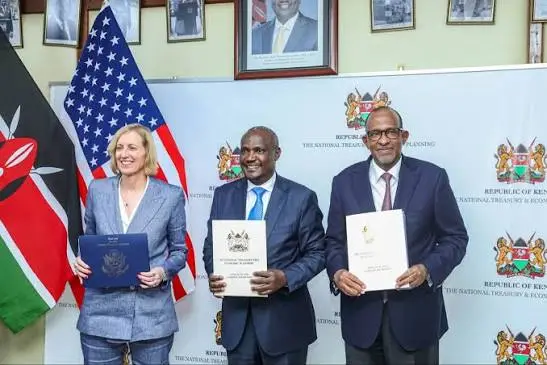
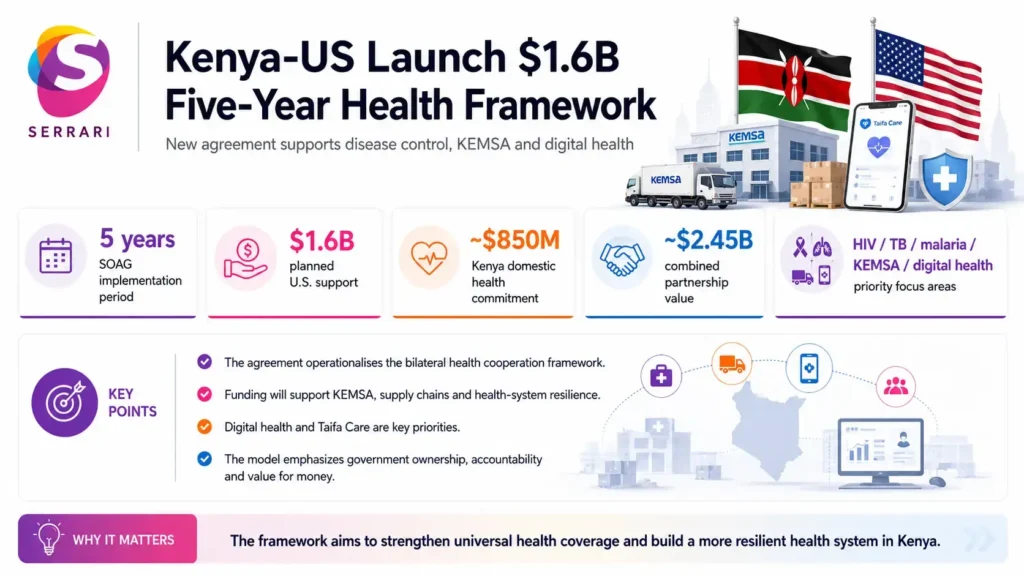
Kenya and the United States have signed a five-year Strategic Objective Grant Agreement that formally operationalises their bilateral Health Cooperation Framework.
The agreement provides a structured mechanism for aligning U.S. health financing with Kenya’s national priorities, including HIV, tuberculosis, malaria, maternal and child health, disease surveillance, health supply chains and digital transformation.
Under the wider framework, the United States plans to provide up to US$1.6 billion over five years, while Kenya has committed approximately US$850 million in additional domestic health spending. Together, the commitments bring the partnership’s stated value to about US$2.45 billion.
Key Overview
- The Strategic Objective Grant Agreement covers a five-year period.
- The United States plans to provide up to US$1.6 billion.
- Kenya has pledged approximately US$850 million in additional domestic health spending.
- Priority areas include HIV, tuberculosis, malaria, KEMSA, digital health and system resilience.
- The agreement promotes a government-to-government funding model.
- Implementation follows months of legal, technical and data-governance discussions.
New Agreement Moves Framework Into Implementation
The July 2026 signing does not represent the first announcement of the Kenya–U.S. health partnership. The wider bilateral framework was initially signed in Washington on 4 December 2025.
The newly signed Strategic Objective Grant Agreement provides the implementation and accountability structure needed to translate that framework into funded programmes. According to the latest signing announcement, the agreement establishes clearer objectives, funding commitments and monitoring requirements.
The original framework was described by the United States as a five-year health partnership valued at approximately US$2.5 billion. That total includes up to US$1.6 billion in planned U.S. support and Kenya’s commitment to increase domestic health spending by roughly US$850 million.
Health Cabinet Secretary Aden Duale said the signing followed months of technical engagement focused on strengthening local institutions, supply chains and health-system capacity.
Disease Programmes Remain a Major Priority
The framework will continue supporting programmes targeting HIV and AIDS, tuberculosis, malaria and other infectious diseases.
These programmes have historically depended heavily on international funding for medicines, testing, laboratory systems, community outreach and health-worker support. The new model aims to maintain essential services while gradually increasing Kenya’s responsibility for financing and managing them.
The U.S. government’s original framework announcement also identified maternal and child health, polio eradication, disease surveillance and outbreak preparedness as priority areas.
A gradual transition is important because abrupt funding reductions could disrupt treatment continuity, commodity procurement and health-worker contracts. The framework is therefore intended to combine continued external support with greater domestic financing over the five-year period.
KEMSA and Supply Chains Targeted for Reform
Strengthening the Kenya Medical Supplies Authority is among the agreement’s central priorities.
KEMSA is responsible for procuring, storing and distributing medicines and health commodities to public facilities. Weak forecasting, delayed payments, stock shortages and governance concerns have repeatedly affected the reliability of Kenya’s medical supply system.
The partnership is expected to support stronger procurement controls, inventory management and distribution systems. Improving these functions would help ensure that medicines financed through both domestic and international resources reach facilities more consistently.
The Ministry of Health has also emphasised local manufacturing and supply resilience. Kenya’s 2026–2030 manufacturing strategy seeks to reduce dependence on imported health products and build domestic production capacity.
Context is everything. Stay ahead of shifting trends with today’s market updates, and uncover emerging opportunities using the Serrari Group Market Index and Marketplace. Then, take control of your own financial future by exploring our Money & Life Reset Transformation Blueprint ™ to build stronger habits, create better systems, and design a path toward lasting wealth.
Digital Health Investment Brings Opportunity and Scrutiny
Digital health transformation is another major component of the agreement. Planned investments are expected to strengthen health-information systems, improve programme monitoring and support Taifa Care, Kenya’s universal health coverage model.
Better data can help authorities identify disease outbreaks, track medicine use and allocate resources more effectively. Integration across the Social Health Authority, Digital Health Agency, hospitals and public-health programmes could also improve continuity of care.
However, data governance has been one of the most contested aspects of the partnership. In December 2025, Kenya’s High Court temporarily suspended implementation following a petition raising concerns about privacy, public participation and oversight of health data.
The Court of Appeal temporarily lifted the blocking orders in May 2026, allowing implementation to proceed while the legal appeal continued.
The government has maintained that Kenyan law will govern the handling of citizens’ health information. Transparent safeguards, independent oversight and clear limits on data access will nevertheless remain essential to maintaining public trust.
Funding Model Shifts Toward Government Ownership
The framework reflects a wider change in how the United States delivers global health assistance. Rather than relying mainly on international contractors and non-governmental organisations, more funding is expected to flow through government systems.
Duale said the model will be anchored in national ownership, transparency, accountability and value for money. The approach could strengthen Kenyan institutions by embedding planning, procurement and implementation within public agencies.
It also creates additional responsibility. Government systems must demonstrate that funds are protected, procurement is competitive, services are measured accurately and county governments are fully involved.
Kenya’s devolved health structure means national institutions cannot implement the agreement alone. Counties manage most frontline services and will need reliable financing, commodities, workers and data systems if the programme is to achieve nationwide results.
Long-Term Success Depends on Sustainable Transition
The framework has the potential to preserve critical disease programmes while strengthening Kenya’s path towards universal health coverage.
Its success will depend not only on the amount committed but also on whether funds are released on schedule, institutions meet accountability requirements and Kenya steadily increases its own health financing.
The partnership must also balance ambitious digital integration with strong privacy protections and public transparency.
If those conditions are met, the five-year framework could improve disease control, strengthen KEMSA, modernise health systems and reduce Kenya’s long-term dependence on external financing without disrupting essential services.
Sources: KBC Digital / United States Department of State / Kenya Ministry of Health / Reuters / Capital Business
Your financial future isn’t something you wait for—it’s something you build.
The real question is: when do you begin?
Move beyond simply staying informed.
Navigate the markets with clarity—track trends through the Serrari Group Market Index, uncover opportunities in the Serrari Marketplace, and build practical knowledge with our Curated Wealth Builder Platform.
Stay connected to what truly matters.
Get daily insights on macro trends and financial movements across Kenya, Africa, and global markets—delivered through the Serrari Newsletter.
Growth opens doors.
Advance your career through professional programs including ACCA, HESI A2, ATI TEAS 7 , HESI EXIT , NCLEX – RN and NCLEX – PN, Financial Literacy!🌟—designed to move you forward with confidence.
See where money is flowing—clearly and in real time.
Track Money Market Funds, Treasury Bills, Treasury Bonds, Green Bonds, and Fixed Deposits, alongside global and African indexes, key economic indicators, and the evolving Crypto and stablecoin landscape—all within Serrari’s Market Index.