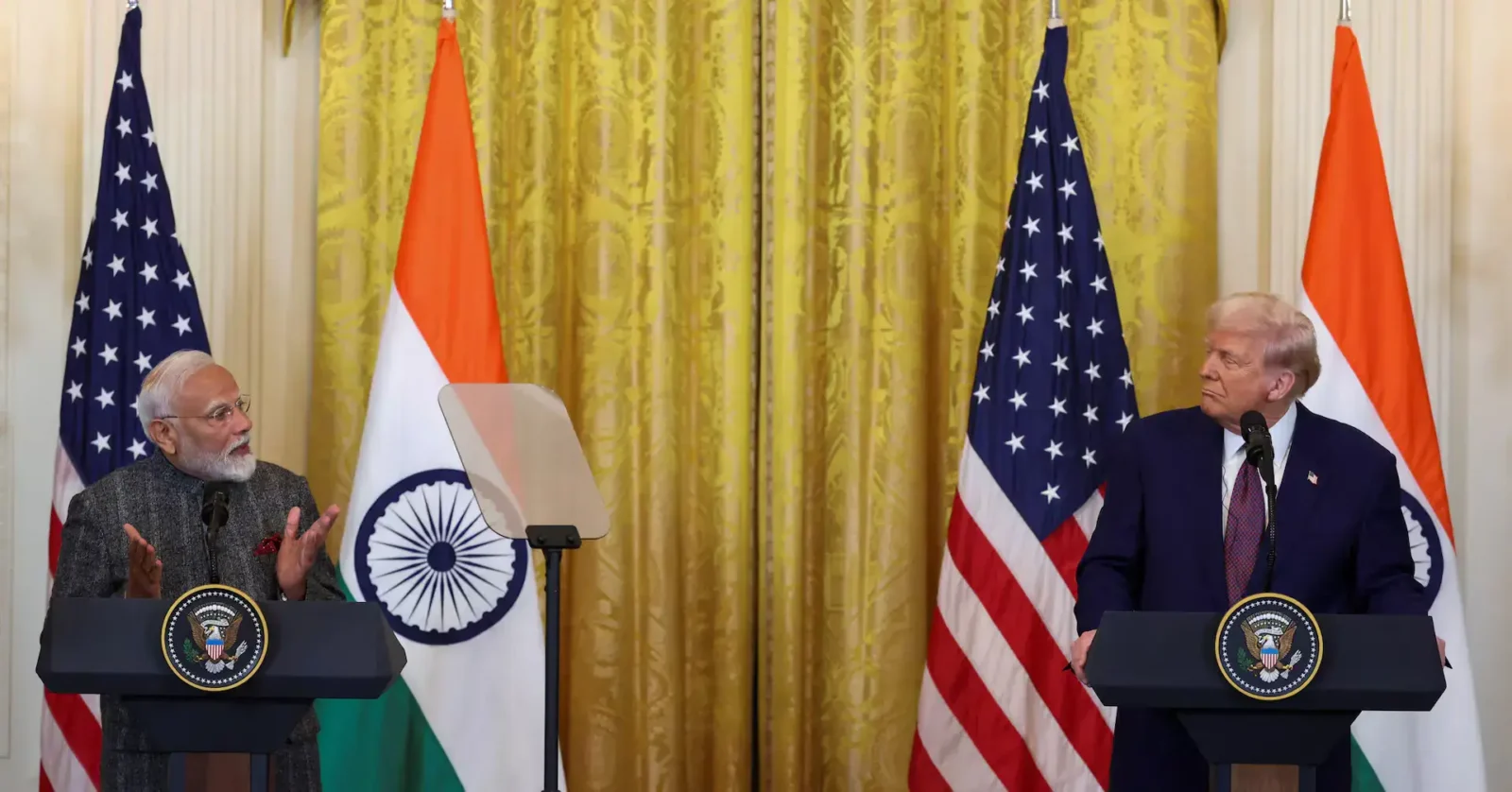
India-US trade negotiations have reached a difficult stage, with Indian Finance Minister Nirmala Sitharaman saying the two sides have reached a point where further concessions are increasingly difficult.
The stalemate comes despite more than a year of negotiations and a trade framework announced earlier in 2026. New US tariff powers linked to purchases of Russian energy have complicated the negotiations further, leaving India balancing access to its largest export market against energy-security considerations and domestic economic pressures.
Both governments say negotiations are continuing, but officials on both sides have publicly signalled that a final agreement is not imminent.
Key Overview
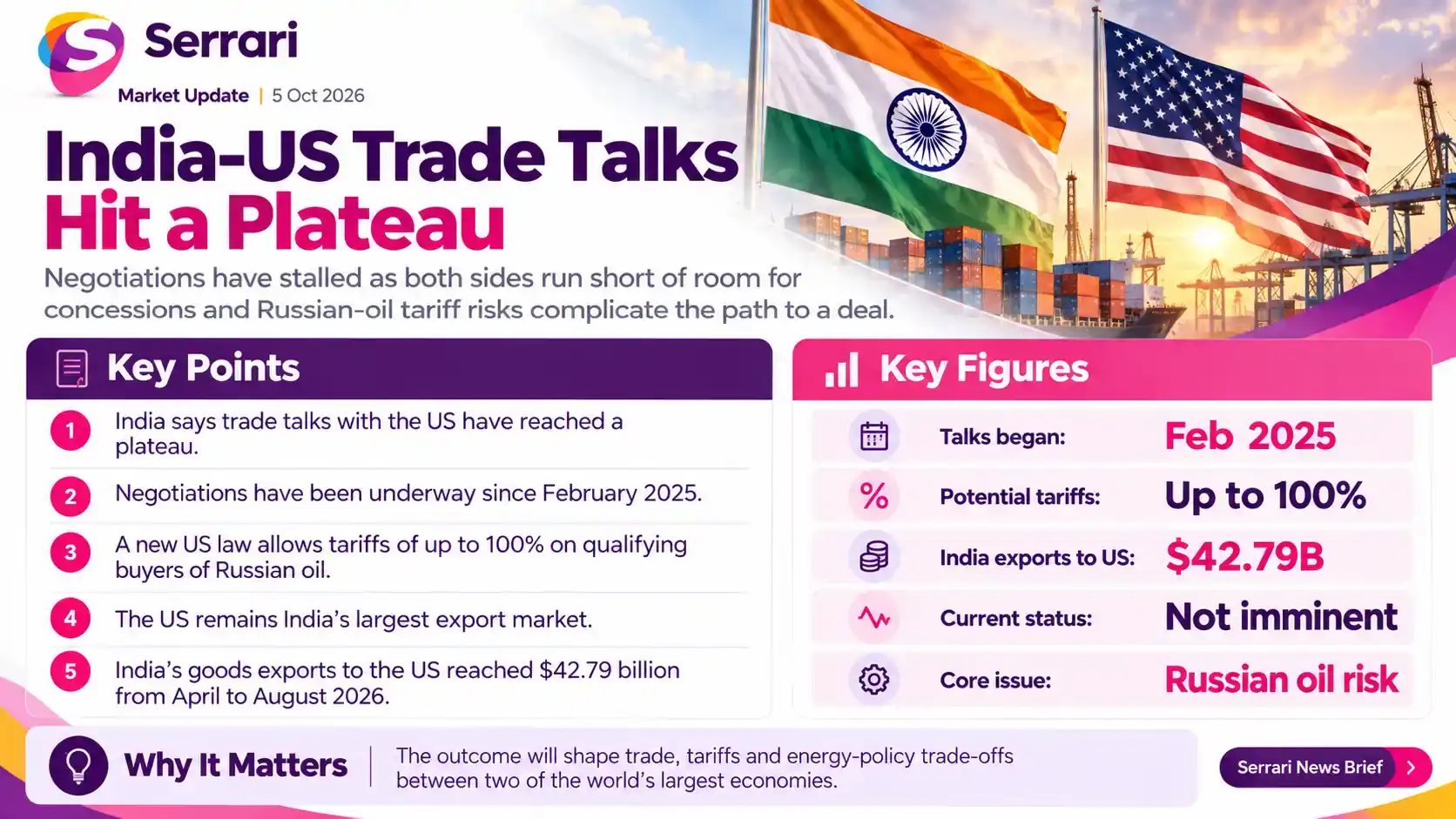
- India says trade negotiations with the US have reached a “plateau”, leaving limited space for further concessions.
- The two countries have been negotiating a bilateral trade agreement since 2025.
- A February 2026 framework lowered punitive US tariffs on many Indian products, but a final comprehensive agreement remains unfinished.
- New US legislation allows tariffs of up to 100% on qualifying major buyers of Russian crude oil or natural gas.
- India remains one of the largest purchasers of Russian oil, making energy policy a major factor in the trade negotiations.
- The US remains India’s largest export destination, with merchandise exports reaching $42.79 billion between April and August 2026.
Negotiations Reach a Difficult Stage
Sitharaman offered one of New Delhi’s clearest acknowledgements yet that the negotiations are struggling, saying trade talks have reached a plateau while stressing that discussions are continuing.
Her comments followed a similar signal from Washington. After discussions with Indian Commerce and Industry Minister Piyush Goyal, US Trade Representative Jamieson Greer said that although negotiators had identified the remaining sticking points, a final agreement was not imminent and further work was still required.
The current difficulties follow substantial progress earlier in the year. The two countries announced a trade framework in February 2026 aimed at reducing tariff and non-tariff barriers and deepening bilateral commerce.
That framework lowered punitive tariffs on most Indian goods from 50% to 18%, although subsequent US legal and trade-policy changes altered the tariff environment again.
The negotiations nevertheless remain focused on longstanding issues including market access, agricultural products, tariff certainty and the bilateral trade imbalance.
Context is everything. Stay ahead of shifting trends with today’s market updates, and uncover emerging opportunities using the Serrari Group Market Index and Marketplace. Then, take control of your own financial future by exploring our Money & Life Reset Transformation Blueprint ™ to build stronger habits, create better systems, and design a path toward lasting wealth.
Russian Oil Adds a New Trade Complication
The biggest new uncertainty comes from US legislation targeting countries that continue purchasing Russian energy.
A law enacted on September 18 gives the US president authority to impose duties of up to 100% on goods from countries meeting defined criteria related to Russian crude oil or natural-gas purchases and sanctions evasion.
The measure focuses in part on countries ranking among the five largest buyers of Russian crude oil or natural gas. India’s continued purchases therefore create a potentially significant source of trade risk.
For New Delhi, the calculation is complicated. India relies heavily on imported energy and has purchased substantial volumes of discounted Russian crude since Russia’s full-scale invasion of Ukraine in 2022.
A sharp reduction in those supplies could increase procurement costs and place pressure on domestic fuel prices or public finances. Continuing large purchases, however, exposes Indian exporters to the possibility of significantly higher US tariffs.
The legislation provides scope for adjustments and waivers, meaning the maximum tariff is not automatically imposed simply because a country buys Russian energy. Even so, the additional authority has increased uncertainty around the final tariff treatment India could secure through a bilateral trade agreement.
Trade With the US Remains Crucial for India
The stakes are significant because the United States remains India’s largest individual export market.
Indian goods exports to the US reached $42.79 billion during April-August 2026, up from just over $40 billion during the comparable period a year earlier.
India’s wider export performance has also remained strong. Official figures show total merchandise exports reached $215.91 billion during April-August, representing growth of 17.85% from the previous year.
The large US market is especially important for sectors including pharmaceuticals, electronics, engineering goods, textiles and other manufactured products. This makes tariff certainty one of New Delhi’s main objectives in the negotiations.
Washington, meanwhile, has repeatedly highlighted the US trade deficit with India and is seeking greater access to the Indian market.
Agriculture and Tariff Certainty Remain Sticking Points
Agriculture remains among India’s most politically sensitive negotiating areas. New Delhi has sought to shield products including dairy, poultry, wheat and rice from broad market-opening commitments while pressing for more predictable US tariff treatment.
Washington is also conducting a Section 301 investigation into industrial overcapacity covering India and several other economies, creating another source of uncertainty over future tariff levels.
This leaves both sides with limited room to make further concessions. India wants stronger guarantees over market access before committing to deeper liberalisation, while Washington is seeking movement on trade barriers, Russian energy purchases and the bilateral imbalance.
The negotiations therefore remain active but increasingly constrained. A final agreement would strengthen one of the world’s largest bilateral trading relationships, but the combination of energy security, domestic political sensitivities and new tariff powers means reaching the remaining compromises could prove more difficult than the progress already achieved.
Sources used: Reuters / U.S. Trade Representative / U.S. Government Publishing Office / Press Information Bureau / Business Today
Your financial future isn’t something you wait for—it’s something you build.
The real question is: when do you begin?
Move beyond simply staying informed.
Navigate the markets with clarity—track trends through the Serrari Group Market Index, uncover opportunities in the Serrari Marketplace, and build practical knowledge with our Curated Wealth Builder Platform.
Stay connected to what truly matters.
Get daily insights on macro trends and financial movements across Kenya, Africa, and global markets—delivered through the Serrari Newsletter.
Growth opens doors.
Advance your career through professional programs including ACCA, HESI A2, ATI TEAS 7 , HESI EXIT , NCLEX – RN and NCLEX – PN, Financial Literacy!🌟—designed to move you forward with confidence.
See where money is flowing—clearly and in real time.
Track Money Market Funds, Treasury Bills, Treasury Bonds, Green Bonds, and Fixed Deposits, alongside global and African indexes, key economic indicators, and the evolving Crypto and stablecoin landscape—all within Serrari’s Market Index.