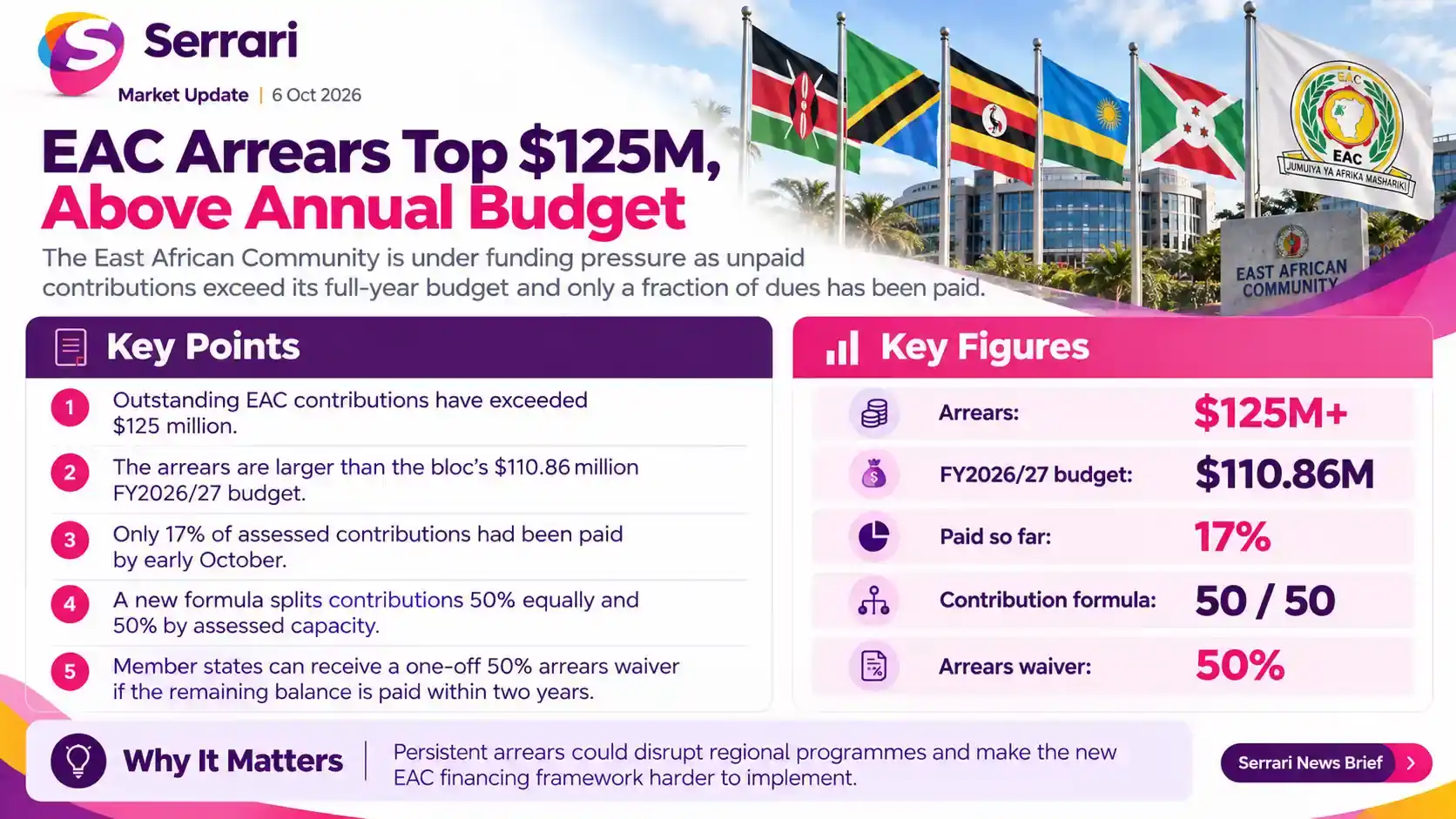
The East African Community is confronting a severe funding shortfall after unpaid contributions from Partner States climbed above $125 million, exceeding the bloc’s entire $110.86 million budget for the 2026/27 financial year.
Only 17% of assessed contributions for the current financial year had been paid by early October, intensifying concerns over the Community’s ability to finance regional programmes consistently. Parliamentary leaders from across the bloc have now committed to increasing pressure on national governments and finance ministries to clear outstanding obligations.
The crisis comes as the EAC begins implementing a new funding model designed to distribute contributions more sustainably while offering states an opportunity to reduce their accumulated arrears.
Key Overview
- Outstanding EAC contributions have exceeded $125 million.
- The arrears are larger than the bloc’s $110.86 million FY2026/27 budget.
- Only 17% of assessed contributions had been paid by early October.
- A new financing formula allocates 50% equally among Partner States and 50% through assessed contributions.
- Governments can receive a one-off 50% waiver on accumulated arrears if the remaining half is paid within two years from March 7, 2026.
- Parliamentary leaders have committed to engage governments and finance ministries to accelerate payments.
- An extraordinary parliamentary meeting is scheduled in Nairobi for October 29, 2026.
EAC Funding Gap Surpasses Its Annual Budget
The scale of the funding problem became clearer at the 21st Ordinary Meeting of the Bureau of Speakers of EAC national parliaments and the regional legislative assembly, which concluded in Arusha on October 3.
Only 17% of assessed contributions had been received by that stage, while total outstanding dues had climbed above $125 million, prompting parliamentary leaders to commit to engaging their respective governments and finance ministries over the arrears.
That outstanding balance now exceeds the Community’s annual spending plan. The FY2026/27 budget stands at $110,863,576 and finances activities across the bloc’s organs and institutions as it begins implementing its seventh regional development strategy.
The contrast highlights the scale of the liquidity challenge. Arrears exceeding an entire year’s budget can disrupt programme implementation, delay payments and make longer-term regional planning more difficult when expected contributions do not arrive according to schedule.
Of the current budget, approximately $64.77 million, or 58%, is expected from Partner States, while roughly $46.10 million, or 42%, is expected from development partners, increasing the importance of predictable government contributions to the Community’s operations.
Context is everything. Stay ahead of shifting trends with today’s market updates, and uncover emerging opportunities using the Serrari Group Market Index and Marketplace. Then, take control of your own financial future by exploring our Money & Life Reset Transformation Blueprint ™ to build stronger habits, create better systems, and design a path toward lasting wealth.
New Formula Shifts How Countries Fund the Bloc
The EAC has already begun changing its financing model in response to persistent payment challenges.
At the 25th Ordinary Summit of Heads of State on March 7, leaders formally adopted a new 50/50 financing formula that became effective on July 1, 2026. Half of Partner State contributions are now allocated equally, while the other half is assessed under the bloc’s contribution framework.
The arrangement replaced an earlier proposed structure under which 65% would have been shared equally and 35% assessed.
The objective is to balance the principle that all members should contribute to maintaining regional institutions with recognition that the economies within the bloc differ significantly in size and capacity.
The financing framework is being implemented across a Community that now consists of eight Partner States: Burundi, Democratic Republic of Congo, Kenya, Rwanda, Somalia, South Sudan, Tanzania and Uganda.
Arrears Waiver Offers Governments a Route Forward
The March summit also introduced an important mechanism to address historical debt.
Heads of State approved a one-off waiver of 50% of accumulated arrears on the condition that the remaining 50% is paid within two years from March 7, 2026.
The measure provides governments carrying large outstanding balances with an incentive to regularise their positions while allowing the bloc to recover part of money that might otherwise remain unpaid for longer.
However, the latest figures show that introducing a new formula has not immediately solved the Community’s cash-flow problem. With just 17% of assessed contributions paid in the current financial year, implementation will depend heavily on whether governments translate their commitments into actual transfers.
Regional lawmakers are therefore becoming more directly involved in the issue, with Speakers agreeing to use their oversight roles to encourage national finance ministries to prioritise EAC obligations.
Funding Pressure Could Affect Regional Priorities
The financing challenge comes as the EAC is attempting to expand regional integration across trade, infrastructure, financial markets, social services and monetary cooperation.
The 2026/27 budget marks the start of the seventh EAC Development Strategy and allocates resources to areas including institutional coordination, trade facilitation, industrialisation, infrastructure, social integration, peace and security, and implementation of the East African Monetary Union roadmap.
Persistent contribution delays could make it harder to execute these programmes according to schedule, particularly where activities rely directly on Partner State financing.
The issue is especially significant as the EAC has expanded rapidly in recent years. A larger membership can increase the Community’s economic reach and strategic importance, but it also makes a reliable financing architecture increasingly important.
Parliamentary leaders will meet again in Nairobi on October 29 for an extraordinary session primarily addressing outstanding directives concerning elections and remuneration arrangements for members of the sixth regional legislative assembly. The meeting will follow sessions involving parliamentary clerks and secretaries-general on October 27 and 28.
For the EAC, however, the more fundamental test will be whether the new financing system can transform government commitments into predictable cash flows. With unpaid contributions already exceeding the Community’s annual budget, restoring payment discipline has become central to sustaining the bloc’s expanding regional integration agenda.
Sources used: East African Community / East African Legislative Assembly / The EastAfrican
Your financial future isn’t something you wait for—it’s something you build.
The real question is: when do you begin?
Move beyond simply staying informed.
Navigate the markets with clarity—track trends through the Serrari Group Market Index, uncover opportunities in the Serrari Marketplace, and build practical knowledge with our Curated Wealth Builder Platform.
Stay connected to what truly matters.
Get daily insights on macro trends and financial movements across Kenya, Africa, and global markets—delivered through the Serrari Newsletter.
Growth opens doors.
Advance your career through professional programs including ACCA, HESI A2, ATI TEAS 7 , HESI EXIT , NCLEX – RN and NCLEX – PN, Financial Literacy!🌟—designed to move you forward with confidence.
See where money is flowing—clearly and in real time.
Track Money Market Funds, Treasury Bills, Treasury Bonds, Green Bonds, and Fixed Deposits, alongside global and African indexes, key economic indicators, and the evolving Crypto and stablecoin landscape—all within Serrari’s Market Index.