India is rapidly positioning itself as a global electro-tech manufacturing centre by combining expanding solar power, falling battery costs, electric mobility and a fast-growing electronics manufacturing base. A World Economic Forum analysis of India’s energy transition argues that the country has an opportunity to industrialise through electricity-based technologies without following the same fossil-fuel-heavy development path previously taken by Western economies and China.
The shift is being supported by increasingly competitive renewable-energy economics, government incentives and major expansion in domestic manufacturing. More recent official renewable-energy data shows that India’s solar module manufacturing capacity had reached around 172 GW by March 31, 2026, substantially above earlier estimates of 120 GW.
Key Overview
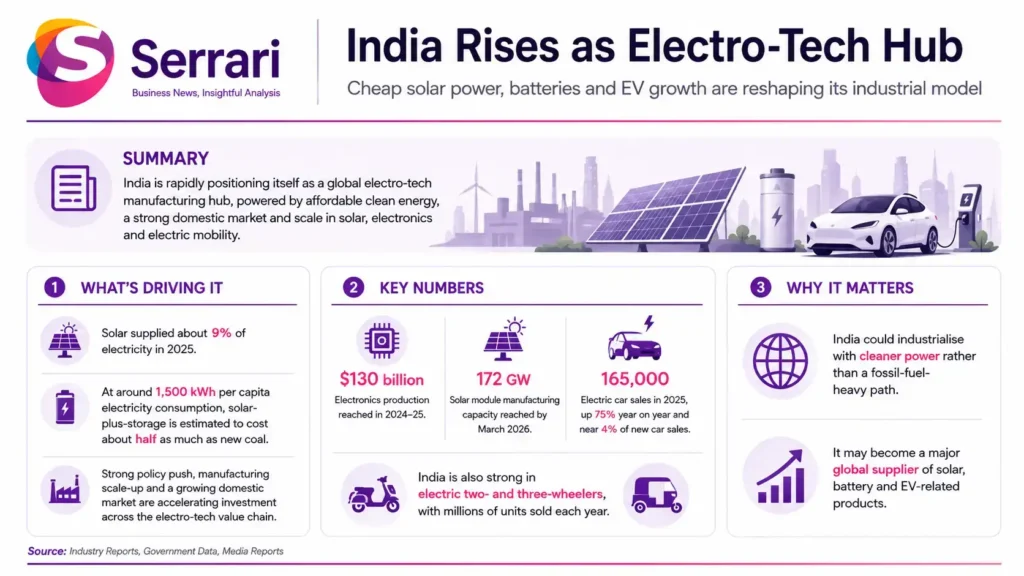
- Solar supplied approximately 9% of India’s electricity in 2025, while coal consumption per person remained substantially below China’s level at a comparable stage of economic development.
- At roughly 1,500 kWh of electricity consumption per capita, solar-plus-storage costs are estimated at about half the cost of new coal generation.
- India’s electronics production has expanded almost six-fold in a decade, reaching ₹11.3 lakh crore in 2024–25, equivalent to roughly $130 billion.
- Solar module manufacturing capacity reached around 172 GW by March 2026, compared with only 2.3 GW in 2014.
- Electric car sales reached approximately 165,000 units in 2025, increasing 75% year-on-year and accounting for almost 4% of new car sales.
- India remains especially strong in electric two- and three-wheelers, creating a large domestic market for batteries, motors and electric drivetrains.
Cheap Solar Reshapes India’s Industrial Growth Model
India’s emerging manufacturing advantage begins with a major change in the economics of electricity. When China reached approximately 1,500 kWh of annual electricity consumption per capita during its earlier industrial expansion, coal provided the cheapest route for supplying the energy required by factories, cities and infrastructure.
India is now reaching a similar electricity-consumption threshold in a completely different technology environment. The cost comparison highlighted for India indicates that solar generation combined with battery storage can now cost roughly half as much as building new coal generation.
This gives India an opportunity to increase electricity consumption and industrial output without necessarily repeating the same level of fossil-fuel dependence experienced by earlier industrial economies.
The country added 44.61 GW of solar capacity during FY2025–26, nearly twice the amount added during the previous financial year, while total non-fossil-fuel power capacity reached 283.46 GW, according to official capacity figures.
Cheap domestic renewable electricity also carries an energy-security benefit. Expanding electrification across industry and transport can reduce exposure to imported fossil fuels while supporting domestic production of energy technologies.
Context is everything. Stay ahead of shifting trends with today’s market updates, and uncover emerging opportunities using the Serrari Group Market Index and Marketplace. Then, take control of your own financial future by exploring our Money & Life Reset Transformation Blueprint ™ to build stronger habits, create better systems, and design a path toward lasting wealth.
Electronics Manufacturing Builds the Industrial Base
India’s large electronics sector provides an important foundation for its expansion into solar equipment, batteries, power electronics and electric vehicles.
Domestic electronics production increased from approximately ₹1.9 lakh crore in 2014–15 to ₹11.3 lakh crore in 2024–25, representing almost six-fold growth in a decade. Electronics exports also expanded significantly over the same period.
This manufacturing ecosystem creates capabilities that can be transferred into other electro-tech industries, including component assembly, semiconductor applications, power management systems, battery electronics and advanced manufacturing.
Solar manufacturing has expanded particularly quickly. Earlier assessments cited approximately 120 GW of solar module production capacity, but updated figures show installed manufacturing capacity reaching approximately 172 GW by March 31, 2026, compared with only 2.3 GW in 2014.
However, India’s solar supply chain is not yet fully integrated. Domestic solar-cell manufacturing capacity remains considerably lower than module production, leaving manufacturers dependent on imported cells and other upstream technologies.
Industry reporting has highlighted this imbalance, with solar-cell capacity estimated at around 27 GW on a nameplate basis in mid-2026, while effective operating capacity was estimated at approximately 16–18 GW.
Electric Mobility Creates Another Manufacturing Engine
India’s transition is also accelerating in transportation. Passenger electric vehicles still represent a relatively small share of total car sales, but adoption is increasing rapidly.
Around 165,000 electric cars were sold in India during 2025, representing a 75% increase from the previous year and nearly 4% of new passenger-car sales.
Domestic manufacturers already play a significant role in this market. Tata Motors and Mahindra together accounted for roughly 60% of electric-car sales during the year, demonstrating how domestic demand is supporting local electric-vehicle production.
India is even further ahead in smaller vehicles. Electric two- and three-wheelers have become increasingly common in commercial and urban transport, generating demand for locally produced batteries, electric motors, power electronics and charging infrastructure.
The scale of this domestic market could allow manufacturers to build technologies for India first and later export similar products to other emerging economies with comparable transport and affordability requirements.
India Targets a Larger Role in Global Supply Chains
India’s wider opportunity is to move beyond serving its domestic market and become a major international supplier of electro-tech equipment.
Countries and multinational companies are increasingly seeking to diversify supply chains for solar panels, batteries, electronics and other strategic clean-energy technologies. India’s manufacturing scale, engineering workforce, expanding domestic market and lower-cost renewable power could make it an increasingly important alternative production base.
Challenges remain. The continued reliance on imported solar cells illustrates how rapidly expanding final-product capacity does not automatically create a fully domestic supply chain.
India will therefore need to deepen manufacturing across upstream components, battery materials, cells, semiconductors and other critical technologies if it wants to capture a larger share of global value chains.
If that integration succeeds, the combination of inexpensive renewable power, a large domestic consumer market and rapidly expanding manufacturing capabilities could make electro-tech one of India’s most important industrial growth sectors and strengthen its position as a global manufacturing hub.
Sources: World Economic Forum / Press Information Bureau / International Energy Agency / Reuters / Ember
Your financial future isn’t something you wait for—it’s something you build.
The real question is: when do you begin?
Move beyond simply staying informed.
Navigate the markets with clarity—track trends through the Serrari Group Market Index, uncover opportunities in the Serrari Marketplace, and build practical knowledge with our Curated Wealth Builder Platform.
Stay connected to what truly matters.
Get daily insights on macro trends and financial movements across Kenya, Africa, and global markets—delivered through the Serrari Newsletter.
Growth opens doors.
Advance your career through professional programs including ACCA, HESI A2, ATI TEAS 7 , HESI EXIT , NCLEX – RN and NCLEX – PN, Financial Literacy!🌟—designed to move you forward with confidence.
See where money is flowing—clearly and in real time.
Track Money Market Funds, Treasury Bills, Treasury Bonds, Green Bonds, and Fixed Deposits, alongside global and African indexes, key economic indicators, and the evolving Crypto and stablecoin landscape—all within Serrari’s Market Index.