
















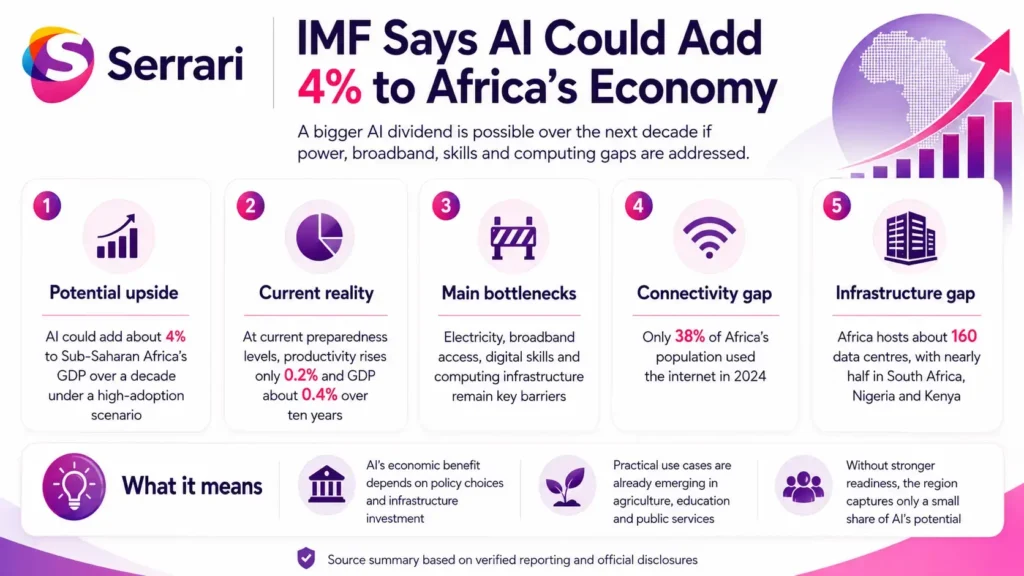
Artificial intelligence could increase Sub-Saharan Africa’s economic output by about 4% over the next decade, but only if governments accelerate investment in electricity, affordable broadband, digital skills and computing infrastructure.
The estimate is a high-adoption scenario rather than a forecast of automatic growth. Under today’s conditions, the International Monetary Fund calculates that AI would raise regional productivity by only 0.2% and total GDP by about 0.4% cumulatively over ten years. The large gap between the two scenarios shows how strongly the outcome depends on policy choices and the region’s ability to spread useful AI tools beyond a small group of connected firms.
Key Overview
- AI could add about 4% to regional GDP over ten years under a high-adoption scenario.
- Current conditions imply only a 0.2% productivity gain and a 0.4% GDP increase.
- Sub-Saharan Africa ranks below other regions on overall AI preparedness.
- Only 38% of Africa’s population used the internet in 2024.
- Africa hosts about 160 data centres, with nearly half in three countries.
- Agriculture, education, healthcare and tax administration offer practical early uses.
The 4% Estimate Depends on Faster AI Adoption
According to the IMF’s departmental paper on AI in Sub-Saharan Africa, productivity could rise by between 0.2% and 2.1% over the next decade, depending on adoption rates and supporting investment.
At the lower end, the Fund estimates a cumulative 0.2% productivity improvement. Additional investment in AI-related capital would bring the total GDP effect to about 0.4% over ten years.
Under a stronger scenario, faster adoption across more sectors could lift productivity by roughly 2.1% and add close to half a percentage point to annual growth. Compounded across the decade, that would translate into an economic-output gain of about 4%.
The distinction matters because the 4% figure is neither an annual growth rate nor a guaranteed forecast. It represents what the region could gain if governments and businesses overcome infrastructure and capability gaps.
The report also separates AI exposure from readiness. South Africa, Mauritius, Nigeria, Botswana and Namibia record the five highest estimated productivity gains under current job structures. By contrast, Kenya, Mauritius, Rwanda, Seychelles and South Africa are highlighted as comparatively better positioned on information technology, policy commitment and institutional preparedness.
Electricity and Connectivity Remain the Biggest Barriers
Around half of Sub-Saharan Africa’s population lacks reliable electricity, limiting the operation of mobile devices, cloud services and data centres. The IMF recommends investment in national grids and mini-grids serving schools, health facilities and other public institutions.
Connectivity is similarly uneven. The latest global internet-use data show that only 38% of Africa’s population used the internet in 2024, compared with 68% worldwide.
The IMF argues that governments should expand fibre backbones, encourage open-access networks and lower the cost of connectivity. Without affordable internet, AI tools are likely to remain concentrated among large companies, urban workers and wealthier households.
Computing capacity presents another constraint. Africa hosts about 160 data centres, equal to roughly 5.5% of global installations. Nearly half are located in South Africa, Nigeria and Kenya, creating a risk that AI investment widens disparities between countries.
Context is everything. Stay ahead of shifting trends with today’s market updates, and uncover emerging opportunities using the Serrari Group Market Index and Marketplace. Then, take control of your own financial future by exploring our Money & Life Reset Transformation Blueprint ™ to build stronger habits, create better systems, and design a path toward lasting wealth.
Practical AI Tools Are Already Producing Results
The Fund expects the region’s near-term benefits to come mainly from practical applications rather than the development of frontier AI models.
In agriculture, Kenya’s Agricultural Observatory Platform uses satellite and weather data to provide real-time guidance to more than 700,000 farmers. Trials across several African countries indicate that digital advisory tools can improve crop yields, particularly when combined with better seeds, fertiliser and farming practices.
Education offers another example. A six-week AI tutoring programme in Nigeria produced learning gains equivalent to roughly 1.5 to two years of conventional schooling. Teachers remained involved, helping students use the chatbot and identify inaccurate responses.
AI is also being used to support medical triage, disease diagnosis and patient follow-up. In public administration, data analytics can improve tax-audit selection and identify compliance risks, potentially helping governments mobilise more revenue without simply increasing tax rates.
These examples suggest that Africa’s strongest opportunities may come from tools adapted to local languages, basic devices and low-bandwidth channels such as SMS and messaging applications.
Governments Are Building Policy and Skills Foundations
Several countries have started creating national frameworks. Kenya’s AI Strategy 2025–2030 focuses on digital infrastructure, data governance, research, innovation and commercialisation.
Nigeria’s Three Million Technical Talent programme is intended to build a national pipeline of workers in fields including AI, machine learning, cloud computing, data science and cybersecurity.
However, policy documents and training schemes will have limited impact unless they are supported by reliable power, affordable connectivity, stronger education systems and clear safeguards covering privacy, cybersecurity, consumer protection and the public sector’s use of AI.
Africa’s AI Dividend Is a Policy Choice
The IMF’s findings show that AI could either narrow or widen the productivity gap between Sub-Saharan Africa and more advanced economies. The technology’s economic value will depend less on whether African countries build the world’s largest models and more on whether ordinary firms, farms, schools, clinics and government agencies can use affordable and trusted tools.
The current 0.4% GDP estimate reflects today’s constraints. Reaching the potential 4% gain will require coordinated investment in power, broadband, computing, skills and governance throughout the next decade.
Sources: International Monetary Fund / International Telecommunication Union / World Bank / Kenya Ministry of Information, Communications and the Digital Economy / Nigeria Federal Ministry of Communications, Innovation and Digital Economy
Your financial future isn’t something you wait for—it’s something you build.
The real question is: when do you begin?
Move beyond simply staying informed.
Navigate the markets with clarity—track trends through the Serrari Group Market Index, uncover opportunities in the Serrari Marketplace, and build practical knowledge with our Curated Wealth Builder Platform.
Stay connected to what truly matters.
Get daily insights on macro trends and financial movements across Kenya, Africa, and global markets—delivered through the Serrari Newsletter.
Growth opens doors.
Advance your career through professional programs including ACCA, HESI A2, ATI TEAS 7 , HESI EXIT , NCLEX – RN and NCLEX – PN, Financial Literacy!🌟—designed to move you forward with confidence.
See where money is flowing—clearly and in real time.
Track Money Market Funds, Treasury Bills, Treasury Bonds, Green Bonds, and Fixed Deposits, alongside global and African indexes, key economic indicators, and the evolving Crypto and stablecoin landscape—all within Serrari’s Market Index.