France has begun debating its 2027 budget amid growing concerns that persistent government deficits, weak economic growth and higher borrowing costs are reinforcing one another. The National Assembly’s parliamentary timetable for the 2027 budget scheduled debate on revenue measures and public debt from October 13, bringing fiscal pressures into focus before next year’s presidential election.
France’s 2025 deficit narrowed, but its total public debt continued to grow. That distinction matters: reducing the annual shortfall does not automatically stop debt from rising, particularly when interest payments increase and economic growth remains subdued.
Key Overview
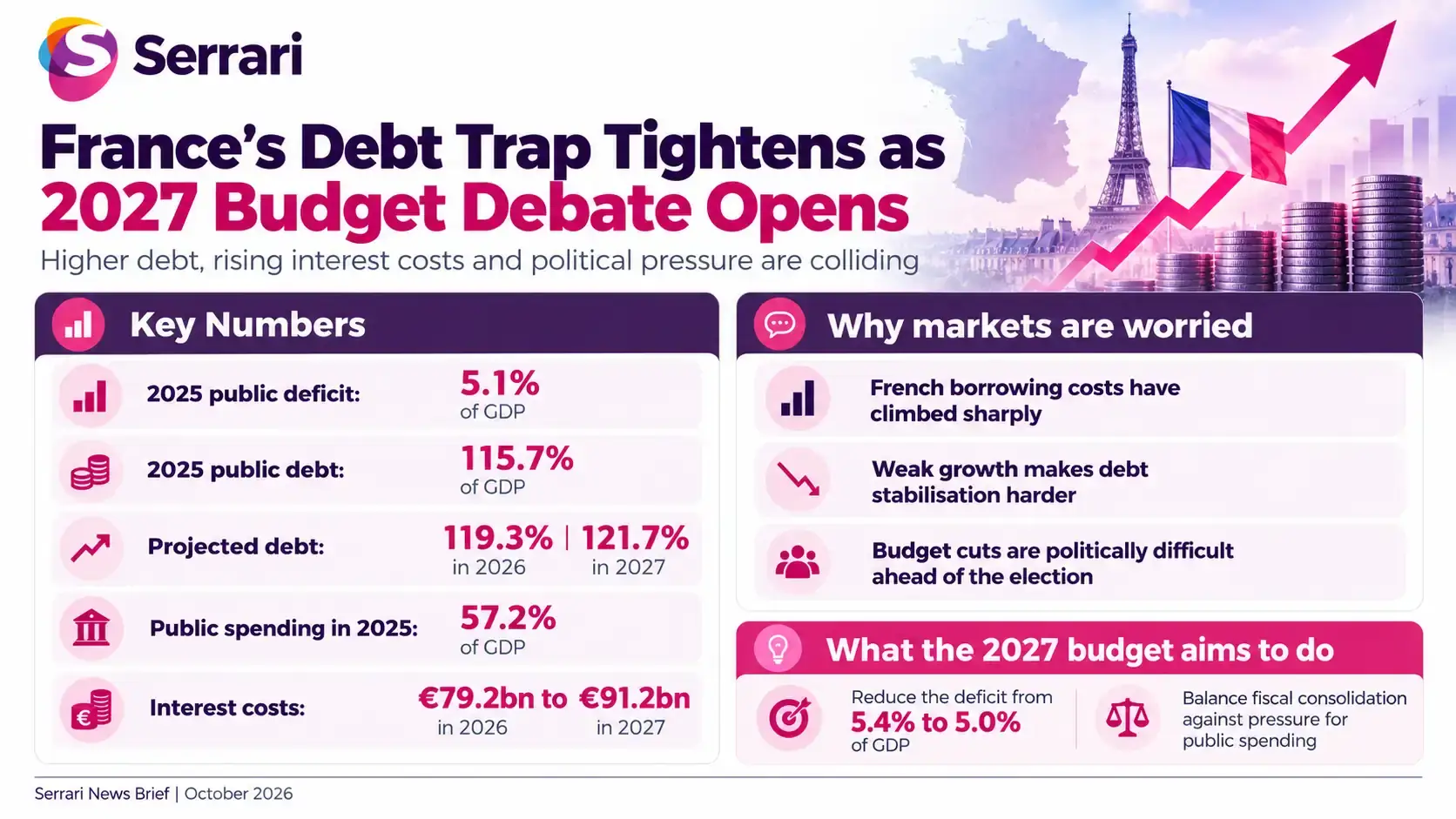
- France’s 2025 public deficit was 5.1% of GDP, down from 5.8% in 2024, while revised public debt reached 115.7% of GDP.
- Government projections put debt at 119.3% of GDP in 2026 and 121.7% in 2027, subject to economic and budget outcomes.
- Public spending accounted for 57.2% of GDP in 2025, well above the euro-area average.
- Annual debt-interest costs are forecast to rise from €79.2 billion in 2026 to €91.2 billion in 2027.
- The proposed 2027 budget aims to reduce the deficit from 5.4% to 5.0% of GDP, amid parliamentary resistance and student protests.
How France Accumulated a Heavy Debt Burden
The revised 2025 national accounts put France’s public debt at 115.7% of GDP, up from 112.6% in 2024. The original March estimate was 115.6%, but later official accounts revised it slightly higher. The deficit improved to €152.5 billion, or 5.1% of GDP, compared with €169.1 billion, or 5.8%, the previous year.
The government’s updated debt outlook projects a further rise to 119.3% of GDP in 2026 and 121.7% in 2027, although these estimates depend on future economic conditions.
The numbers reflect a structural challenge. France has repeatedly spent more than it collects, while successive crises have required extraordinary government support. The 2026 assessment of public finances found that spending reached 57.2% of GDP in 2025, around 7.4 percentage points above the euro-area average, with pensions, healthcare and economic support explaining much of the difference.
High spending is not necessarily unproductive, but financing longstanding commitments becomes more difficult when revenues and output fail to keep pace.
Context is everything. Stay ahead of shifting trends with today’s market updates, and uncover emerging opportunities using the Serrari Group Market Index and Marketplace. Then, take control of your own financial future by exploring our Money & Life Reset Transformation Blueprint ™ to build stronger habits, create better systems, and design a path toward lasting wealth.
Bond Markets Make the Problem More Expensive
French 10-year government bond yields have approached 5%, levels not seen in almost a quarter of a century. Investors also demand a substantial premium over comparable German bonds, with recent sovereign-market reporting describing a spread of roughly 1.4 percentage points during the sell-off.
Higher market yields do not instantly raise the cost of all outstanding fixed-rate debt. However, they increase the price of new borrowing and refinancing maturing bonds. Under the government’s 2027 fiscal plan, annual interest costs are projected to reach €91.2 billion, up €12 billion from 2026. France also expects to issue around €340 billion in medium- and long-term government securities in 2027, according to its published financing programme, reflecting substantial funding and refinancing needs.
This creates an uncomfortable cycle: bigger interest bills leave less budget room, while doubts about debt sustainability can push borrowing rates even higher.
The 2027 Budget Faces Political and Social Resistance
The government expects economic growth of just 0.5% in 2026 and 1% in 2027. Its budget seeks €54 billion in total fiscal improvement, including €43 billion in measures within the new finance and social-security bills, to lower the projected deficit from 5.4% of GDP this year to 5.0% next year. These figures are proposals and forecasts, not enacted outcomes.
But spending restraint is contentious. Lawmakers have challenged proposed pension-related changes, while nationwide student demonstrations over school conditions have underscored demands for stronger public services. The debate highlights the difficulty of combining fiscal consolidation with public expectations over education, healthcare and pensions ahead of the 2027 election.
Could the Debt Strain Spread Across Europe?
France is the euro area’s second-largest economy, so sustained instability in its bond market could affect borrowing costs and investor confidence beyond its borders. However, higher yields do not by themselves establish that a default or wider euro-area crisis is imminent.
The central bank’s Transmission Protection Instrument can address disorderly market conditions that threaten the implementation of monetary policy, but any intervention is conditional and is not intended to erase risks rooted in weak fiscal fundamentals.
For France, the immediate test is whether lawmakers can agree on durable budget measures while protecting essential services and supporting growth. Without sustained improvements, financing costs and public debt could continue to rise even as the government reduces its annual deficit.
Sources: CNBC / INSEE / French National Assembly / OECD / French Ministry of Economy and Finance / French Presidency / Agence France Trésor / Financial Times / Reuters / Associated Press / European Central Bank
Your financial future isn’t something you wait for—it’s something you build.
The real question is: when do you begin?
Move beyond simply staying informed.
Navigate the markets with clarity—track trends through the Serrari Group Market Index, uncover opportunities in the Serrari Marketplace, and build practical knowledge with our Curated Wealth Builder Platform.
Stay connected to what truly matters.
Get daily insights on macro trends and financial movements across Kenya, Africa, and global markets—delivered through the Serrari Newsletter.
Growth opens doors.
Advance your career through professional programs including ACCA, HESI A2, ATI TEAS 7 , HESI EXIT , NCLEX – RN and NCLEX – PN, Financial Literacy!🌟—designed to move you forward with confidence.
See where money is flowing—clearly and in real time.
Track Money Market Funds, Treasury Bills, Treasury Bonds, Green Bonds, and Fixed Deposits, alongside global and African indexes, key economic indicators, and the evolving Crypto and stablecoin landscape—all within Serrari’s Market Index.