The International Monetary Fund (IMF) projects Kenya’s economy will grow by 4.5% in 2026 before accelerating to 4.7% in 2027, according to October 2026 growth estimates. The forecast points to a modest recovery as inflation is expected to ease next year, although high energy costs, pressure on public finances and external uncertainty could limit the improvement.
The estimates, released alongside the October World Economic Outlook dataset, are more cautious than the Central Bank of Kenya’s latest projections. They also underline that stronger national output does not automatically translate into lower prices or higher household purchasing power.
Key Overview
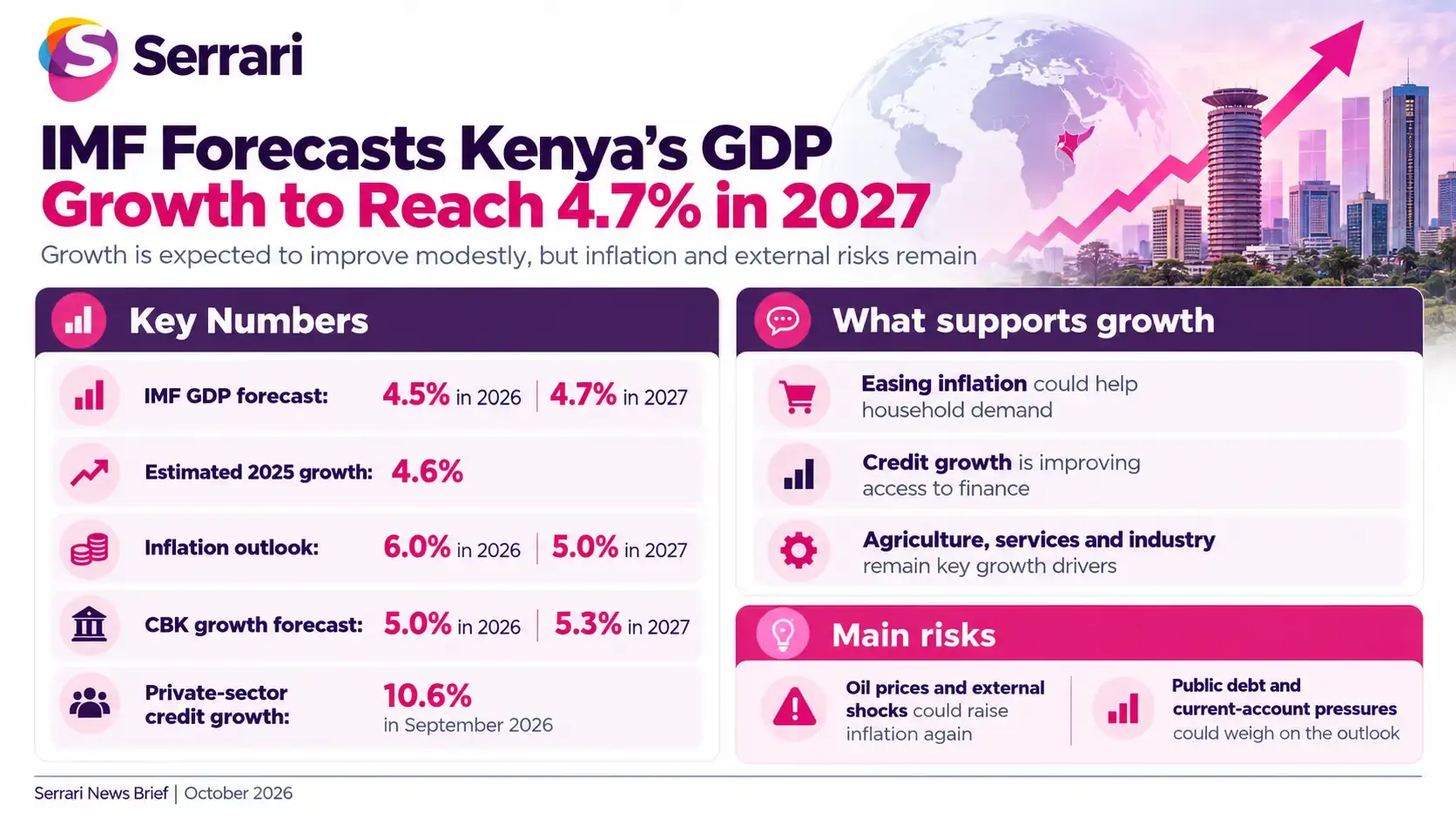
- GDP growth: The IMF projects 4.5% in 2026 and 4.7% in 2027, following estimated growth of 4.6% in 2025.
- Inflation outlook: Annual inflation is projected at approximately 6.0% in 2026, easing to 5.0% in 2027, compared with 4.1% in 2025.
- Central bank forecast: The monetary authority expects faster GDP growth of 5.0% in 2026 and 5.3% in 2027.
- Bank lending: Private-sector credit grew 10.6% year on year in September 2026, reflecting improving demand for loans.
- External pressures: Elevated fuel-import costs, global instability and the widening current-account deficit remain important risks.
IMF Expects a Gradual Economic Recovery
The IMF’s forecast suggests that Kenya’s economy will expand slightly faster in 2027 than in 2026, supported by domestic activity and an anticipated moderation in price pressures. However, the increase of 0.2 percentage points is modest, and the projection remains conditional on developments in the global economy and within Kenya.
Agriculture, services and industrial output will remain important determinants of growth. Household consumption and business investment could also benefit if inflation slows and credit remains available. Nevertheless, projected GDP growth describes the increase in inflation-adjusted economic output, not a direct increase in every Kenyan’s income.
Inflation May Ease, but Consumer Prices Could Keep Rising
The reported inflation projections indicate an acceleration from 4.1% in 2025 to around 6.0% in 2026, followed by a slowdown to 5.0% in 2027. Slower inflation would mean consumer prices are rising less quickly, not necessarily returning to previous levels.
The distinction matters because Kenyan households continue to face higher expenses for food, transport and other essentials. In its October monetary policy assessment, the central bank reported that annual inflation reached 6.8% in September, up from 6.6% in August, but remained within its target range of 2.5% to 7.5%.
Context is everything. Stay ahead of shifting trends with today’s market updates, and uncover emerging opportunities using the Serrari Group Market Index and Marketplace. Then, take control of your own financial future by exploring our Money & Life Reset Transformation Blueprint ™ to build stronger habits, create better systems, and design a path toward lasting wealth.
Central Bank Takes a More Optimistic View
Following its October 7, 2026 policy meeting, the central bank raised its 2026 growth forecast from 4.9% to 5.0%, while maintaining its 5.3% projection for 2027. The upgrade reflects stronger activity in industry and services, alongside improved business confidence.
The bank kept its benchmark interest rate at 8.75%. Credit growth to the private sector reached 10.6% in September, up from 10.3% in August and a contraction of 2.9% in January 2025. More lending can support businesses and consumption, although its benefits depend on loan costs, credit quality and how funds are invested.
World Bank Remains More Cautious About Growth
The World Bank’s July 2026 economic projections put Kenya’s GDP growth at 4.3% in 2026 and 4.4% in 2027, below both the IMF and central bank forecasts. Its assessment highlighted higher energy prices, weaker household purchasing power and the possibility of investment delays ahead of the 2027 elections.
Differences between institutional forecasts reflect their assumptions, assessment dates and views of economic risks. None is a guaranteed outcome, and projections may be revised as new information becomes available.
Oil Costs and External Balances Remain Key Risks
Kenya remains vulnerable to oil-price volatility because imported fuel affects transport costs, production expenses and demand for foreign currency. The global commodity outlook has warned that energy shocks can raise inflation and reduce economic growth in importing economies.
The central bank expects Kenya’s current-account deficit to widen to 3.2% of GDP in 2026, from 2.1% in 2025, mainly because of higher mineral-fuel imports and weaker remittances. This makes export earnings, foreign investment, exchange-rate stability and fiscal discipline important to the outlook.
Globally, the IMF projects growth of 3.1% in 2026, rising to 3.4% in 2027, while warning that geopolitical tensions and inflation could undermine the recovery. For Kenya, the central question is whether improving economic activity can deliver more jobs, affordable credit and sustained gains in household purchasing power despite those risks.
Sources: International Monetary Fund / Citizen Digital / Central Bank of Kenya / World Bank / Reuters
Your financial future isn’t something you wait for—it’s something you build.
The real question is: when do you begin?
Move beyond simply staying informed.
Navigate the markets with clarity—track trends through the Serrari Group Market Index, uncover opportunities in the Serrari Marketplace, and build practical knowledge with our Curated Wealth Builder Platform.
Stay connected to what truly matters.
Get daily insights on macro trends and financial movements across Kenya, Africa, and global markets—delivered through the Serrari Newsletter.
Growth opens doors.
Advance your career through professional programs including ACCA, HESI A2, ATI TEAS 7 , HESI EXIT , NCLEX – RN and NCLEX – PN, Financial Literacy!🌟—designed to move you forward with confidence.
See where money is flowing—clearly and in real time.
Track Money Market Funds, Treasury Bills, Treasury Bonds, Green Bonds, and Fixed Deposits, alongside global and African indexes, key economic indicators, and the evolving Crypto and stablecoin landscape—all within Serrari’s Market Index.