The European Union has agreed to strengthen Carbon Price Controls within its upcoming ETS2 carbon market, introducing new safeguards designed to prevent excessive price increases and reduce the risk of higher fuel bills for consumers. The reforms expand the market stability reserve, allowing additional carbon permits to be released when prices rise too sharply. The measures aim to balance emissions reduction goals with affordability as the EU prepares to launch the new system in 2028.
Key Overview
- EU agrees stronger safeguards for the ETS2 carbon market
- Additional permits will be released if carbon prices exceed €45 per tonne
- Stability reserve capacity doubled from 20 million to 40 million permits
- Up to 80 million permits can be released annually
- ETS2 will apply to heating and transport fuels from 2028
- Funds generated will support households and clean energy adoption
- New measures aim to reduce consumer fuel cost concerns
EU Strengthens ETS2 Rules to Curb Carbon Costs, Protect
The European Union has agreed on stronger safeguards for its upcoming ETS2 Carbon Market , introducing new mechanisms designed to control carbon prices and reduce the risk of higher fuel costs for households and businesses.
The agreement, reached after negotiations between EU member states and the European Parliament, responds to growing concerns that the bloc’s new emissions trading system could increase heating and transportation costs if carbon prices rise too rapidly.
The changes are intended to ensure that the EU can continue reducing greenhouse gas emissions while maintaining public support for climate policies.
New Measures to Stabilize Carbon Prices
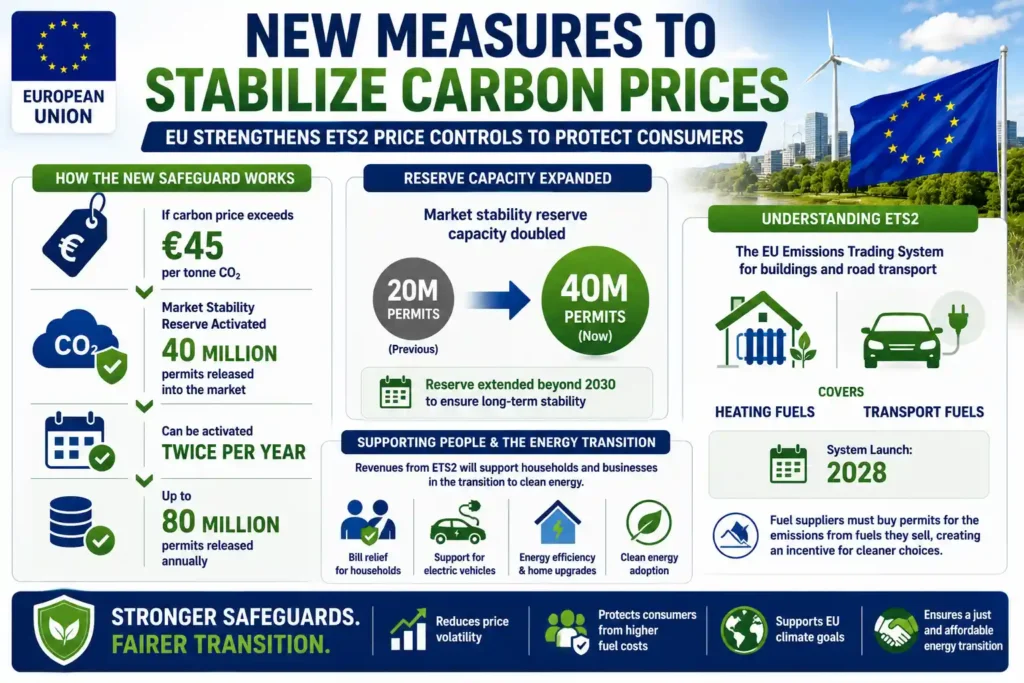
At the center of the agreement is an expansion of the market stability reserve, a mechanism designed to regulate the supply of carbon permits.
Under the revised rules, if the price of carbon permits exceeds €45 per tonne of CO₂, the EU will release 40 million permits into the market from the reserve.
This doubles the previously planned intervention level of 20 million permits.
The reserve can be activated twice per year, allowing up to 80 million extra permits annually to enter the market if necessary.
Lawmakers also agreed to extend the reserve beyond 2030, ensuring that the mechanism remains available as the market develops.
The changes are designed to prevent sudden price spikes while maintaining the environmental objectives of the carbon trading system.
Understanding the ETS2 Carbon Market
The new EU Emissions Trading System for buildings and road transport, known as ETS2, is scheduled to begin in 2028.
Unlike the EU’s existing emissions trading scheme, which focuses on power generation and heavy industry, ETS2 will cover heating and transportation emissions .
Fuel suppliers and distributors will be required to purchase carbon permits corresponding to the emissions associated with the fuels they sell.
By placing a price on carbon emissions, policymakers aim to encourage consumers and businesses to adopt cleaner technologies, including electric vehicles, energy-efficient heating systems, and building renovations.
The system forms a key part of the EU’s strategy to achieve its climate targets while accelerating decarbonization across sectors that have traditionally been difficult to reduce emissions in.
Context is everything. Stay ahead of shifting trends with today’s market updates, and uncover emerging opportunities using the Serrari Group Market Index and Marketplace. Then, take control of your own financial future by exploring our Money & Life Reset Transformation Blueprint ™ to build stronger habits, create better systems, and design a path toward lasting wealth.
Governments Push for Consumer Protection
The stronger safeguards were introduced following warnings from several governments, including France and the Czech Republic, which argued that high carbon prices could increase household fuel bills and undermine public support for climate action.
Because ETS2 directly affects transportation and heating costs, it has generated greater political sensitivity than the existing industrial carbon market.
Many policymakers have emphasized the importance of protecting consumers during the transition to a low-carbon economy.
To address these concerns, the EU agreed to release permits more gradually when market supply tightens.
Instead of releasing 100 million permits at once when permit volumes fall below 210 million, smaller releases will begin once the market drops below 260 million permits.
Officials believe the revised mechanism will help reduce volatility and avoid sudden market disruptions.
Supporting Climate Policy and Households
The reforms are part of a broader Climate Policy Europe agenda aimed at reducing emissions while ensuring that the transition remains socially acceptable.
Revenue generated through ETS2 will be used to support households and businesses as they adapt to cleaner energy systems.
The EU plans to allocate funds toward bill relief measures, electric vehicle purchases, and energy-efficiency improvements such as home insulation and building renovations.
This approach seeks to ensure that the costs associated with reducing emissions are balanced by financial support that helps consumers transition to cleaner technologies.
Financing the Energy Transition
A key objective of ETS2 is generating long-term Energy Transition Funding that can accelerate investment in low-carbon solutions across Europe.
By creating a carbon price signal, policymakers hope to encourage greater investment in renewable energy, electric mobility, cleaner heating technologies, and energy-saving infrastructure.
Supporters argue that a predictable carbon pricing framework can help drive innovation and reduce dependence on fossil fuels while improving energy security.
At the same time, the enhanced safeguards aim to prevent excessive price increases that could place undue pressure on households and businesses.
Outlook
The agreement marks an important step in preparing the EU’s ETS2 carbon market for its planned 2028 launch. By strengthening price controls and expanding the market stability reserve, policymakers are seeking to strike a balance between ambitious climate goals and consumer affordability.
If approved by EU member states and the European Parliament, the new safeguards will help shape one of Europe’s most significant climate policy initiatives, ensuring that emissions reductions can be achieved while supporting households and maintaining public confidence in the energy transition.
FAQs
Q1: What is the ETS2 carbon market?
ETS2 is the European Union’s new emissions trading system that will apply to emissions from heating and road transport fuels starting in 2028. It is designed to reduce carbon emissions by placing a price on fossil fuel use and encouraging cleaner alternatives.
Q2: Why is the EU strengthening ETS2 price controls?
The EU is strengthening ETS2 safeguards to prevent excessive carbon price increases that could lead to higher fuel and heating costs for households and businesses. The measures aim to balance climate goals with consumer affordability.
Q3: How will the new carbon price stabilization mechanism work?
If carbon permit prices rise above €45 per tonne of CO₂, the EU can release up to 40 million additional permits from its market stability reserve. The mechanism can be triggered twice a year, allowing up to 80 million permits annually to help stabilize prices.
Q4: How will ETS2 revenues benefit consumers?
Revenue generated through ETS2 will help fund household energy bill support, electric vehicle purchases, home energy-efficiency upgrades, and other initiatives designed to support Europe’s transition to a cleaner, low-carbon economy.
Sources: ESG News, AOL, New Straits Times, Offshore Engineer Magazine
Your financial future isn’t something you wait for—it’s something you build.
The real question is: when do you begin?
Move beyond simply staying informed.
Navigate the markets with clarity—track trends through the Serrari Group Market Index, uncover opportunities in the Serrari Marketplace, and build practical knowledge with our Curated Wealth Builder Platform.
Stay connected to what truly matters.
Get daily insights on macro trends and financial movements across Kenya, Africa, and global markets—delivered through the Serrari Newsletter.
Growth opens doors.
Advance your career through professional programs including ACCA, HESI A2, ATI TEAS 7 , HESI EXIT , NCLEX – RN and NCLEX – PN, Financial Literacy!🌟—designed to move you forward with confidence.
See where money is flowing—clearly and in real time.
Track Money Market Funds, Treasury Bills, Treasury Bonds, Green Bonds, and Fixed Deposits, alongside global and African indexes, key economic indicators, and the evolving Crypto and stablecoin landscape—all within Serrari’s Market Index.