The European Union has agreed its negotiating position on strengthening the EU Carbon Border Adjustment Mechanism (CBAM), a key climate policy tool designed to support Carbon Leakage Prevention. The proposed reforms would expand the scope of CBAM to include additional downstream products, tighten enforcement measures, and close loopholes that allow carbon-intensive imports to avoid carbon pricing. The changes are intended to protect European industry while advancing the bloc’s climate goals.
Key Overview
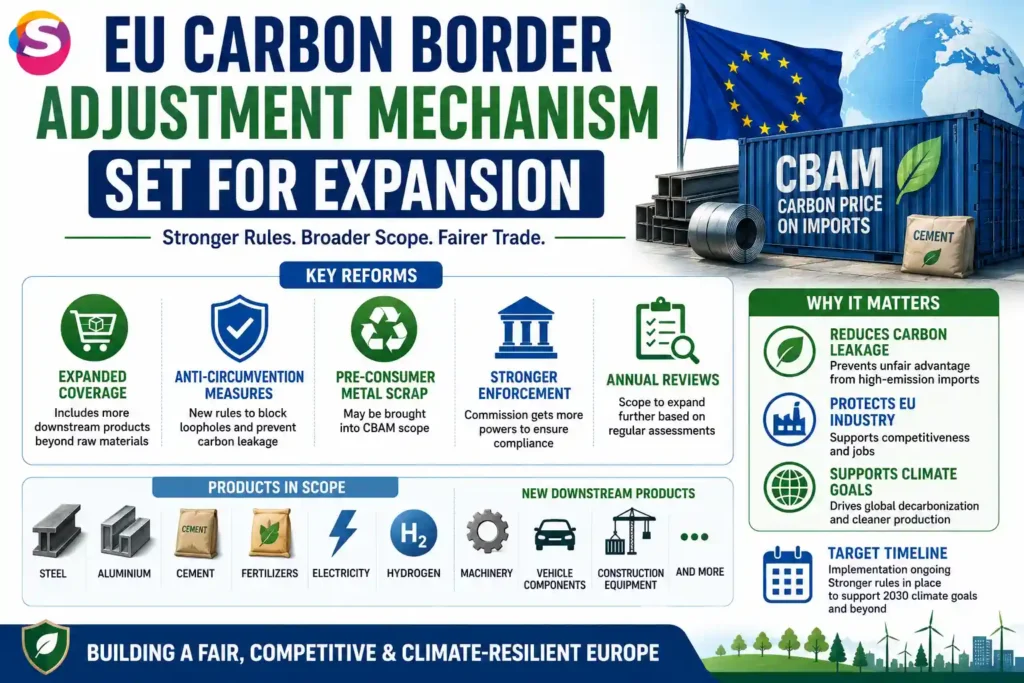
- EU Council agreed its position on strengthening CBAM
- Proposal expands coverage to selected downstream products
- New anti-circumvention measures will target additional imports
- Pre-consumer metal scrap may be brought into scope
- Commission would receive stronger enforcement powers
- Annual reviews could further expand product coverage
- Reforms aim to reduce carbon leakage and support climate goals
EU Carbon Border Adjustment Mechanism Set for Expansion
The European Union has moved a step closer to strengthening its EU Carbon Border Adjustment Mechanism (CBAM) after the Council of the European Union agreed its negotiating position ahead of discussions with the European Parliament.
The proposed reforms would significantly broaden the scope of the bloc’s carbon border policy by extending coverage to additional downstream products and introducing stronger measures to prevent companies from circumventing the system.
The move reflects growing efforts by Brussels to ensure that climate policies do not place European manufacturers at a competitive disadvantage while continuing to drive global emissions reductions.
Expanding Beyond Raw Materials
Since becoming fully operational on 1 January 2026, CBAM has focused primarily on carbon-intensive raw materials including steel, aluminum, cement, fertilizers, electricity, and hydrogen.
However, policymakers identified a growing gap in the current framework.
While basic materials are subject to carbon pricing requirements, many finished products containing those materials can still enter the European market without facing equivalent costs.
The proposed CBAM Expansion seeks to address that issue by extending the mechanism to selected downstream products that rely heavily on carbon-intensive inputs.
The European Commission initially proposed adding around 180 products, including machinery, construction equipment, vehicle components, domestic appliances, and fabricated metal products.
The Council’s position goes further by adding additional industrial machinery, electrical equipment components, conveyor systems, forklift equipment, and other metal-intensive products.
Addressing Carbon Leakage Risks
A central objective of the reform is strengthening Carbon Leakage Prevention.
Carbon leakage occurs when companies relocate production to countries with less stringent environmental regulations to avoid carbon costs, undermining climate policies while potentially increasing global emissions.
CBAM was designed to prevent this by aligning the carbon costs faced by imported products with those paid by European manufacturers under the EU Emissions Trading System (ETS).
Importers are required to purchase CBAM certificates that reflect the carbon content of imported goods, helping create a more level competitive environment.
Policymakers believe extending CBAM to downstream products will reduce incentives for companies to move value-added manufacturing activities outside the European Union.
Context is everything. Stay ahead of shifting trends with today’s market updates, and uncover emerging opportunities using the Serrari Group Market Index and Marketplace. Then, take control of your own financial future by exploring our Money & Life Reset Transformation Blueprint ™ to build stronger habits, create better systems, and design a path toward lasting wealth.
Stronger Enforcement Measures
The Council also supports several new anti-circumvention measures aimed at strengthening compliance.
Among the proposed changes is the inclusion of pre-consumer metal scrap within the CBAM framework, addressing concerns that some businesses could use intermediate materials to avoid carbon pricing obligations.
Enhanced reporting requirements are also planned to improve traceability and ensure more accurate emissions reporting.
In addition, the European Commission would gain stronger authority to investigate and address practices designed to circumvent the system.
The reforms are intended to improve transparency and strengthen the credibility of the EU’s evolving Carbon Border Tax framework.
Annual Reviews Could Expand Scope Further
One of the most significant elements of the Council’s position is a proposal requiring the Commission to review CBAM annually.
These reviews would allow policymakers to assess whether additional downstream products should be added in future years.
The approach reflects the EU’s intention to gradually expand the mechanism as industries adapt and carbon accounting capabilities improve.
For businesses exporting to Europe, this means carbon reporting and supply-chain transparency are likely to become increasingly important over time.
Manufacturers may need to gather more detailed emissions data across their value chains to maintain access to European markets.
Supporting Industrial Decarbonization
The reforms also support broader efforts toward Industrial Decarbonization across Europe.
By ensuring imported goods face comparable carbon costs, policymakers aim to encourage cleaner production methods both within and outside the EU.
Supporters argue that a stronger CBAM will help preserve industrial competitiveness while maintaining the bloc’s climate ambitions.
The European Commission welcomed the Council’s progress, stating that the proposed changes demonstrate continued commitment to ensuring CBAM remains effective in advancing both climate objectives and industrial transformation.
Outlook
The agreement marks an important step in the evolution of the EU Carbon Border Adjustment Mechanism. By expanding product coverage, strengthening enforcement tools, and introducing annual reviews, the EU is seeking to close loopholes and create a more comprehensive carbon pricing framework.
As negotiations with the European Parliament begin, businesses across global supply chains will be closely watching the outcome. If adopted, the reforms could significantly expand the reach of CBAM, influencing trade flows, supply-chain strategies, and investment decisions while reinforcing the EU’s position as a leader in climate-focused industrial policy.
FAQS
Q1: What is the EU Carbon Border Adjustment Mechanism (CBAM)?
The EU Carbon Border Adjustment Mechanism (CBAM) is a climate policy tool that places a carbon price on certain imported goods. It is designed to ensure that imported products face carbon costs similar to those paid by EU manufacturers under the EU Emissions Trading System (ETS).
Q2: Why is the EU expanding CBAM?
The EU is expanding CBAM to address loopholes that allow some carbon-intensive finished products to enter the European market without equivalent carbon costs. The changes aim to reduce carbon leakage and protect the competitiveness of EU industries.
Q3: Which products could be added under the new CBAM rules?
The proposed expansion would include selected downstream products that use carbon-intensive materials such as steel and aluminum. Examples include machinery, vehicle components, construction equipment, electrical equipment, and fabricated metal products.
Q4: How will the updated CBAM affect businesses?
Companies exporting products to the EU may face additional reporting and compliance requirements. Businesses will need more detailed data on embedded emissions within their supply chains and may have to purchase CBAM certificates if their products fall within the expanded scope of the mechanism.
Sources: ESG News, OneStop ESG, ESG Today
Your financial future isn’t something you wait for—it’s something you build.
The real question is: when do you begin?
Move beyond simply staying informed.
Navigate the markets with clarity—track trends through the Serrari Group Market Index, uncover opportunities in the Serrari Marketplace, and build practical knowledge with our Curated Wealth Builder Platform.
Stay connected to what truly matters.
Get daily insights on macro trends and financial movements across Kenya, Africa, and global markets—delivered through the Serrari Newsletter.
Growth opens doors.
Advance your career through professional programs including ACCA, HESI A2, ATI TEAS 7 , HESI EXIT , NCLEX – RN and NCLEX – PN, Financial Literacy!🌟—designed to move you forward with confidence.
See where money is flowing—clearly and in real time.
Track Money Market Funds, Treasury Bills, Treasury Bonds, Green Bonds, and Fixed Deposits, alongside global and African indexes, key economic indicators, and the evolving Crypto and stablecoin landscape—all within Serrari’s Market Index.