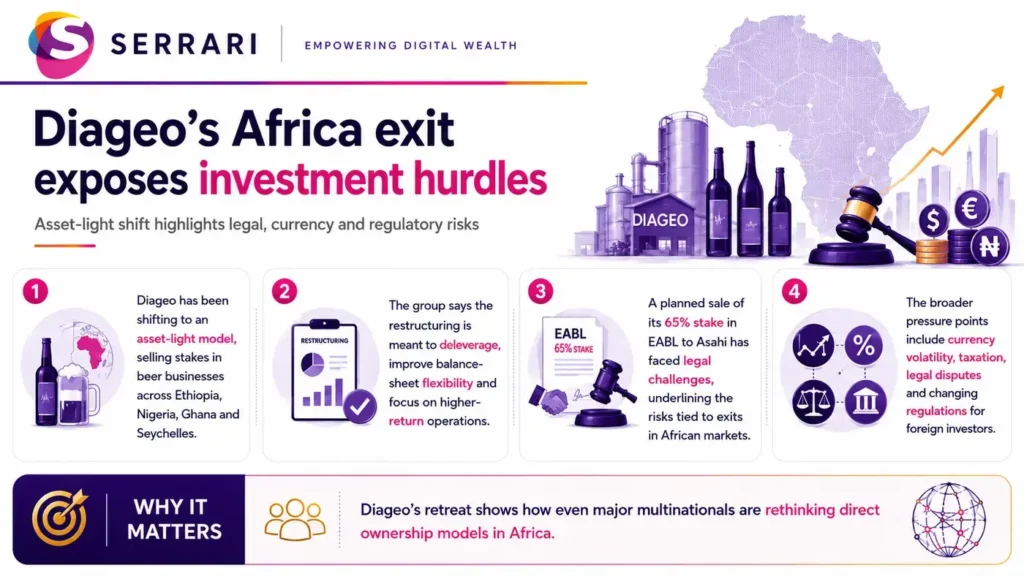
Diageo’s retreat from direct ownership of several African beer businesses is putting a spotlight on the investment hurdles facing multinationals across the continent. The British drinks group has shifted toward a more asset-light model after selling stakes in Ethiopia, Nigeria, Ghana, Cameroon and Seychelles, while its proposed exit from East African Breweries Ltd faces legal delays in Kenya.
The restructuring reflects Diageo’s effort to reduce capital intensity, improve balance-sheet flexibility and focus investment on higher-return areas. It also shows how foreign investors in Africa continue to navigate currency volatility, regulatory complexity, taxation pressure and unpredictable legal risks.
Key Overview
- Diageo has moved toward an asset-light Africa model, relying more on licensing, partnerships and third-party operators.
- The company completed the sale of its Guinness Nigeria stake to Tolaram in 2024 and sold Guinness Ghana Breweries to Castel Group in 2025.
- Its planned $2.3 billion sale of a 65% EABL stake to Asahi has faced repeated legal challenges in Kenya.
- Africa accounted for 9% of Diageo’s reported net sales in fiscal 2025, compared with 40% from North America.
- The exits mirror a wider trend of some foreign companies reducing direct exposure in African markets while keeping brand, licensing or distribution arrangements.
Diageo Moves Toward an Asset-Light Africa Model
Diageo’s Africa restructuring has gathered pace as the group reduces direct ownership of breweries and shifts toward licensing and partnership-based operations. In its 2025 reporting, the company said it had made selective disposals, including a shift to an asset-light model in parts of Africa through sales of shareholdings in Guinness Nigeria, Guinness Ghana and Seychelles Breweries.
The model allows Diageo to reduce capital tied up in manufacturing assets while still earning from brand licensing, royalties and distribution partnerships. In Nigeria, Diageo completed the sale of its 58.02% shareholding in Guinness Nigeria to Tolaram, with Guinness Nigeria continuing to produce and distribute Guinness and other locally manufactured brands under a licence and royalty agreement.
A similar structure has emerged elsewhere. Diageo completed the sale of its 80.4% stake in Guinness Ghana Breweries to Castel Group in July 2025 after announcing the transaction in January. It also sold its 54.4% stake in Seychelles Breweries to Phoenix Beverages, a subsidiary of Mauritius-based IBL Group.
Losses and Gains Show a Mixed Exit Picture
The financial outcome of Diageo’s Africa disposals has been uneven. According to reporting on the group’s exit strategy, Diageo recorded estimated losses of about $365 million from asset sales in Ethiopia, Nigeria and Ghana. The loss profile included the Meta Abo Brewery disposal in Ethiopia, the Guinness Nigeria sale and the Ghana transaction.
Diageo had earlier agreed to sell Meta Abo Brewery in Ethiopia to BGI, part of Castel Group. The company later recorded a £95 million loss connected to the sale, showing the cost of exiting a market where scale, competition and operating conditions had become less attractive.
Not all sales were loss-making. Diageo completed the sale of Guinness Cameroun to Castel Group in 2023, with Castel taking over production and distribution under a licence and royalty agreement. The company’s financial statements show that the Cameroon disposal generated a significant gain, contrasting with the losses recorded in other African markets.
Context is everything. Stay ahead of shifting trends with today’s market updates, and uncover emerging opportunities using the Serrari Group Market Index and Marketplace. Then, take control of your own financial future by exploring our Money & Life Reset Transformation Blueprint ™ to build stronger habits, create better systems, and design a path toward lasting wealth.
EABL Sale Faces Legal Pressure in Kenya
The most closely watched transaction is Diageo’s planned sale of its 65% stake in East African Breweries Ltd to Japan’s Asahi Group Holdings. The $2.3 billion deal would transfer Diageo’s majority EABL stake and related Kenyan spirits interests to Asahi, while keeping long-term arrangements for Guinness and selected Diageo brands in the region.
The transaction, announced in December 2025, would mark Diageo’s exit from direct ownership of African beer assets. According to deal reporting, it valued EABL at about $4.8 billion and was expected to close in the second half of 2026.
However, the process has faced legal delays in Kenya. EABL recently asked Kenya’s Chief Justice to fast-track hearings after court challenges threatened to slow the proposed sale. The latest legal pressure follows earlier attempts to block the transaction, including disputes involving minority shareholders and third parties.
Wider Lessons for Foreign Investors
Diageo’s Africa exit does not mean the company is abandoning the continent entirely. Instead, it is reducing direct exposure to capital-heavy beer assets while keeping brand and commercial links through partners. That approach may appeal to multinationals facing pressure to protect margins, reduce debt and allocate capital more selectively.
Still, the restructuring highlights the difficult balance foreign investors face in Africa. The continent offers long-term consumer growth, urbanisation and rising demand for branded products. But those opportunities are often paired with currency depreciation, tax uncertainty, regulatory shifts, litigation risk and high operating costs.
For Africa, the bigger question is whether these exits signal investor caution or a normal evolution of ownership models. For Diageo, the strategy is clear: own fewer physical beer assets, protect global brands and rely more on local or regional partners to operate in complex markets.
Sources used: The East African / Reuters / Diageo / Monitor / Business Daily Africa / Financial Times
Your financial future isn’t something you wait for—it’s something you build.
The real question is: when do you begin?
Move beyond simply staying informed.
Navigate the markets with clarity—track trends through the Serrari Group Market Index, uncover opportunities in the Serrari Marketplace, and build practical knowledge with our Curated Wealth Builder Platform.
Stay connected to what truly matters.
Get daily insights on macro trends and financial movements across Kenya, Africa, and global markets—delivered through the Serrari Newsletter.
Growth opens doors.
Advance your career through professional programs including ACCA, HESI A2, ATI TEAS 7 , HESI EXIT , NCLEX – RN and NCLEX – PN, Financial Literacy!🌟—designed to move you forward with confidence.
See where money is flowing—clearly and in real time.
Track Money Market Funds, Treasury Bills, Treasury Bonds, Green Bonds, and Fixed Deposits, alongside global and African indexes, key economic indicators, and the evolving Crypto and stablecoin landscape—all within Serrari’s Market Index.