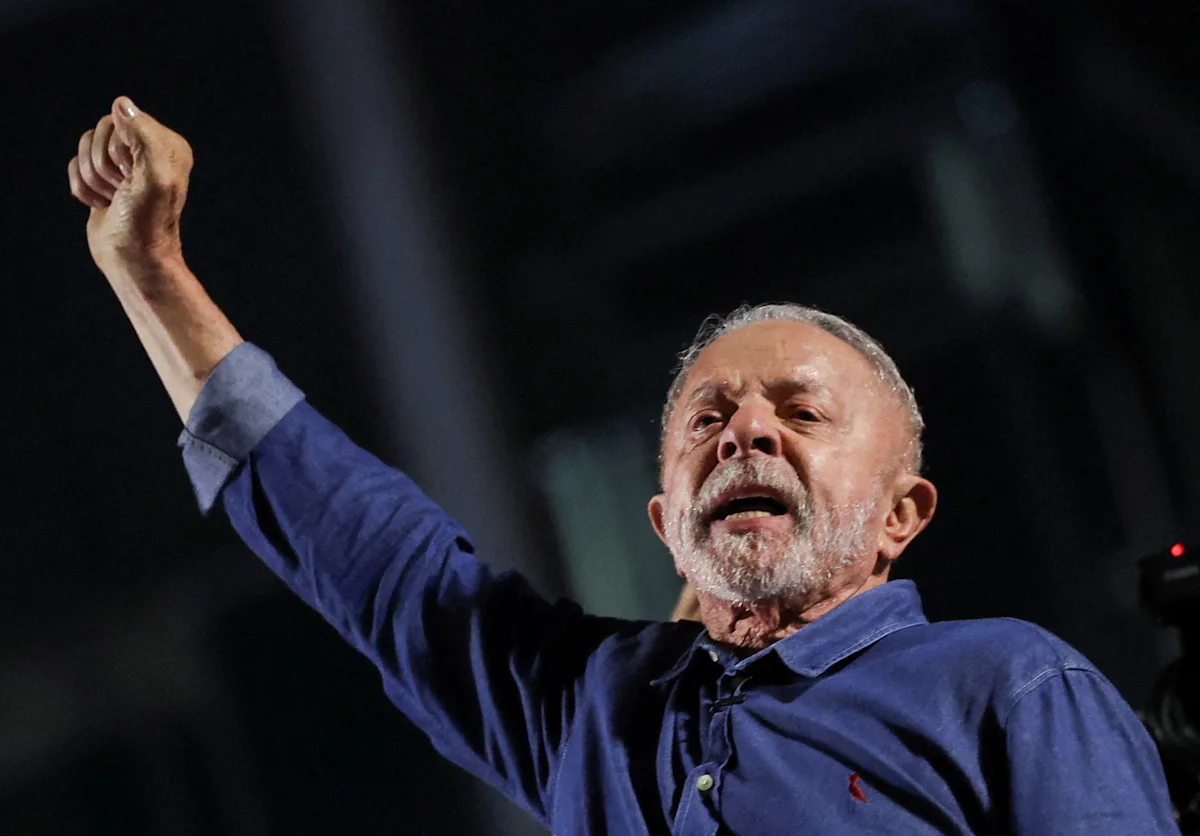
Brazilian stocks, the real and government bonds sold off sharply on October 26, 2026, after President Luiz Inácio Lula da Silva secured a fourth, non-consecutive term. The election result surprised investors positioned for a victory by Senator Flávio Bolsonaro, shifting attention toward Lula’s next finance minister and the government’s ability to contain debt without cutting essential spending.
Key Overview
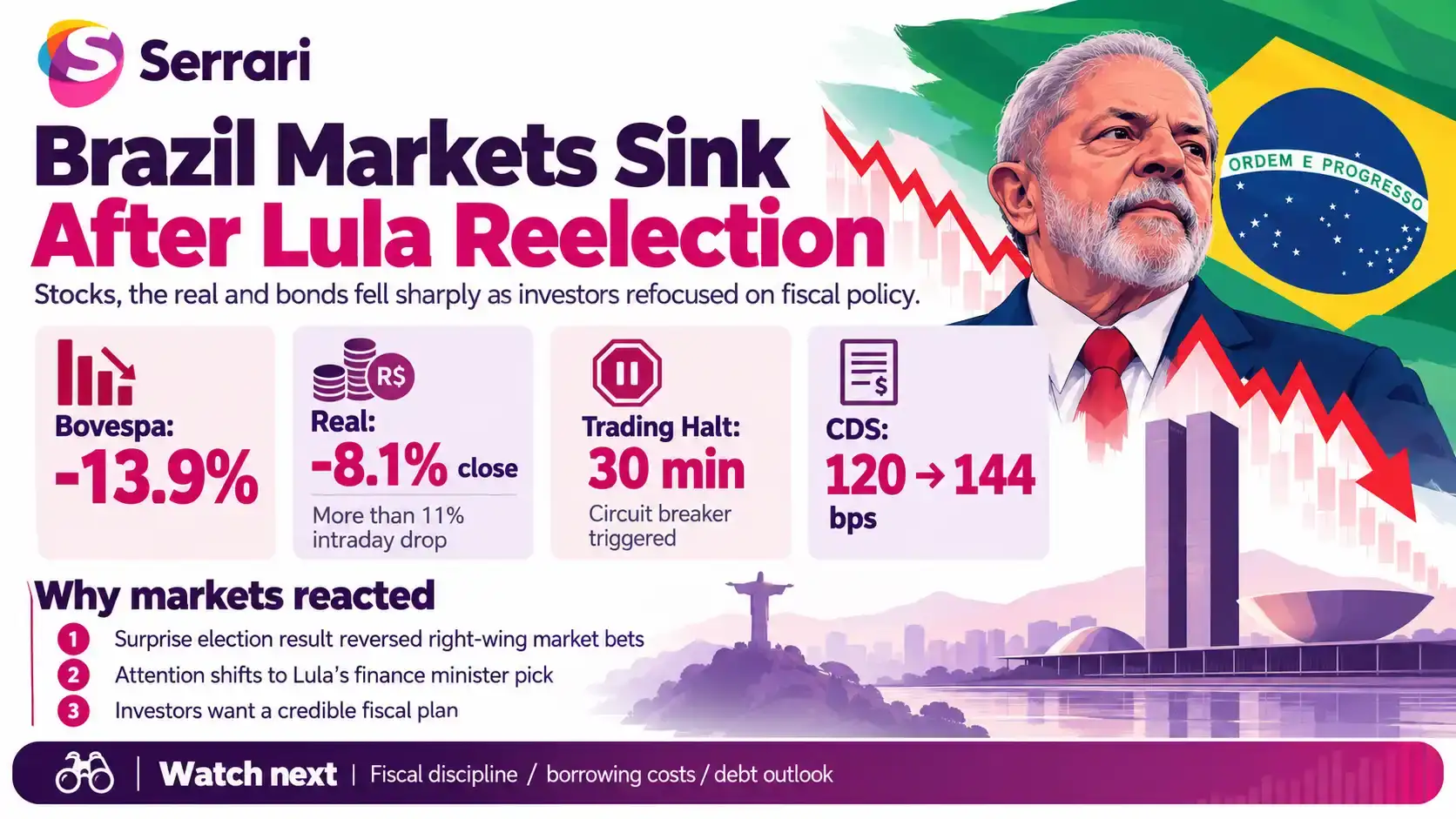
- The Ibovespa index fell 13.88% to 176,608.23 points, its worst daily percentage decline since March 2020.
- The dollar rose 8.21% against the real to around R$5.403, after briefly exceeding R$5.60.
- Stock trading stopped for 30 minutes when the market’s circuit breaker was triggered.
- Brazilian sovereign debt weakened, while five-year credit default swap spreads widened from roughly 120 to 144 basis points.
- Investors are watching Lula’s finance minister appointment and whether his administration presents a credible plan to stabilize government debt.
Election Surprise Triggers Historic Market Selloff
Brazil’s financial markets suffered a severe reversal after Lula defeated Senator Flávio Bolsonaro in the October 25 presidential runoff. The incumbent’s victory upset expectations formed after Bolsonaro led the opening round earlier in the month.
The benchmark Ibovespa index closed down 13.88%, with the selloff briefly pushing losses beyond 17% during trading. Exchange operator B3 halted stock trading for 30 minutes after the index breached the 10% decline threshold.
Currency markets were equally unsettled. The US dollar gained 8.21% against the real by the close, while its intraday high of about R$5.605 showed how dramatically investors had repriced Brazilian assets. The figures describe the dollar’s appreciation against the real; equivalently, Brazil’s currency weakened.
The declines unwound a pre-election rally that had lifted stocks and strengthened the real on expectations that a Bolsonaro presidency would pursue tighter fiscal policy. The market response reflects investors’ policy expectations rather than an immediate change in Brazil’s economic fundamentals.
Context is everything. Stay ahead of shifting trends with today’s market updates, and uncover emerging opportunities using the Serrari Group Market Index and Marketplace. Then, take control of your own financial future by exploring our Money & Life Reset Transformation Blueprint ™ to build stronger habits, create better systems, and design a path toward lasting wealth.
Government Bonds and Borrowing Costs Come Under Pressure
The turbulence spread beyond equities and foreign exchange. Longer-dated Brazilian government bonds lost value, with a dollar-denominated bond maturing in 2054 reportedly falling about 2.2 cents and its yield reaching 7.45%.
Five-year credit default swap spreads, an indicator of the cost of insuring against sovereign default, rose from approximately 120 to 144 basis points. The Brazilian Treasury also cancelled scheduled bond auctions for October 27 and 29 amid market volatility.
Higher government borrowing costs can spill into corporate lending and household credit. They also make managing public debt more difficult if refinancing costs remain elevated.
Brazil’s currency depreciation reverberated into commodities, with raw sugar prices falling as the weaker real improved the competitiveness of Brazilian exports priced in dollars.
Finance Minister Choice Becomes the Next Market Test
Investors are now assessing whether Lula’s administration can balance social programmes, employment objectives and public investment with a convincing approach to fiscal consolidation.
The president’s economic team has outlined a goal of achieving a budget surplus of about 1.3% of gross domestic product by 2030. Markets, however, are seeking specific measures on spending, revenues and debt stabilization rather than broad commitments.
Analysts also highlight the risk that persistent deficits could raise borrowing costs and weigh on Brazil’s credit outlook. Moody’s rates the country’s external sovereign debt Ba1, one notch below investment grade, with a stable outlook, according to coverage of the market reaction.
Political uncertainty has added another complication. Bolsonaro initially disputed the election outcome, although his party subsequently acknowledged Lula’s victory. Investors will be watching both the transition and the composition of the incoming economic team.
What the Selloff Means for Brazil’s Economy
The immediate market shock does not establish the longer-term direction of Brazil’s economy. That will depend on fiscal decisions, monetary conditions and whether the government can build sufficient political support for its proposals.
For investors, the clearest near-term signals will be the finance minister appointment, details of the fiscal programme and movements in bond yields and the exchange rate. A credible, measurable debt strategy could help reduce uncertainty; continued ambiguity risks keeping financing conditions tight.
Sources: Reuters / Agência Brasil / Associated Press
Your financial future isn’t something you wait for—it’s something you build.
The real question is: when do you begin?
Move beyond simply staying informed.
Navigate the markets with clarity—track trends through the Serrari Group Market Index, uncover opportunities in the Serrari Marketplace, and build practical knowledge with our Curated Wealth Builder Platform.
Stay connected to what truly matters.
Get daily insights on macro trends and financial movements across Kenya, Africa, and global markets—delivered through the Serrari Newsletter.
Growth opens doors.
Advance your career through professional programs including ACCA, HESI A2, ATI TEAS 7 , HESI EXIT , NCLEX – RN and NCLEX – PN, Financial Literacy!🌟—designed to move you forward with confidence.
See where money is flowing—clearly and in real time.
Track Money Market Funds, Treasury Bills, Treasury Bonds, Green Bonds, and Fixed Deposits, alongside global and African indexes, key economic indicators, and the evolving Crypto and stablecoin landscape—all within Serrari’s Market Index.