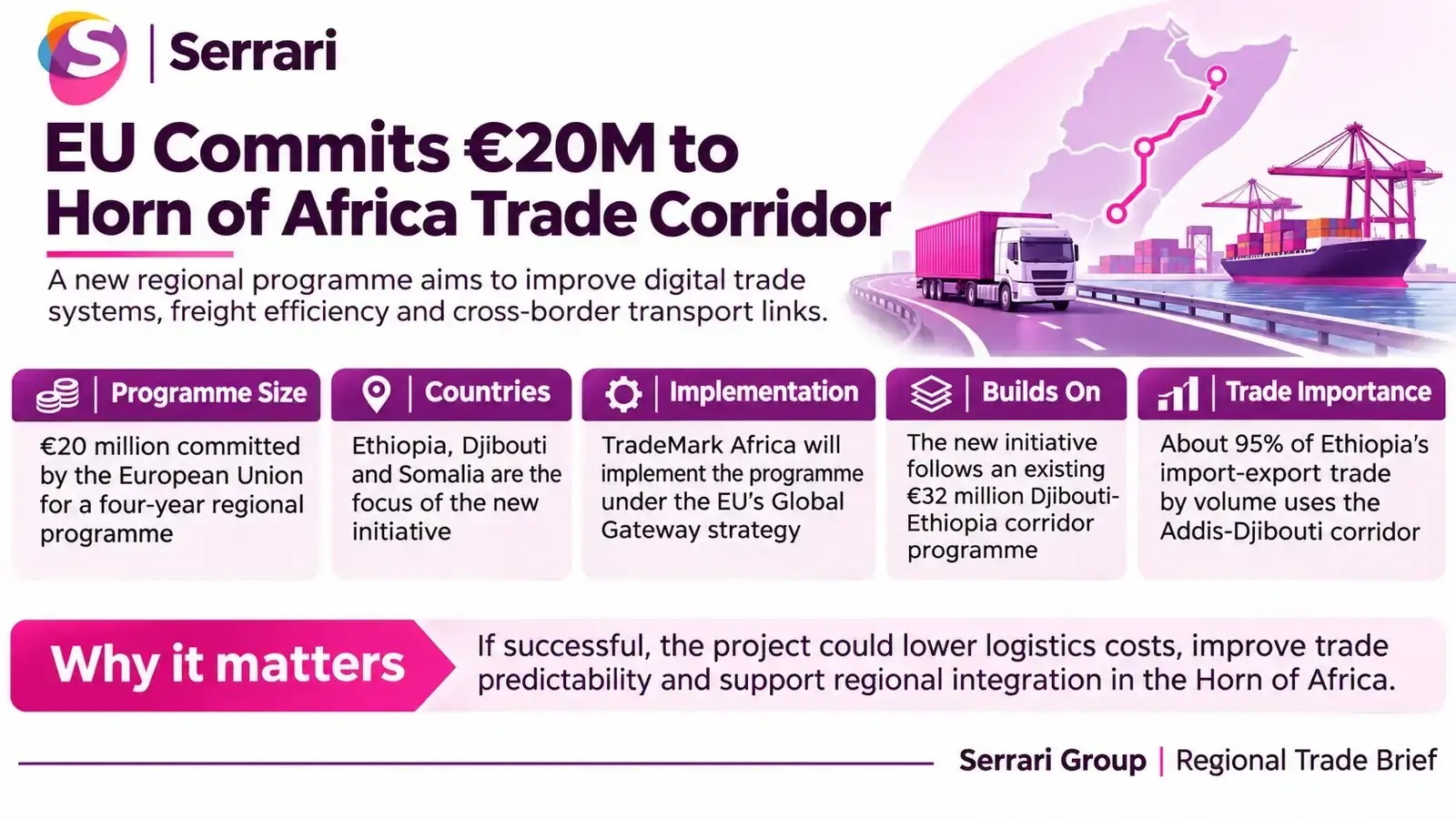
The European Union has committed €20 million to a four-year trade and transport programme covering Ethiopia, Djibouti and Somalia, seeking to reduce the cost and uncertainty of moving goods across the Horn of Africa. Announced during the Africa Trade and Development Forum in Addis Ababa in November 2026, the initiative will be implemented by TradeMark Africa under the EU’s Global Gateway strategy. Building on an existing €32 million bilateral corridor programme, the partnership prioritises digital trade procedures, agricultural export logistics and sustainable freight. Its broader significance lies in addressing regulatory and operational barriers that prevent existing transport infrastructure from generating its full economic value.
Key Overview
- The EU has committed €20 million to a four-year programme involving Ethiopia, Djibouti and Somalia.
- The initiative builds on an existing €32 million Ethiopia–Djibouti corridor programme.
- Approximately 95% of Ethiopia’s import and export trade by volume uses the Addis–Djibouti corridor.
- Digital certification, coordinated border procedures and sustainable logistics are central priorities.
- Earlier reforms have enabled more than 80 Ethiopian exporters to exchange electronic phytosanitary certificates.
- The programme supports regional integration and the implementation of the African Continental Free Trade Area.
Why the EU Is Investing in Regional Trade Efficiency
The new regional trade partnership announced on November 23, 2026, addresses a problem that cannot be solved by constructing roads and ports alone. Goods travelling between countries must also pass through regulatory systems, customs controls and commercial logistics networks that frequently operate under different procedures.
For businesses, the economic cost of transportation includes more than fuel and freight charges. Delays increase the amount of capital tied up in inventory, expose perishable products to deterioration and make delivery commitments harder to fulfil. Smaller businesses are particularly vulnerable because they generally have fewer financial resources to absorb unexpected expenses.
A manufacturer that cannot reliably estimate when imported components will arrive may need to maintain larger inventories. An agricultural exporter facing unpredictable inspection procedures may lose access to customers requiring consistent delivery schedules. These costs can weaken competitiveness even when physical infrastructure is adequate.
The EU’s approach seeks to address these operational barriers through shared systems and institutional cooperation. Rather than treating each border or transport route as an isolated project, it recognises that the performance of an entire supply chain depends on the efficiency of its weakest link.
This distinction explains why the €20 million commitment matters. Its potential economic value depends less on the absolute size of the funding than on whether it can improve the functioning of infrastructure and commercial networks already in place.
Ethiopia’s Dependence on Djibouti Creates a Strategic Economic Priority
The Addis–Djibouti corridor’s economic importance reflects Ethiopia’s position as a landlocked economy. More than 95% of its international merchandise trade by volume uses this route, according to the World Bank’s 2023 project announcement.
This concentration creates an interdependence between the two economies. Ethiopia requires dependable maritime access for imported machinery, fuel and other goods, while Djibouti benefits from the commercial activity generated by Ethiopian cargo passing through its logistics network.
A disruption along the corridor can therefore have consequences beyond transportation. Delayed imports may interrupt manufacturing schedules, increase inventories and raise the cost of goods reaching consumers. Export delays may reduce foreign exchange earnings when businesses cannot fulfil international orders.
Improving the reliability of the existing route can help reduce these vulnerabilities, although it does not eliminate the risks associated with dependence on a single principal trade gateway.
The new programme also complements separate infrastructure investments. In June 2026, the World Bank approved additional financing of $45 million for Djibouti’s regional economic corridor, reinforcing efforts to improve transport connectivity.
The distinction between these investments is important: physical infrastructure expands transport capacity, while coordinated trade procedures help businesses use that capacity efficiently. Neither intervention can deliver its full benefits without the other.
Digital Trade Systems Could Improve Agricultural Export Competitiveness
The existing €32 million bilateral corridor programme provides evidence of how administrative reforms can complement transport investment. Ethiopia launched an electronic phytosanitary certification system in October 2025, connecting agricultural export certification with an international digital exchange network.
Phytosanitary certificates demonstrate that agricultural products satisfy the plant health requirements of importing markets. Conventional paper-based procedures can create delays when documents are misplaced, require manual verification or must be transferred between agencies.
Digitisation can reduce these administrative difficulties and make certification records easier to verify. According to the programme’s November update, more than 80 exporters can exchange electronic certificates through a network reaching nearly 110 countries.
The same update reports that False Codling Moth-related interceptions declined from seven in 2023–24 to zero in 2024–25. This is an encouraging compliance indicator, but it does not establish that electronic certification alone caused the improvement. Pest management, inspection practices and exporter compliance also influence the outcome.
For agricultural businesses, the wider opportunity is to reduce the probability of costly shipment rejections and improve confidence among international buyers. Perishable exports are particularly sensitive to delays because their commercial value can decline while goods await clearance.
The benefits could extend to farmers if more reliable export channels support demand for agricultural produce. However, this will depend on how exporters share the gains and whether smaller producers can meet international quality and traceability requirements.
Context is everything. Stay ahead of shifting trends with today’s market updates, and uncover emerging opportunities using the Serrari Group Market Index and Marketplace. Then, take control of your own financial future by exploring our Money & Life Reset Transformation Blueprint ™ to build stronger habits, create better systems, and design a path toward lasting wealth.
Border Coordination and Cargo Tracking Address Hidden Logistics Costs
The Galafi border coordination initiative illustrates why cooperation between neighbouring governments matters as much as infrastructure investment. Ethiopia and Djibouti are working towards operating a one-stop border post, which would allow agencies on both sides to coordinate clearance more effectively.
Where border procedures are duplicated, traders may need to submit similar information repeatedly or wait for separate inspections. Coordinated processes can reduce unnecessary administrative work without removing legitimate safety, customs and security controls.
Djibouti’s electronic cargo tracking project has also completed user acceptance testing and technical training covering 12 system modules. The technology is intended to improve cargo monitoring and reduce transit delays once fully operational.
Testing is not equivalent to full deployment, however. The benefits depend on system reliability, staff training, consistent enforcement and the ability of neighbouring administrations to exchange relevant information securely.
For transport companies, predictable clearance times could improve vehicle utilisation and reduce expenses associated with trucks waiting at borders. Importers could also benefit from better delivery estimates, allowing them to manage inventories and working capital more efficiently.
These improvements matter particularly for small enterprises that cannot afford prolonged interruptions to their cash conversion cycles. Faster and more predictable delivery can reduce the time between paying suppliers and receiving revenue from customers.
Why Somalia’s Inclusion Changes the Regional Dimension
Extending the partnership to Somalia moves the initiative beyond the bilateral relationship between Ethiopia and Djibouti. It creates an opportunity to coordinate trade reforms across a broader regional market rather than optimising one corridor in isolation.
The Somalia regional road infrastructure programme identifies transport connectivity and cross-border commerce as important development priorities. Weak infrastructure and fragmented trade procedures can limit the country’s ability to attract logistics investment and participate in regional supply chains.
Coordinating digital documentation and transport standards could help businesses engage with neighbouring markets more easily. For Somalia, this may support formal commercial activity and improve opportunities for logistics providers and exporters.
Nevertheless, the €20 million programme cannot resolve every infrastructure, security or political constraint affecting regional trade. Its effectiveness will depend on continued government cooperation, institutional capacity and complementary investments in physical connectivity.
The regional approach is therefore significant because it establishes a framework for addressing shared problems, not because it guarantees immediate integration or unrestricted access to every port and market.
Greener Freight and the Economics of Sustainable Transport
The programme’s environmental objectives are closely connected to its commercial priorities. Trucks spending excessive time idling at borders consume fuel without generating productive transport services. Poor route coordination and inefficient vehicle utilisation can similarly increase operating costs and emissions.
The existing corridor fleet management initiative covers several transport routes between the two countries. Better visibility of freight movements can support operational planning and help identify recurring delays.
A proposed transport observatory could further improve decision-making by measuring logistics performance and transport-related emissions. Reliable data would allow governments to identify whether congestion, administrative procedures or infrastructure deficiencies are responsible for specific bottlenecks.
For exporters facing increasingly demanding environmental standards in international markets, more efficient freight operations could also strengthen competitiveness. However, achieving measurable emissions reductions will require credible baseline data and sustained changes in transport practices, not simply the introduction of monitoring technology.
What the €20 Million Commitment Means for African Trade Integration
The partnership supports the African Continental Free Trade Area by addressing practical barriers that can persist even when tariffs are reduced. The regional trade facilitation programme connects institutional reforms with the wider objective of improving market access.
A lower tariff offers limited commercial value if businesses still encounter lengthy clearance procedures, inconsistent documentation requirements or unreliable freight services. Making regional trade predictable is therefore essential to converting preferential market access into actual transactions.
The programme’s success should be assessed through measurable outcomes, including clearance times, logistics costs, digital system adoption, shipment reliability and participation by smaller enterprises. Announcing funding or installing equipment is only an intermediate step.
Ultimately, the EU’s €20 million commitment reflects a recognition that the Horn of Africa’s trade potential depends on more than expanding physical transport capacity. The region needs coordinated institutions, reliable digital systems and commercially efficient logistics. If the three governments can sustain those reforms beyond the four-year programme, the investment could help businesses participate more effectively in regional and international commerce.
Sources: TradeMark Africa / World Bank / African Development Bank
Your financial future isn’t something you wait for—it’s something you build.
The real question is: when do you begin?
Move beyond simply staying informed.
Navigate the markets with clarity—track trends through the Serrari Group Market Index, uncover opportunities in the Serrari Marketplace, and build practical knowledge with our Curated Wealth Builder Platform.
Stay connected to what truly matters.
Get daily insights on macro trends and financial movements across Kenya, Africa, and global markets—delivered through the Serrari Newsletter.
Growth opens doors.
Advance your career through professional programs including ACCA, HESI A2, ATI TEAS 7 , HESI EXIT , NCLEX – RN and NCLEX – PN, Financial Literacy!🌟—designed to move you forward with confidence.
See where money is flowing—clearly and in real time.
Track Money Market Funds, Treasury Bills, Treasury Bonds, Green Bonds, and Fixed Deposits, alongside global and African indexes, key economic indicators, and the evolving Crypto and stablecoin landscape—all within Serrari’s Market Index.