
Ukraine’s parliament has approved legislation to legalise and regulate the country’s cryptocurrency market, establishing licensing requirements for crypto service providers, investor protection measures and a tax framework for digital asset transactions. Bill No. 10225-d passed its second reading and was adopted in full on 25 November 2026, with 271 lawmakers voting in favour. Most of its provisions are scheduled to take effect on 1 July 2027, subject to presidential signature. The framework divides regulatory responsibilities between the National Securities and Stock Market Commission and the National Bank of Ukraine. Individuals will generally pay an 18% personal income tax and a 5% military levy on taxable net annual crypto profits.
Key Takeaways
- Ukraine’s parliament approved Bill No. 10225-d on 25 November 2026, with 271 lawmakers voting in favour.
- The framework is expected to take effect on 1 July 2027, but it still requires President Volodymyr Zelensky’s signature.
- Crypto exchanges and custody providers will require authorisation and face reporting, disclosure and risk-management requirements.
- Individuals will generally pay 18% personal income tax and a 5% military levy on taxable net annual cryptocurrency profits.
- Crypto-to-crypto exchanges will be exempt from taxation, while eligible losses can be carried forward to offset future gains.
- Regulatory responsibilities will be shared between the National Securities and Stock Market Commission and the National Bank of Ukraine.
Ukraine Moves to Establish a Regulated Cryptocurrency Market
Ukraine has taken a significant step towards formalising its cryptocurrency industry after parliament approved legislation establishing rules for digital asset businesses, investors and financial regulators.
On 25 November 2026, the Verkhovna Rada adopted Bill No. 10225-d in its second reading and as a whole, with 271 lawmakers voting in favour. The legislation amends the Tax Code and other laws to introduce operating requirements for crypto businesses, define regulatory responsibilities and establish how individuals’ cryptocurrency profits will be taxed.
The bill’s main provisions are expected to take effect on 1 July 2027, although it still requires President Volodymyr Zelensky’s signature before becoming binding.
The decision follows several months of legislative discussions. The bill passed its first reading on 3 September 2025, before further consultations and amendments led to its final parliamentary approval.
The move is important because it provides a route towards bringing cryptocurrency activities within a formal legal and supervisory framework rather than leaving businesses and investors operating under an incomplete regulatory structure.
The legislation covers the duties of financial regulators, operating requirements for crypto businesses and protections for retail investors.
For Ukraine, the objective is not simply to introduce taxes on digital assets. It is also to establish who can provide cryptocurrency services, how customer assets should be protected and how transactions involving digital assets should be monitored.
Two Regulators Will Share Oversight
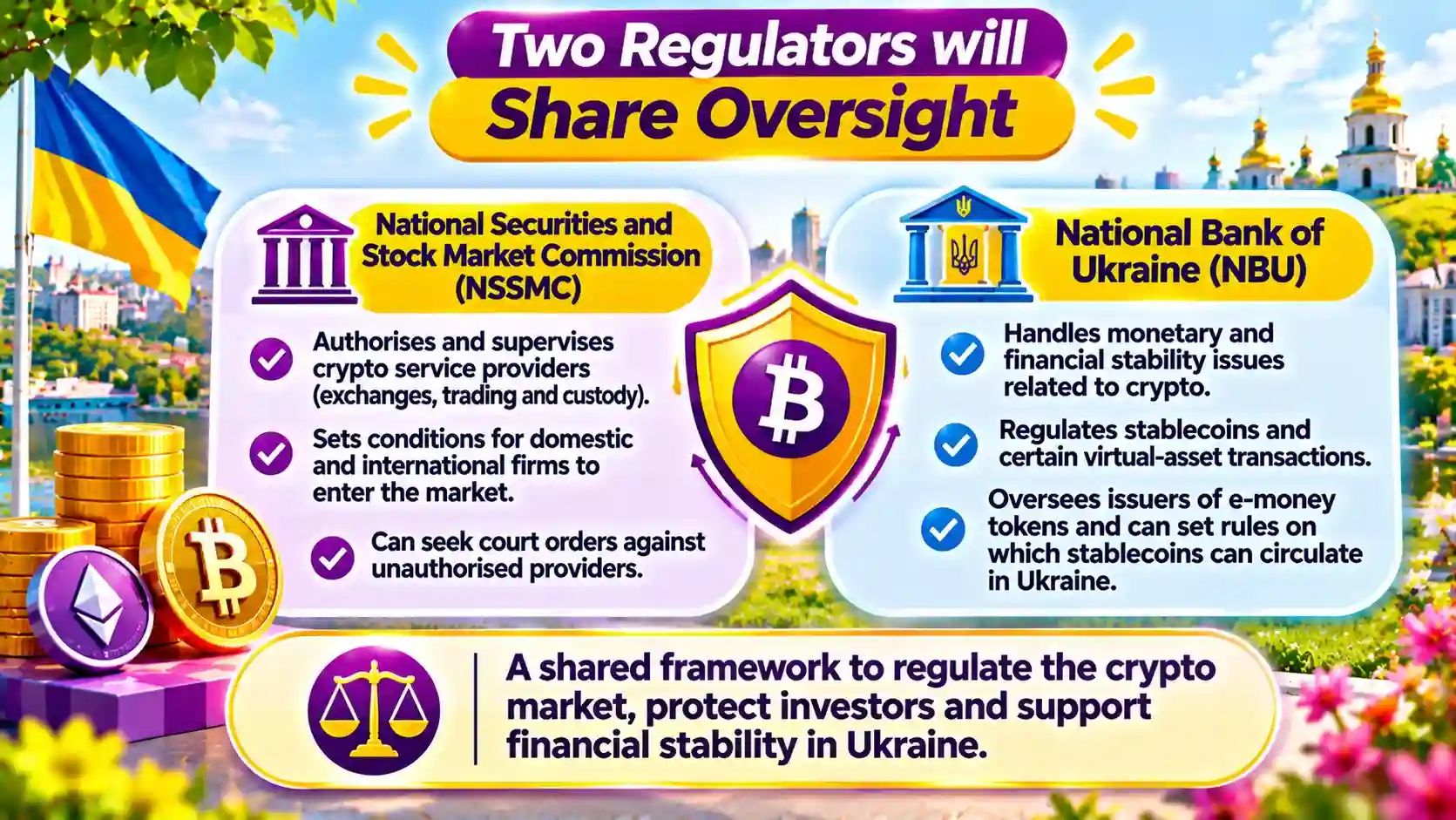
One of the central features of the legislation is the division of responsibilities between two financial authorities: the National Securities and Stock Market Commission (NSSMC) and the National Bank of Ukraine (NBU).
The NSSMC will oversee the authorisation and supervision of virtual-asset service providers, including businesses offering crypto trading, exchange and custody services.
The commission will establish the conditions under which domestic and international firms can enter the market. It will also supervise authorised platforms and can seek court orders against providers operating without permission.
The National Bank of Ukraine will handle responsibilities involving monetary and financial stability, including the regulation of stablecoins and certain transactions involving virtual assets and money.
The NBU will also be responsible for issuers of e-money tokens and will be able to establish rules governing the use of stablecoins, including whether particular tokens can circulate in Ukraine.
This division is intended to separate the supervision of crypto service providers from issues involving monetary stability and the relationship between digital assets and conventional money.
The arrangement is particularly relevant as stablecoins become increasingly important in digital payments and cryptocurrency markets. Their value is typically linked to an underlying currency or other asset, making their issuance and circulation a concern for financial authorities.
However, the final regulatory framework will depend partly on the secondary regulations that the NSSMC and NBU develop before the law takes effect.
What Changes for Cryptocurrency Exchanges?
The legislation introduces authorisation requirements for companies providing cryptocurrency-related services.
Crypto exchanges, trading platforms and custody providers will need approval to operate within the regulated market. They will also face requirements covering disclosure, risk management, customer protection and measures against market manipulation.
One important requirement concerns the separation of customer assets from company assets.
Companies that hold crypto for customers must keep corporate and client assets separate, helping protect investors if a service provider encounters financial difficulties or operational problems.
The framework also introduces reporting obligations. Exchanges and custody providers will be required to submit annual reports on transactions involving Ukrainian residents.
This reporting requirement is described as an initial step towards alignment with international tax transparency initiatives, including the OECD’s Crypto-Asset Reporting Framework (CARF) and the European Union’s DAC8 rules.
These frameworks are designed to improve the exchange of information about cryptocurrency transactions and help tax authorities monitor digital asset activity.
The legislation also introduces measures aimed at protecting consumers from misleading promotions.
Misleading cryptocurrency advertising will be prohibited, including advertisements presenting digital currencies as a means of payment in Ukraine or promising guaranteed investment returns.
Financial monitoring will also be strengthened through source-of-funds checks modelled on those used in the banking sector. Whistleblowers who report regulatory breaches will receive legal protection.
Although penalties will apply for violations, the legislation provides for substantially reduced penalties during the transitional period as the market adjusts to the new requirements.
Together, these measures are intended to establish clearer operating standards and make it easier for regulators to identify businesses that fail to meet their obligations.
Context is everything. Stay ahead of shifting trends with today’s market updates, and uncover emerging opportunities using the Serrari Group Market Index and Marketplace. Then, take control of your own financial future by exploring our Money & Life Reset Transformation Blueprint ™ to build stronger habits, create better systems, and design a path toward lasting wealth.
How Cryptocurrency Profits Will Be Taxed
Taxation is another major part of the legislation, with Ukraine seeking to establish how individuals should report and pay tax on profits earned from cryptocurrency transactions.
Under the general framework described in the supplied reports, individuals will pay an 18% personal income tax and a 5% military levy on taxable net annual profits.
This means that taxation will generally apply to profits rather than the total value of every cryptocurrency transaction.
For example, an investor who sells cryptocurrency at a profit would calculate the taxable gain under the applicable rules rather than automatically paying tax on the entire amount received from the sale.
The legislation also provides for several exemptions and adjustments.
Swapping one virtual asset for another will not be taxed, meaning that exchanging one cryptocurrency for another will not automatically trigger a tax liability under the framework.
Investors will also be able to carry forward eligible losses to offset future cryptocurrency gains. The supplied reporting further identifies an exemption for profits within one minimum wage and tokens received free of charge.
These provisions are intended to distinguish taxable investment gains from transactions that do not necessarily represent realised profits in traditional currency.
Preferential Tax Treatment for Existing Holdings
The legislation also provides a transitional arrangement for individuals who acquired cryptocurrency before the new rules take effect.
Investors with qualifying existing holdings will be able to opt for a reduced 5% personal income tax rate when converting those assets into fiat currency during 2027 and 2028. The 5% military levy will also apply.
Under this option, the two levies are applied to the full sale proceeds rather than the net annual profit used under the general framework.
The arrangement provides an opportunity for existing holders to bring previously acquired assets into the new tax framework under preferential conditions.
However, investors will need to understand the eligibility requirements and applicable calculation rules before relying on the transitional option.
The supplied materials do not provide a complete explanation of how every activity, including staking, mining and corporate cryptocurrency holdings, will be treated. Further clarification will therefore be necessary as the authorities develop the detailed regulations.
Expected Contribution to Government Revenue
The legislation is also expected to create an additional source of revenue for the Ukrainian government.
Yaroslav Zhelezniak, first deputy chair of parliament’s finance, tax and customs committee, estimated that the framework could generate an additional UAH 15 billion in budget revenue.
This estimate highlights the government’s expectation that formalising cryptocurrency activity and introducing taxation will help bring more digital asset-related economic activity into the official tax system.
However, the projected revenue will depend on how the market responds, how effectively the new requirements are implemented and the level of taxable cryptocurrency activity.
Ukraine’s Move Towards European Union Crypto Standards
The legislation has also been developed with reference to the European Union’s Markets in Crypto-Assets Regulation (MiCA).
MiCA establishes a regulatory framework for crypto-asset markets across the EU, covering areas such as authorisation, transparency, consumer protection and the responsibilities of crypto service providers.
The NSSMC said the Ukrainian legislation incorporates the main approaches of MiCA and forms part of the country’s commitments to the European Union and the International Monetary Fund.
Crypto regulation is also linked to Ukraine’s commitments under the EU’s Ukraine Facility, with the legislative requirement originally due to be met in the third quarter of 2026.
For Ukraine, aligning its cryptocurrency rules with European standards is part of a wider effort to bring its financial and regulatory systems closer to those of the EU as it pursues membership.
The legislation could also make the country’s digital asset market more accessible to businesses seeking a clearer regulatory environment.
The NSSMC has argued that formalising the market could help attract investment and increase government revenue.
Nevertheless, adopting legislation that reflects European standards does not automatically mean that Ukraine’s market will operate identically to the EU’s. The effectiveness of the framework will depend on its implementation, supervision and enforcement.
Why Does This Matter Now?
Ukraine’s decision comes as governments increasingly seek to establish clearer rules for cryptocurrency businesses, digital asset transactions and stablecoin activity.
Without clear authorisation requirements, consumer protections and reporting obligations, investors may face uncertainty about the responsibilities of service providers and the safeguards available when something goes wrong.
For cryptocurrency businesses, the new framework introduces a more defined route to operating legally in Ukraine. However, authorisation, compliance and reporting requirements will also create additional responsibilities and costs.
For investors, the tax provisions clarify the general treatment of cryptocurrency profits, provide an exemption for crypto-to-crypto exchanges and establish a transitional arrangement for eligible existing holdings.
The legislation also matters for Ukraine’s relationship with international financial and regulatory institutions. Its alignment with MiCA and commitments to the EU and IMF place crypto regulation within the country’s broader efforts to strengthen its financial framework.
The central challenge will be balancing stronger oversight with an environment that allows legitimate businesses to operate and develop.
The Bigger Picture: Cryptocurrency Regulation Is Becoming More Formalised
Ukraine’s legislation reflects a wider shift towards bringing digital assets within established financial and tax systems.
Rather than treating cryptocurrency solely as a technology or investment trend, regulators are increasingly addressing the activities surrounding it: trading, custody, stablecoin issuance, advertising, customer protection and taxation.
The emphasis on separating customer assets, monitoring transactions and licensing service providers shows that Ukraine’s approach extends beyond collecting tax revenue.
It is also an attempt to establish accountability across the cryptocurrency industry.
The reference to MiCA, CARF and DAC8 is particularly relevant because digital asset markets operate across national borders. Differences in reporting and regulatory requirements can create challenges for authorities seeking to monitor transactions involving residents and international service providers.
Ukraine’s framework is therefore designed to address domestic market supervision while moving towards greater consistency with international regulatory approaches.
However, the legislation’s adoption is only one stage of that process. The development of secondary regulations, licensing arrangements and effective enforcement will determine whether the new framework achieves its intended objectives.
Outlook: What Happens Before July 2027?
The next step is presidential approval. The bill still requires President Volodymyr Zelensky’s signature before it becomes binding.
After that, the NSSMC and NBU will need to prepare the detailed regulations required to operationalise the framework.
The NSSMC has identified the preparation of secondary rules as its next priority. These will be important in defining how crypto businesses apply for authorisation, meet compliance requirements and operate under the new system.
Businesses will also need to prepare for the new reporting, disclosure and customer asset protection obligations ahead of the expected July 2027 implementation date.
For investors, the main considerations will include understanding the tax treatment of their holdings, keeping appropriate transaction records and determining whether they qualify for the transitional tax arrangement.
The legislation represents an important step towards establishing a regulated cryptocurrency market in Ukraine. However, its practical impact will depend on presidential approval, the quality of the implementing rules and the ability of regulators to enforce them.
For now, the parliamentary vote signals a clear move towards greater oversight of digital assets, but the regulated market is not yet fully operational.
Frequently Asked Questions
1. Has Ukraine officially legalised cryptocurrency?
Ukraine’s parliament approved Bill No. 10225-d on 25 November 2026, establishing a framework to legalise and regulate the cryptocurrency market. However, the bill still requires President Volodymyr Zelensky’s signature before becoming binding.
2. When will Ukraine’s new cryptocurrency regulations take effect?
The main provisions are scheduled to take effect on 1 July 2027, subject to presidential approval and the development of the necessary implementing regulations.
3. How will cryptocurrency profits be taxed in Ukraine?
Individuals will generally pay an 18% personal income tax and a 5% military levy on taxable net annual cryptocurrency profits. Crypto-to-crypto exchanges will be exempt, and eligible losses can be carried forward.
4. Which authorities will regulate cryptocurrency in Ukraine?
The National Securities and Stock Market Commission will oversee the authorisation and supervision of crypto service providers, while the National Bank of Ukraine will handle responsibilities involving stablecoins, e-money tokens and monetary and financial stability.
Your financial future isn’t something you wait for—it’s something you build.
The real question is: when do you begin?
Move beyond simply staying informed.
Navigate the markets with clarity—track trends through the Serrari Group Market Index, uncover opportunities in the Serrari Marketplace, and build practical knowledge with our Curated Wealth Builder Platform.
Stay connected to what truly matters.
Get daily insights on macro trends and financial movements across Kenya, Africa, and global markets—delivered through the Serrari Newsletter.
Growth opens doors.
Advance your career through professional programs including ACCA, HESI A2, ATI TEAS 7 , HESI EXIT , NCLEX – RN and NCLEX – PN, Financial Literacy!🌟—designed to move you forward with confidence.
See where money is flowing—clearly and in real time.
Track Money Market Funds, Treasury Bills, Treasury Bonds, Green Bonds, and Fixed Deposits, alongside global and African indexes, key economic indicators, and the evolving Crypto and stablecoin landscape—all within Serrari’s Market Index.