Microsoft has reaffirmed its long-term commitment to South Africa’s technology ecosystem following President Cyril Ramaphosa’s November 2026 working visit to Silicon Valley. The engagement builds on the company’s earlier R5.4 billion cloud and artificial intelligence infrastructure investment plan through 2027. South Africa wants to move beyond consuming imported AI products towards developing intellectual property, building technology companies and exporting digital services. Achieving that ambition will require more than foreign investment, however, as affordable computing capacity, reliable electricity, specialist skills and effective data governance will determine how much economic value the country retains.
Key Overview
- Microsoft reaffirmed its commitment to South Africa’s AI development following discussions with the presidential delegation in Silicon Valley.
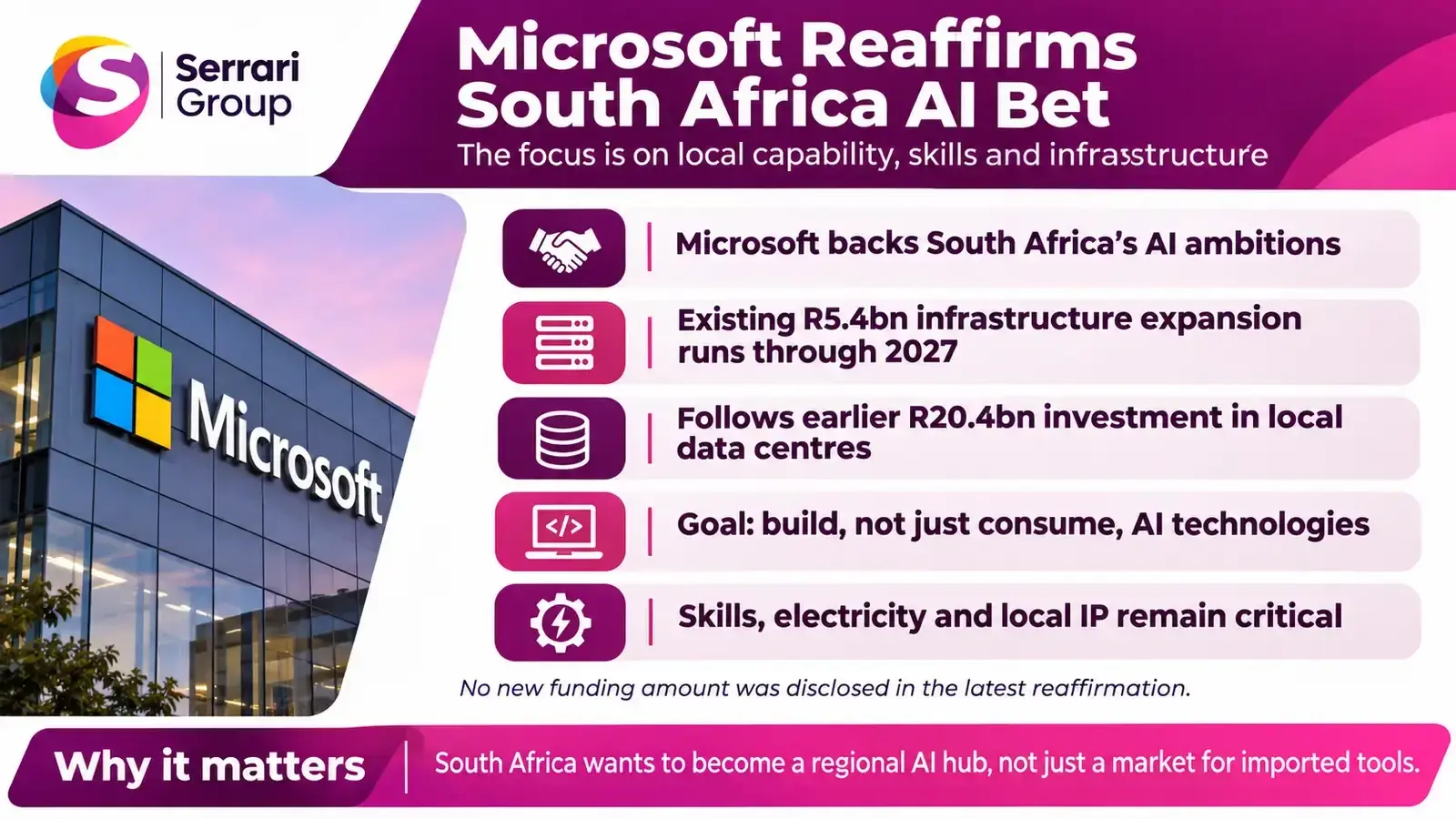
- Its previously announced R5.4 billion infrastructure expansion is targeted for completion by the end of 2027.
- The investment builds on R20.4 billion in earlier spending associated with its South African data centre infrastructure.
- Microsoft previously announced funding for 50,000 people to pursue professional digital certifications.
- South Africa wants to attract computing infrastructure investment serving its domestic economy and the wider African market.
- The November engagement did not disclose an additional quantified investment commitment.
Why Microsoft Is Deepening Its South African Commitment
Microsoft’s renewed commitment to South Africa reflects an alignment between the technology company’s commercial ambitions and the government’s desire to participate more actively in the global artificial intelligence economy.
During President Cyril Ramaphosa’s working visit to Silicon Valley, discussions with Microsoft addressed AI capabilities, digital skills, investment and the management of national data. The engagement formed part of a wider effort to establish partnerships with technology companies and research institutions.
Microsoft South Africa chief executive Vukani Mngxati subsequently emphasised the importance of local entrepreneurship, technology development and intellectual property creation. His reaffirmation of long-term investment positioned South Africa as a potential contributor to global AI innovation rather than merely a destination for imported software.
For Microsoft, the commercial opportunity is substantial. As banks, retailers, manufacturers and public institutions digitise their operations, they require computing infrastructure, cybersecurity systems, data storage and increasingly sophisticated analytical tools.
Providing these services locally can help the company attract customers whose operational or regulatory requirements make overseas hosting less attractive. It can also deepen relationships with businesses that may subsequently adopt more advanced AI products.
The strategic significance of the investment therefore extends beyond selling software licences. Microsoft is positioning itself to supply infrastructure on which other companies may build their own products and services, creating opportunities for recurring revenue as digital adoption increases.
The R5.4 Billion Investment and the Economics of AI Infrastructure
In March 2025, Microsoft announced a R5.4 billion expansion plan to increase its cloud and AI infrastructure capacity in South Africa by the end of 2027. The announcement reflected growing regional demand for its Azure cloud services.
That investment follows earlier expenditure of R20.4 billion associated with establishing enterprise-grade data centres in Johannesburg and Cape Town. Together, these amounts represent R25.8 billion in historical investment and announced expansion plans, rather than confirmation that the entire amount has already been spent.
The November 2026 engagement reinforces the earlier strategy but does not establish a fresh multibillion-rand funding package.
Local computing infrastructure matters because developing and operating AI applications requires access to processors, storage systems and reliable communications networks. Purchasing dedicated equipment can be prohibitively expensive for smaller technology companies.
Cloud services allow businesses to rent computing capacity instead of financing their entire infrastructure upfront. This can lower barriers to entry, enable faster experimentation and allow developers to increase capacity as demand grows.
Nevertheless, the availability of domestic data centres does not automatically make AI affordable. Subscription charges, specialist processing requirements and the pricing of advanced models can still constrain smaller businesses.
The economic test is whether the expansion results in computing services that local entrepreneurs can afford, not merely an increase in installed infrastructure capacity.
Digital Sovereignty Does Not Necessarily Mean Isolation
One of the most consequential aspects of Microsoft’s engagement is the relationship between foreign technology investment and digital sovereignty.
Digital sovereignty concerns a country’s ability to exercise meaningful control over its data, digital infrastructure and technology governance. For governments, this includes deciding how sensitive public information is stored, accessed, processed and protected.
South Africa’s national digital sovereignty agenda recognises that cybersecurity, technological change and geopolitical developments require adaptable governance and clear public-interest objectives.
Foreign-owned data centres can support some sovereignty objectives by enabling domestic hosting and reducing dependence on distant infrastructure. However, physical data residency is not equivalent to complete technological independence.
Ownership of software, control over encryption keys, contractual access rights and the ability to transfer workloads between providers remain important considerations. A locally hosted application can still depend on proprietary technology controlled by an overseas company.
South Africa consequently faces a balancing act. Restricting access to international technology could slow innovation and increase costs, while excessive dependence on a single provider could weaken competition and bargaining power.
An effective approach would combine international partnerships with clear data protection requirements, interoperable systems and procurement arrangements that preserve the ability to change suppliers. Such safeguards could help the country benefit from global expertise without surrendering control over critical digital functions.
Context is everything. Stay ahead of shifting trends with today’s market updates, and uncover emerging opportunities using the Serrari Group Market Index and Marketplace. Then, take control of your own financial future by exploring our Money & Life Reset Transformation Blueprint ™ to build stronger habits, create better systems, and design a path toward lasting wealth.
Skills and Intellectual Property Will Determine Local Value Creation
Data centres are an important foundation for AI development, but the largest long-term economic gains may come from the businesses and skilled workers using that infrastructure.
Microsoft previously announced an expanded digital certification initiative funding 50,000 people to pursue qualifications in areas including artificial intelligence, data science, cybersecurity and cloud architecture.
Such programmes can help address skills shortages, although certification alone cannot guarantee employment or entrepreneurial success. Employers also require practical experience, industry knowledge and the ability to translate technical capabilities into commercially useful products.
For South Africa, the distinction between adopting AI and producing AI-enabled intellectual property is particularly important. A business purchasing an overseas automation product may improve productivity, but a domestic company developing and exporting its own software can also generate intellectual property income and create specialist jobs.
Local developers do not necessarily need to build expensive general-purpose AI models from scratch. They can develop specialised applications using existing models, improve systems for local languages or build industry-specific tools adapted to African operating conditions.
Potential markets include financial fraud detection, agricultural forecasting, mining safety and healthcare administration. These are opportunities rather than confirmed projects arising from the November meeting.
The challenge is to ensure that promising companies have access to financing, customers and technical support. Without those conditions, trained workers may struggle to find suitable employment, while successful start-ups may relocate to markets offering better access to capital.
Electricity and Regulation Could Limit South Africa’s Ambitions
President Ramaphosa’s AI investment strategy outlined in Silicon Valley envisages South Africa becoming a destination for computing infrastructure serving both domestic and continental demand.
However, large computing facilities require reliable electricity, sufficient network connectivity and appropriate cooling infrastructure. Interruptions in power supply can increase operating costs and undermine service reliability. Developers must also consider water consumption where their cooling systems require it.
The opportunity cost of allocating electricity and other resources to data centres deserves attention. Infrastructure investment should contribute to broader economic development rather than simply competing with households and established industries for constrained resources.
Regulatory certainty is equally important. The government’s June 2026 Cabinet statement confirmed the withdrawal of an earlier draft AI policy. That development illustrates the need for credible policy design before translating AI ambitions into enforceable governance arrangements.
Businesses need predictable rules governing sensitive information, accountability and the deployment of automated systems. At the same time, excessive compliance costs could disproportionately burden smaller developers.
A proportionate regulatory approach would distinguish higher-risk applications, such as those affecting access to credit or essential services, from lower-risk business productivity tools.
What South Africa’s AI Strategy Means for the Wider Continent
South Africa’s ambition has implications for other African economies seeking to participate in the expanding digital services market.
Regional computing infrastructure could provide additional hosting and processing options for African businesses. However, cross-border data requirements, internet transit costs and differences in national regulation will influence whether those services are commercially attractive outside South Africa.
For Kenya, the potential opportunity includes partnerships between software developers, financial technology companies and regional infrastructure providers. Kenyan businesses could benefit from additional cloud capacity where pricing, performance and regulatory requirements are suitable.
Equally, South Africa’s investment drive creates competition for other countries seeking to attract technology capital and highly skilled workers. African governments will increasingly need to demonstrate the quality of their infrastructure, talent pipelines and investment environments rather than relying solely on the size of their domestic markets.
The broader objective should be a more connected African digital economy in which businesses can develop products in one country, access infrastructure in another and sell services across multiple markets.
Microsoft’s commitment offers South Africa an opportunity to strengthen its position within that economy. The decisive measure of success, however, will be the emergence of sustainable local technology businesses, internationally competitive digital services and productivity improvements that extend beyond the technology sector itself.
Sources Used
Tech Review Africa / SAnews / Reuters / Microsoft / South African Government
Your financial future isn’t something you wait for—it’s something you build.
The real question is: when do you begin?
Move beyond simply staying informed.
Navigate the markets with clarity—track trends through the Serrari Group Market Index, uncover opportunities in the Serrari Marketplace, and build practical knowledge with our Curated Wealth Builder Platform.
Stay connected to what truly matters.
Get daily insights on macro trends and financial movements across Kenya, Africa, and global markets—delivered through the Serrari Newsletter.
Growth opens doors.
Advance your career through professional programs including ACCA, HESI A2, ATI TEAS 7 , HESI EXIT , NCLEX – RN and NCLEX – PN, Financial Literacy!🌟—designed to move you forward with confidence.
See where money is flowing—clearly and in real time.
Track Money Market Funds, Treasury Bills, Treasury Bonds, Green Bonds, and Fixed Deposits, alongside global and African indexes, key economic indicators, and the evolving Crypto and stablecoin landscape—all within Serrari’s Market Index.