The African Development Bank (AfDB) and the Korea-Africa Economic Cooperation Trust Fund are advancing plans to develop impact-investment instruments for small businesses in North Africa. The initiative, launched through a workshop in Rabat on November 23, 2026, brings together stakeholders from Morocco, Egypt and Tunisia to address financing constraints that restrict entrepreneurship and employment. Against a global formal MSME financing shortfall of US$4 trillion across emerging and developing economies, the programme seeks to mobilise private capital while demonstrating measurable development outcomes. Its success will depend on whether new financing structures can improve access to affordable capital without transferring excessive risks to governments or investors.
Key Overview
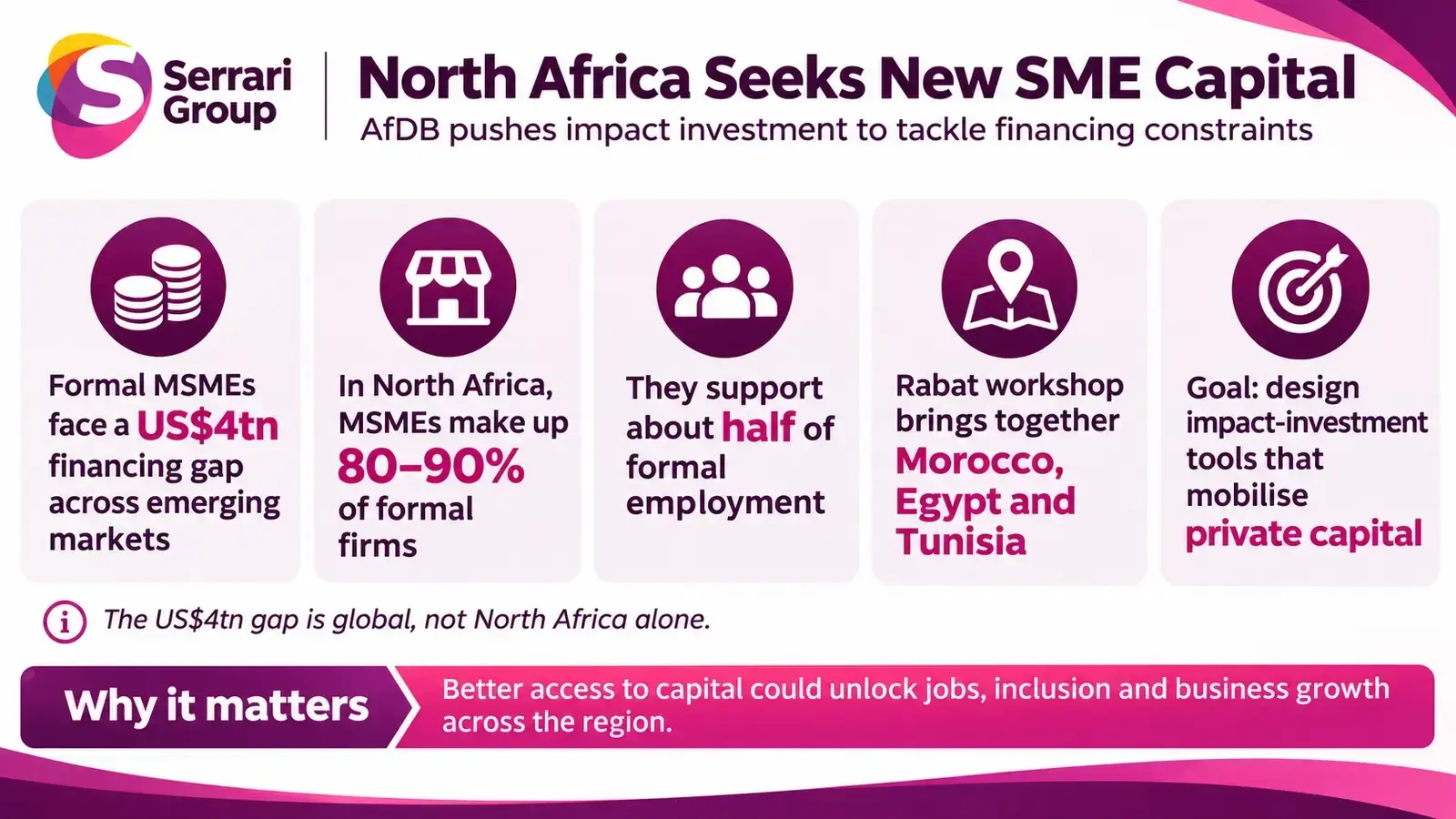
- Formal MSMEs in emerging markets and developing economies face an estimated US$4 trillion financing gap, based on 2023 data.
- North African MSMEs account for 80–90% of formal enterprises and approximately half of formal employment.
- The Rabat initiative brings together around 100 representatives from Morocco, Egypt and Tunisia.
- A three-day technical masterclass follows the November 23 workshop.
- Participants are examining investment structures, governance, safeguards and methods of measuring development outcomes.
- No final fund size or capital commitment was disclosed in the workshop announcement.
Why Conventional Financing Is Failing Small Businesses
North Africa’s efforts to stimulate private-sector employment face a structural obstacle: many smaller enterprises cannot obtain the financing needed to expand production, acquire equipment or recruit additional workers.
The AfDB’s November 2026 initiative in Rabat seeks to address this problem through investment instruments that combine commercial financing objectives with measurable development outcomes.
The challenge is not necessarily an absence of entrepreneurial demand. Rather, the financial system frequently struggles to assess and price the risks associated with smaller businesses.
Commercial lenders typically rely on financial statements, credit histories, collateral and predictable cash flows when evaluating borrowers. Smaller enterprises may have viable commercial opportunities but lack the documentation or assets necessary to satisfy conventional underwriting requirements.
Transaction costs also matter. Assessing a small loan can require much of the same administrative work as assessing a substantially larger facility, while generating less absolute interest income. This can discourage banks from serving smaller borrowers, especially when alternative investments offer attractive returns with lower administrative costs.
The result is a financing market in which potentially productive enterprises may remain undercapitalised, restricting their ability to hire workers or participate in larger supply chains.
Understanding the US$4 Trillion Financing Gap
The latest assessment of MSME financing demand estimates that formal enterprises across emerging markets and developing economies faced potential financing demand of US6.4 trillion in formal credit supply.
The difference amounts to US$4 trillion, representing approximately 38.5% of estimated potential demand. It is a global emerging-market estimate, not the financing shortfall of Morocco, Egypt and Tunisia alone.
This distinction matters because the appropriate size of any North African investment vehicle must be determined using country-specific evidence rather than a global headline figure. The estimate also excludes informal enterprises from its headline calculation.
Closing the gap does not mean approving every rejected loan. Some businesses require equity rather than debt, while others need better financial management, stronger market access or more reliable revenue before additional borrowing becomes appropriate.
An effective financing strategy must therefore distinguish commercially viable demand from borrowing that could expose entrepreneurs to unsustainable obligations.
How Impact Investment Could Mobilise Private Capital
Impact investment differs from conventional financing because it explicitly seeks measurable social or environmental outcomes alongside financial returns. For North Africa, employment creation and economic inclusion are central objectives.
One possible approach involves blended finance, where development institutions or public investors absorb a defined portion of investment risk to encourage commercial participation.
A hypothetical US20 million first-loss layer and US12 million, the first-loss layer would absorb those losses under a simplified contractual structure. If losses reached US5 million after the first-loss capital was exhausted.
This example is illustrative and does not represent a structure approved at the Rabat workshop. It demonstrates how risk-sharing can change the distribution of potential losses without eliminating the underlying credit risk.
The IFC’s catalytic first-loss guarantee initiative provides an international example of efforts to encourage financial institutions to reach underserved borrowers.
However, public guarantees must be carefully priced and limited. Excessive protection can weaken lender incentives to assess creditworthiness, creating contingent liabilities for public institutions. The objective should be to attract additional financing that would otherwise be unavailable, not subsidise loans that commercial lenders would have issued anyway.
Context is everything. Stay ahead of shifting trends with today’s market updates, and uncover emerging opportunities using the Serrari Group Market Index and Marketplace. Then, take control of your own financial future by exploring our Money & Life Reset Transformation Blueprint ™ to build stronger habits, create better systems, and design a path toward lasting wealth.
Working Capital Requires Different Solutions From Expansion Funding
A major weakness of treating MSMEs as a single financing category is that enterprises have different capital requirements.
A supplier waiting for a large customer to settle an invoice may need short-term working capital. A manufacturer purchasing machinery may require a multi-year loan, while an innovative start-up with uncertain early revenues may be better suited to equity investment.
The recent international supply-chain financing partnership illustrates how established buyers’ creditworthiness can help smaller suppliers obtain financing despite limited independent credit histories.
Invoice financing can shorten the time between delivering goods and receiving cash. Leasing can enable businesses to use productive equipment without paying the entire purchase price upfront. Equity can provide patient capital without imposing fixed repayments during early growth stages.
Currency denomination is equally important. Businesses earning Moroccan dirhams, Egyptian pounds or Tunisian dinars may struggle to service foreign currency debt if their domestic currencies depreciate. Local currency facilities, where economically feasible, can reduce this mismatch, although hedging and funding costs must still be accounted for.
The proposed instruments will be more useful if they match financing duration, repayment schedules and risk allocation to actual business cash flows rather than offer a uniform credit product across industries.
Employment Outcomes Must Be Measured Beyond Loan Volumes
The emphasis on impact measurement reflects a recognition that disbursing capital does not automatically create sustainable employment.
A business might borrow to replace existing equipment, refinance liabilities or automate production without increasing its workforce. Another could use a relatively small facility to fulfil new orders and recruit permanent employees.
Fund managers should distinguish new jobs from existing jobs supported, temporary employment from permanent employment, and gross hiring from net changes in workforce size.
The quality of employment matters as well. Wages, working conditions, employee retention and opportunities for women and younger workers can provide a more complete picture than headcount alone.
For example, an illustrative US20,000 of capital per job. That ratio would not represent the programme’s fiscal cost, because some or all of the invested principal might be recovered. It would nevertheless provide one useful measure of capital deployment relative to employment outcomes.
Independent verification and proportionate reporting requirements can improve accountability without imposing excessive administrative costs on small enterprises. Measuring additionality is particularly important: investors should establish whether the financing contributed to outcomes that would probably not have occurred without it.
Morocco’s Experience Could Inform Regional Financing Models
The Rabat programme complements broader efforts to strengthen Morocco’s private-sector development. In April 2026, a US$500 million development policy financing package was approved to support employment, enterprise development and green growth, including improvements to credit guarantees and insolvency arrangements.
Separately, a November technical consultancy notice identifies preparations for an impact investment fund in Morocco as part of the AfDB’s regional entrepreneurship work.
These developments suggest that the workshop is connected to wider institutional reforms rather than an isolated training exercise. Nevertheless, the US$500 million policy financing package is separate from the proposed impact investment instruments and should not be counted as their capital.
South Korean participation could also facilitate exchanges of technical knowledge and business development experience. Such collaboration is most useful when adapted to local industrial conditions, regulatory systems and enterprise capabilities rather than directly transplanting financing models from another economy.
Egypt and Tunisia will similarly require structures reflecting their own financial markets, currency risks and regulatory environments.
What the Initiative Could Mean for the Wider African Economy
The principles being examined in North Africa have relevance for other African economies, including Kenya, where smaller enterprises frequently need financing to bridge payment delays, acquire productive assets and enter larger markets.
Pension funds and insurers could potentially participate in appropriately structured diversified credit portfolios, provided investments meet their regulatory requirements, liquidity needs and risk-return objectives. This is a potential financing channel, not a commitment from any Kenyan institution.
Development finance institutions can also support better underwriting systems and technical assistance, reducing dependence on permanent public subsidies.
However, finance alone cannot compensate for unreliable infrastructure, weak market demand or delayed payments by major customers. Investment programmes must operate alongside reforms that improve the conditions in which businesses trade and grow.
The decisive test of the Rabat initiative will be whether it produces investable structures capable of mobilising additional private capital, maintaining acceptable financial performance and demonstrating credible employment outcomes. Until fund terms, capital commitments and actual results are available, the programme should be understood as a promising design-stage initiative rather than a completed solution to North Africa’s financing constraints.
Sources Used
African Development Bank / International Finance Corporation / World Bank
Your financial future isn’t something you wait for—it’s something you build.
The real question is: when do you begin?
Move beyond simply staying informed.
Navigate the markets with clarity—track trends through the Serrari Group Market Index, uncover opportunities in the Serrari Marketplace, and build practical knowledge with our Curated Wealth Builder Platform.
Stay connected to what truly matters.
Get daily insights on macro trends and financial movements across Kenya, Africa, and global markets—delivered through the Serrari Newsletter.
Growth opens doors.
Advance your career through professional programs including ACCA, HESI A2, ATI TEAS 7 , HESI EXIT , NCLEX – RN and NCLEX – PN, Financial Literacy!🌟—designed to move you forward with confidence.
See where money is flowing—clearly and in real time.
Track Money Market Funds, Treasury Bills, Treasury Bonds, Green Bonds, and Fixed Deposits, alongside global and African indexes, key economic indicators, and the evolving Crypto and stablecoin landscape—all within Serrari’s Market Index.