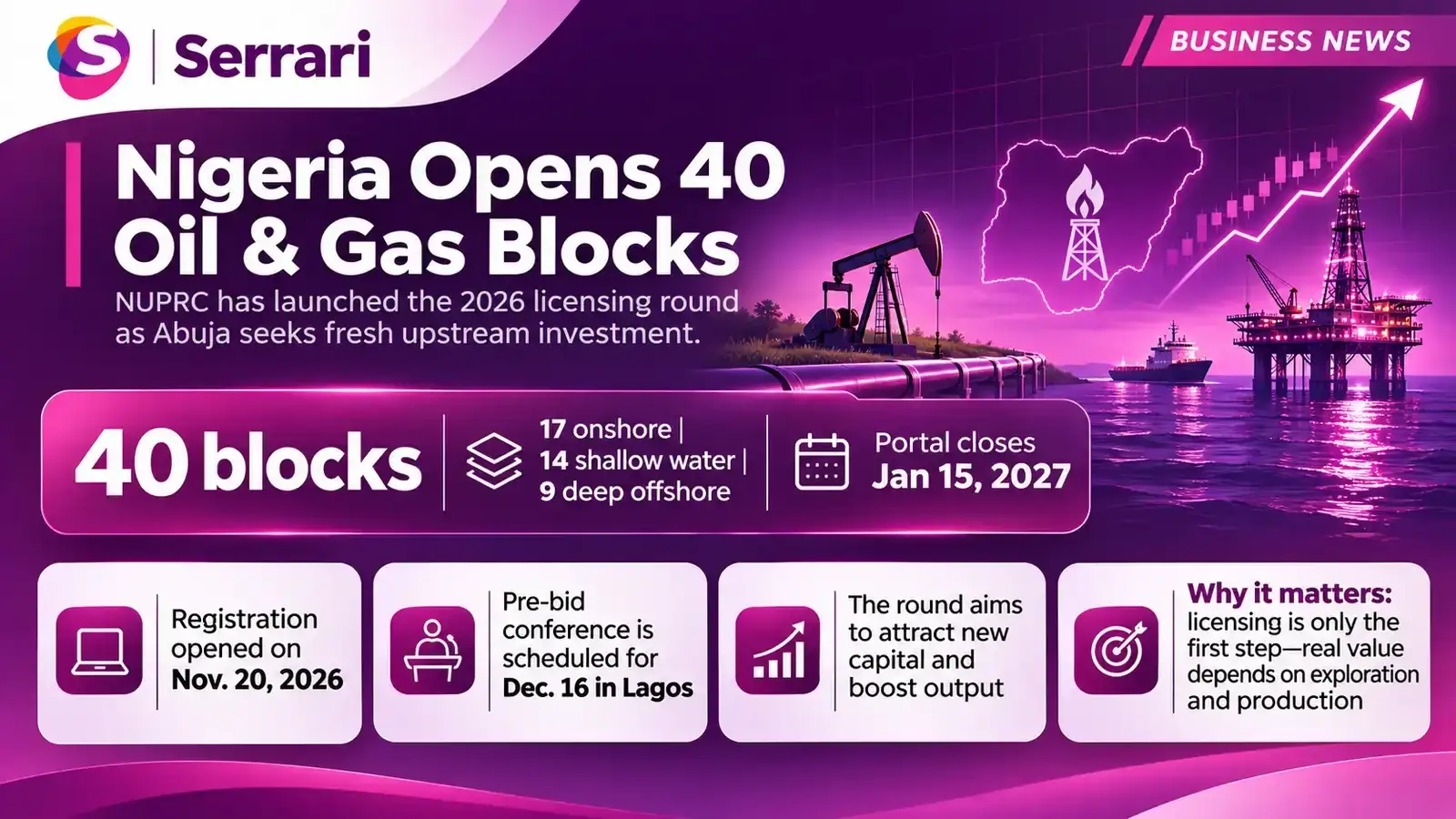
Nigeria has opened registration for its 2026 oil and gas licensing round, offering 40 petroleum blocks as part of efforts to attract upstream investment, replenish reserves and expand production capacity. The Nigerian Upstream Petroleum Regulatory Commission (NUPRC) opened the portal on November 20, 2026, with applications closing on January 15, 2027. The exercise comes as Nigeria seeks to sustain its recent production recovery, improve foreign-exchange earnings and expand domestic gas supplies. Its ultimate success, however, will depend on whether successful bidders commit capital to commercially viable projects rather than simply acquire exploration rights.
Key Overview
- Nigeria is offering 17 onshore, 14 shallow-water and nine deep-offshore blocks.
- Registration closes on January 15, 2027, at 4:30 p.m. West Africa Time.
- The pre-bid conference is scheduled for December 16, 2026, in Lagos.
- Commercial bidding and announcement of successful bidders are scheduled for May 7, 2027.
- Signature bonuses range from $3 million to $7 million per block, depending on the asset.
- Nigeria produced approximately 1.69 million barrels of crude oil and condensate daily in October 2026.
Why Nigeria is opening more petroleum acreage
Nigeria’s decision to release another portfolio of oil and gas blocks reflects a need to sustain production beyond the immediate recovery in existing fields. Petroleum extraction depletes reservoirs over time, meaning that maintaining national output requires continuous investment in exploration, field development and the rehabilitation of ageing infrastructure.
The 2026 licensing round announcement on October 6 placed the acreage offering within a broader strategy to attract technically capable and financially sound operators. The regulator also identified more than 788,000 barrels per day of shut-in production across 63 operators and offshore projects worth an estimated $30 billion to $50 billion that it wants to advance towards final investment decisions.
These figures describe separate opportunities, not guaranteed additional production or investment arising from the new licensing round. Their significance is that Nigeria faces two simultaneous challenges: recovering output from existing assets and establishing a pipeline of future developments.
According to the October production figures, crude oil and condensate production averaged approximately 1.69 million barrels per day. Crude oil alone accounted for about 1.51 million barrels daily, slightly above the country’s OPEC allocation of 1.5 million barrels per day. Nigeria had met its allocation for six consecutive months.
Meeting that quota represents progress, but it does not remove the need for new investment. Production capacity provides flexibility when quotas change and helps compensate for declines elsewhere. Equally, discovering additional resources does not automatically permit Nigeria to export more crude while production restrictions remain applicable.
Why the mix of onshore and offshore blocks matters
The distribution of available acreage gives prospective operators access to three distinct investment environments. Onshore assets account for 42.5% of the offering, shallow-water blocks represent 35%, and deep-offshore acreage makes up the remaining 22.5%.
Onshore development can benefit from proximity to existing roads, pipelines and processing infrastructure, where those facilities are available. It may also offer smaller domestic producers opportunities to participate without committing the capital typically required for deepwater projects. Nevertheless, land-based operations can face security threats, community disputes, environmental liabilities and disruptions to evacuation infrastructure.
Shallow-water projects occupy an intermediate position. Development costs and technical requirements vary substantially, but existing offshore facilities may create opportunities to connect new discoveries to established production systems. Commercial viability depends on water depth, reservoir characteristics, infrastructure access and the cost of transporting hydrocarbons to market.
Deep-offshore projects typically require more sophisticated engineering, substantial financing and longer development schedules. Their potential scale can attract large international operators, although investors must evaluate geological uncertainty, future commodity prices and fiscal arrangements before committing billions of dollars.
Offering all three categories allows Nigeria to attract companies with different risk appetites and technical capabilities. It also reduces dependence on a single development model. The 40 blocks should not, however, be confused with 40 producing fields: prospecting rights provide an opportunity to establish commercial resources, not a guarantee of recoverable reserves.
Context is everything. Stay ahead of shifting trends with today’s market updates, and uncover emerging opportunities using the Serrari Group Market Index and Marketplace. Then, take control of your own financial future by exploring our Money & Life Reset Transformation Blueprint ™ to build stronger habits, create better systems, and design a path toward lasting wealth.
How the bidding process seeks to attract credible investors
The official licensing timetable separates registration, qualification, technical assessment and commercial selection. After applications close in January, eligible companies are expected to receive prequalification notifications on February 1, 2027. The subsequent data review and bid submission window runs until April 15, with commercial selection planned for May 7. Final licence grants remain conditional on successful applicants meeting post-award requirements.
This structure matters because the highest financial offer is not necessarily the best outcome for the government. A bidder that pays a substantial initial bonus but cannot finance exploration or development may leave valuable acreage idle for years.
Under the published participation requirements, applicants must demonstrate technical expertise, financial resources and appropriate environmental and safety capabilities. The process includes a $10,000 registration fee, a $25,000 application fee for each bid and a bank guarantee equal to 5% of the proposed signature bonus. These requirements help distinguish serious participants from companies seeking speculative access to petroleum assets.
Consortium arrangements provide another route for companies that cannot independently mobilise all the necessary expertise or funding. Such partnerships can combine domestic operational knowledge with external capital and technology, although their effectiveness depends on clear responsibilities and enforceable financing commitments.
The regulator’s commitment to publishing evaluation methods and requiring beneficial ownership disclosure is also important. Transparent awards can reduce uncertainty about political influence and strengthen confidence that investment decisions will be governed by predictable rules rather than discretionary access.
What Nigeria could earn from the licensing round
Signature bonuses offer the government a potential source of upfront dollar revenue. With individual payments ranging between $3 million and $7 million, a purely illustrative scenario in which all 40 blocks are awarded and paid for implies aggregate proceeds of $120 million to $280 million.
This is not a revenue forecast. Actual receipts depend on the composition of successful bids, whether every block attracts a qualified investor and whether winning companies satisfy the conditions for granting licences. The previous licensing exercise illustrates this uncertainty: 37 of 50 offered blocks attracted successful bidders, while 13 received no bids.
The economic value of the exercise nevertheless extends far beyond signature payments. Exploration expenditure can generate demand for engineering services, geological surveys, equipment and logistics. Commercial discoveries may subsequently generate royalties, taxes and export proceeds over many years.
For Nigeria, that longer-term revenue stream is particularly significant. The 2026 fiscal assessment projects oil and gas revenue equivalent to 3.8% of GDP in 2026, up from 3.1% in 2025, while noting that petroleum receipts fell short of budget expectations in the preceding year.
Higher and more reliable production could therefore improve fiscal planning and the supply of foreign exchange. However, gross export earnings are not identical to government revenue or net dollar inflows: operating expenses, capital imports, investor distributions and fiscal terms determine how much value ultimately remains in the economy.
Why natural gas and the energy transition matter
The licensing round also provides an opportunity to expand Nigeria’s gas industry. Natural gas can support electricity generation, industrial heating, fertiliser production and export markets, provided processing and transportation infrastructure are available.
The regulator’s published plan outlines medium-term national ambitions of 50 billion barrels of proved and probable oil reserves and 250 trillion standard cubic feet of gas reserves, alongside production targets of three million barrels of oil and 12 billion standard cubic feet of gas daily. These are policy aspirations rather than expected outputs from the 40 blocks alone.
The official licensing objectives link new exploration with greater domestic gas utilisation and indigenous participation. That matters because extracting gas without reliable customers, pipelines and payment arrangements may not generate an adequate commercial return.
Nigeria must also manage environmental obligations as international lenders and energy buyers scrutinise methane emissions and carbon intensity. Reducing flaring and capturing commercially useful gas could improve resource efficiency, but these measures require capital and credible enforcement. Communities hosting petroleum operations also need effective safeguards against pollution and disruption.
The real test begins after the licences are awarded
The registration deadline is an important administrative milestone, not the moment at which new oil reaches the market. Exploration, appraisal, financing, development and regulatory approvals can take years, particularly offshore. Some blocks may never become commercially productive.
For Nigerian businesses and households, the benefits will depend on whether the resulting projects generate employment, strengthen local supply chains, improve gas availability and produce public revenue that is effectively managed. More crude production does not automatically mean cheaper retail fuel or a stronger naira, because international prices, exchange rates and broader economic conditions also influence those outcomes.
The immediate indicators to watch are the number of qualified applicants, competition for individual blocks and the credibility of proposed work programmes. Over time, actual drilling expenditure, discoveries, development approvals and production volumes will provide a more meaningful assessment of success.
Nigeria’s 2026 licensing round is ultimately an attempt to convert ownership of underground resources into productive economic assets. Its value will be measured not simply by the number of licences sold or dollars collected at auction, but by the investment, energy supply and sustainable public revenue that follow.
Sources: Nigerian Upstream Petroleum Regulatory Commission / Nigerian Tribune / Punch / International Monetary Fund
Your financial future isn’t something you wait for—it’s something you build.
The real question is: when do you begin?
Move beyond simply staying informed.
Navigate the markets with clarity—track trends through the Serrari Group Market Index, uncover opportunities in the Serrari Marketplace, and build practical knowledge with our Curated Wealth Builder Platform.
Stay connected to what truly matters.
Get daily insights on macro trends and financial movements across Kenya, Africa, and global markets—delivered through the Serrari Newsletter.
Growth opens doors.
Advance your career through professional programs including ACCA, HESI A2, ATI TEAS 7 , HESI EXIT , NCLEX – RN and NCLEX – PN, Financial Literacy!🌟—designed to move you forward with confidence.
See where money is flowing—clearly and in real time.
Track Money Market Funds, Treasury Bills, Treasury Bonds, Green Bonds, and Fixed Deposits, alongside global and African indexes, key economic indicators, and the evolving Crypto and stablecoin landscape—all within Serrari’s Market Index.