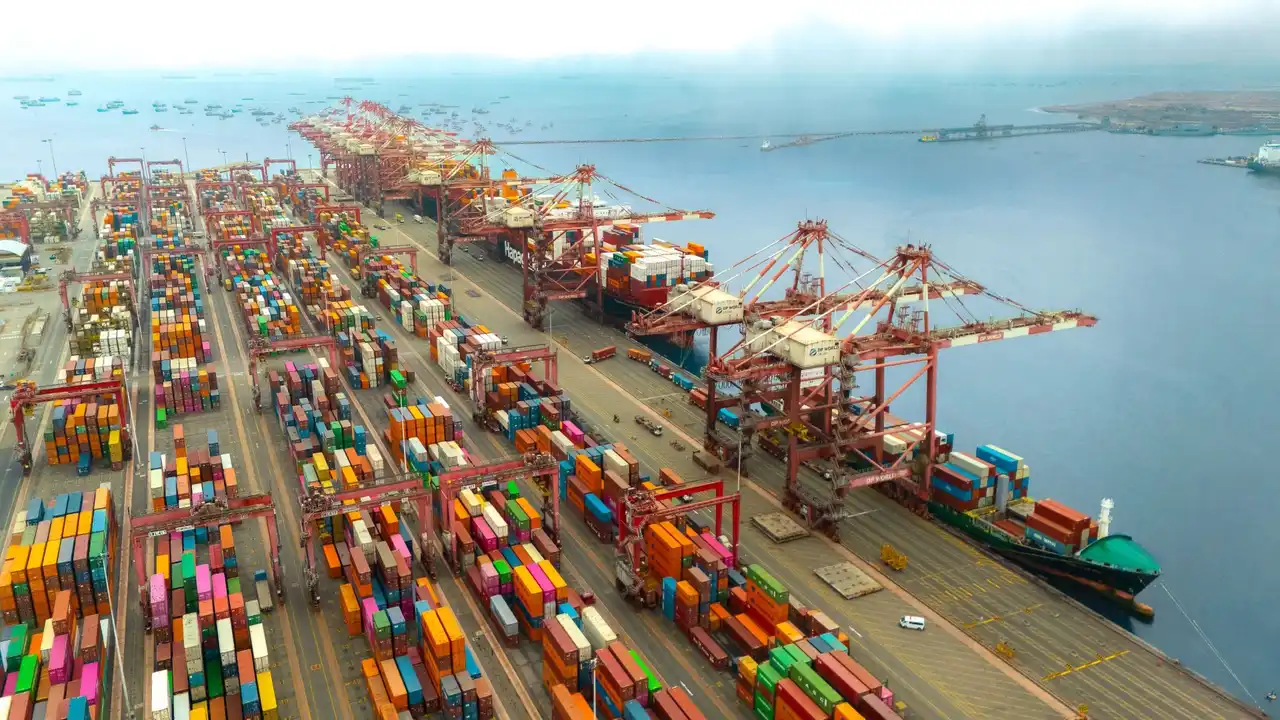
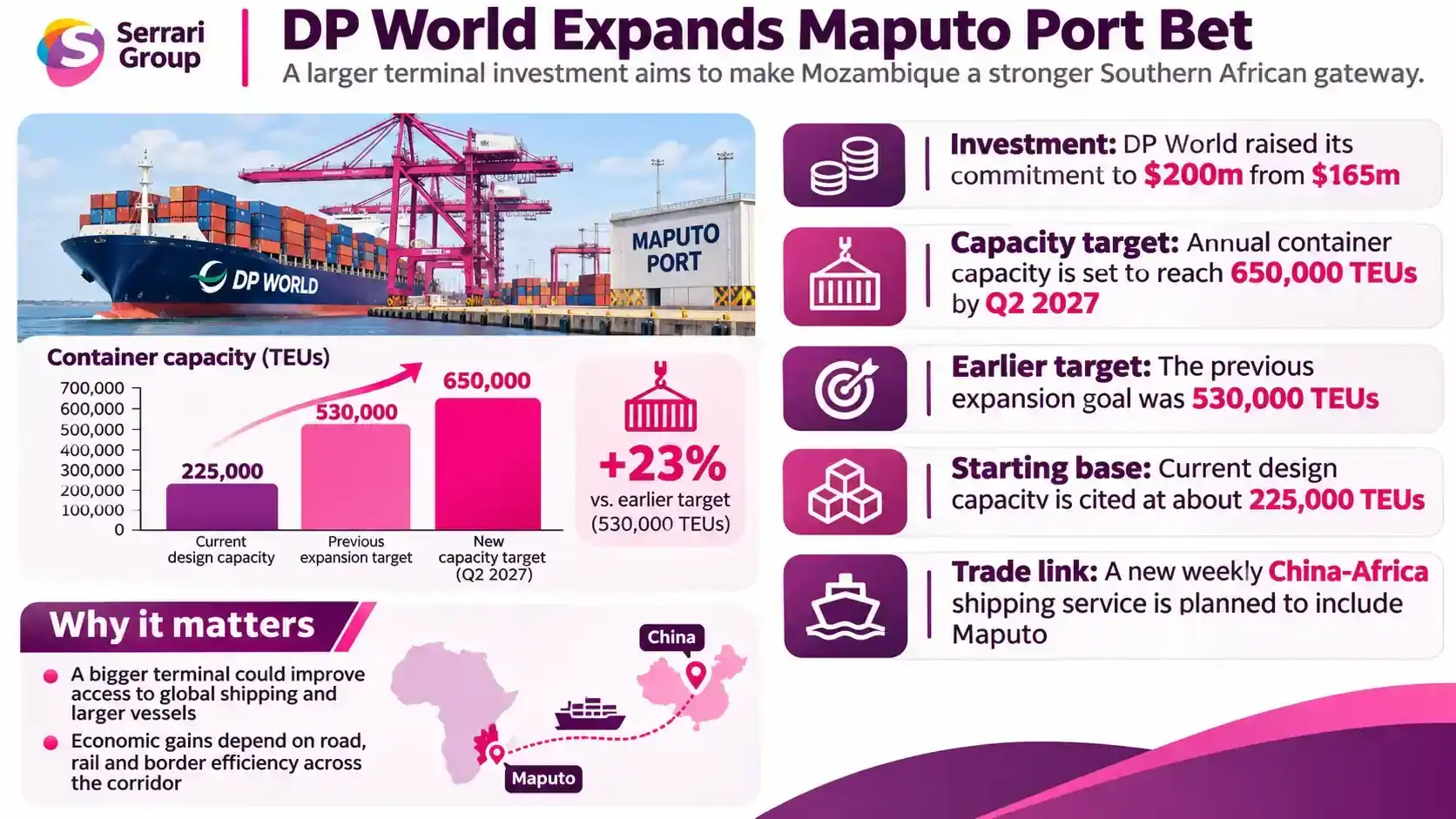
DP World has increased its planned investment in Mozambique’s Port of Maputo container terminal from $165 million to $200 million, targeting annual handling capacity of 650,000 twenty-foot equivalent units (TEUs) by the second quarter of 2027. The decision follows discussions with President Daniel Chapo and reflects more than a larger construction budget: the logistics company wants to turn Maputo into a stronger gateway for cargo moving between global markets and Southern Africa’s industrial, mining and agricultural centres. New shipping connections with Asia, improvements to container-handling infrastructure and cross-border transport links could reduce friction for regional businesses. However, the economic payoff will depend on whether road, rail and border systems can match the port’s planned expansion and attract sufficient cargo volumes.
Key Overview
- Higher investment: DP World increased its Maputo container terminal commitment by $35 million, from $165 million to $200 million.
- Capacity target: The company now aims for 650,000 TEUs annually by the second quarter of 2027, above its previous 530,000-TEU target.
- Bigger ships: Terminal improvements include a longer quay, deeper berth and additional cranes designed to handle larger container vessels.
- Regional strategy: Maputo’s links to South Africa, Zimbabwe and neighbouring economies are central to the investment’s commercial rationale.
- China connection: A weekly China Africa Link shipping service is scheduled to begin in late November 2026, connecting several Chinese ports with Dar es Salaam and Maputo.
- Main uncertainty: Expanded design capacity does not automatically translate into higher cargo throughput, lower freight rates or greater trade revenue.
Why DP World Is Increasing Its Investment Now
The additional $35 million comes as DP World seeks to capture a larger share of the trade moving through southeastern Africa. Its November 18 investment announcement followed a meeting between group executive chairman Essa Kazim and Mozambique’s President Daniel Chapo, during which the parties discussed trade infrastructure and stronger connections with neighbouring markets. The announcement raises the terminal’s planned annual capacity to 650,000 TEUs, compared with the previous expansion target of 530,000.
One TEU represents the capacity of a standard 20-foot shipping container. Increasing the terminal’s capacity is economically significant because container handling determines how much manufactured merchandise, consumer goods, equipment and selected agricultural exports can pass through the facility. The revised target is approximately 23% higher than the former 530,000-TEU plan, reflecting a more ambitious operating scale rather than merely an adjustment for inflation.
The expansion is not starting from scratch. At the May 2025 groundbreaking, DP World outlined a $165 million project involving additional container-yard space, extended quay facilities, greater berth depth and new cranes. The company then described existing capacity as 255,000 TEUs, whereas its November 2026 announcement uses 225,000 TEUs as the baseline. Those published figures are not identical, and neither should be treated as actual annual cargo handled. Using the latest stated baseline, the new target is about 2.9 times present design capacity.
For investors and policymakers, the strategic question is whether Maputo can handle a greater share of cargo that might otherwise travel along alternative Southern African routes. A larger terminal could make shipping calls more commercially attractive, but ships and cargo owners will only shift routes if the full journey is reliable and competitively priced. The additional investment is therefore a bet on cargo demand across the region, not only on Mozambique’s domestic market.
Bigger Berths and Cranes Could Improve Port Economics
The original terminal-modernisation plan specified an extension of the quay from 308 metres to 650 metres and an increase in berth depth from 12 metres to 16 metres. It also included three ship-to-shore cranes capable of serving post-Panamax vessels, more rubber-tyred gantry cranes and an expansion of the container yard by 6.48 hectares. These changes matter because a port’s productivity depends on how efficiently ships can berth, unload, reload and depart.
Larger ships can transport more containers per voyage, potentially spreading operating costs over greater volumes. But they also need suitable water depth, berth length and reliable cranes. Without those assets, a port may lose services to competitors capable of accommodating higher-capacity vessels. Terminal upgrades can therefore help Maputo compete for shipping schedules that determine how frequently exporters and importers can move goods.
Operational technology is another component. The project includes automated gate identification, a vehicle-booking system and improved digital coordination among shipping lines, customs authorities and logistics operators. Such systems can reduce avoidable queues and paperwork, although the actual savings will depend on implementation and the performance of agencies outside the terminal.
The earlier project also planned to increase refrigerated-container connections to more than 700 plugs. That capability is especially relevant for agricultural exporters because temperature-sensitive goods require dependable power and predictable handling. The value of expanded capacity is thus not just the number of containers a port could process, but whether it offers services that allow businesses to reach overseas buyers with less damage, delay and uncertainty.
Context is everything. Stay ahead of shifting trends with today’s market updates, and uncover emerging opportunities using the Serrari Group Market Index and Marketplace. Then, take control of your own financial future by exploring our Money & Life Reset Transformation Blueprint ™ to build stronger habits, create better systems, and design a path toward lasting wealth.
Southern African Trade Corridors Are the Real Opportunity
Maputo’s location gives it an advantage that cannot be understood through Mozambique’s trade volumes alone. The port is positioned to serve cargo from nearby South African industrial centres and inland economies, where shipping costs depend on the combined performance of road, rail, border and maritime networks. DP World also operates an inland logistics facility at Komatipoort in South Africa, providing a connection between the seaport and cargo moving across the border.
The regional transport connections already include a rail service linking Maputo and Komatipoort, alongside a container train service to Harare in Zimbabwe. In July 2026, a rail option for Zimbabwean lithium exports demonstrated the commercial importance of connecting inland production with Mozambique’s ports. These links can help Maputo attract freight generated beyond Mozambique’s borders.
For manufacturers, miners and farmers, route choice has direct financial consequences. Longer journeys, congested crossings and uncertain shipping connections can increase inventory financing costs and delay delivery to customers. A more dependable Maputo route could give businesses another option, improving resilience when other corridors are congested or disrupted. Competition among gateways can also strengthen shippers’ bargaining position, although lower freight charges are not guaranteed.
Mozambique stands to benefit through port services, transport activity, employment and opportunities for warehousing and distribution. Yet cargo passing through a port does not automatically produce broad-based domestic industrial development. Capturing more value requires local suppliers, skills development, transparent procedures and viable connections between logistics facilities and Mozambican businesses.
New China-Africa Shipping Link Strengthens the Investment Case
The terminal expansion is being paired with a shipping-network initiative. In a November 2 service announcement, DP World said its weekly China Africa Link would begin in late November. The planned rotation connects Shanghai, Ningbo and Nansha in China with Port Klang in Malaysia, Dar es Salaam in Tanzania and Maputo before returning through Singapore.
This matters because additional terminal capacity has greater value when shipping lines actually call at the port. A scheduled service can give importers more predictable access to Asian manufactured goods, including machinery, electronics, construction materials and automotive components. It may also offer exporters additional opportunities to move agricultural products, minerals and other commodities into international distribution networks.
The connection fits a wider shift toward more integrated trade corridors, in which the operator links maritime services, port facilities and inland distribution rather than treating each as a separate business. DP World has also announced substantial investment in Dar es Salaam, indicating that its strategy extends across multiple African gateways rather than depending exclusively on Maputo.
However, the China Africa Link had not yet commenced as of the November 18 announcement. Its eventual commercial benefits will depend on sailing reliability, shipping rates, cargo demand and the quality of connections beyond the waterfront. A new route can improve choice, but its existence alone does not establish that trade volumes or exporter earnings will rise.
What Mozambique Must Do to Capture the Benefits
The biggest risk is that terminal capacity expands faster than the systems around it. If trucks remain delayed at borders, rail services are unreliable or customs processing is slow, businesses may see only a limited improvement in total shipment costs. A port is one part of a logistics chain, and the slowest link can determine the experience of the entire route.
This is why DP World’s position as both terminal operator and shareholder in the Maputo Port Development Company matters. The company says the concession holder’s rights extend to 2058, providing a long investment horizon in which infrastructure spending can be recovered and upgraded. But long-term success still requires coordination with governments, transport operators and commercial users whose activities lie beyond a single terminal’s control.
The financial benefits should also be assessed carefully. The $200 million figure is an investment commitment, not immediate government revenue or a forecast of economic output. Likewise, 650,000 TEUs represents planned annual handling capacity, not guaranteed throughput. Actual results will depend on the pace of construction, effective operations, regional trade demand and the ability to win cargo from competing routes.
For Southern African businesses, the potential prize is a more competitive route to global markets. For Mozambique, it is the chance to convert a geographic position into sustained trade services and stronger regional integration. The decisive test in 2027 will not simply be whether Maputo can handle more containers, but whether more businesses find it commercially worthwhile to use the corridor.
Sources: DP World / Baird Maritime / Reuters / Port Technology International / Freight News
Your financial future isn’t something you wait for—it’s something you build.
The real question is: when do you begin?
Move beyond simply staying informed.
Navigate the markets with clarity—track trends through the Serrari Group Market Index, uncover opportunities in the Serrari Marketplace, and build practical knowledge with our Curated Wealth Builder Platform.
Stay connected to what truly matters.
Get daily insights on macro trends and financial movements across Kenya, Africa, and global markets—delivered through the Serrari Newsletter.
Growth opens doors.
Advance your career through professional programs including ACCA, HESI A2, ATI TEAS 7 , HESI EXIT , NCLEX – RN and NCLEX – PN, Financial Literacy!🌟—designed to move you forward with confidence.
See where money is flowing—clearly and in real time.
Track Money Market Funds, Treasury Bills, Treasury Bonds, Green Bonds, and Fixed Deposits, alongside global and African indexes, key economic indicators, and the evolving Crypto and stablecoin landscape—all within Serrari’s Market Index.