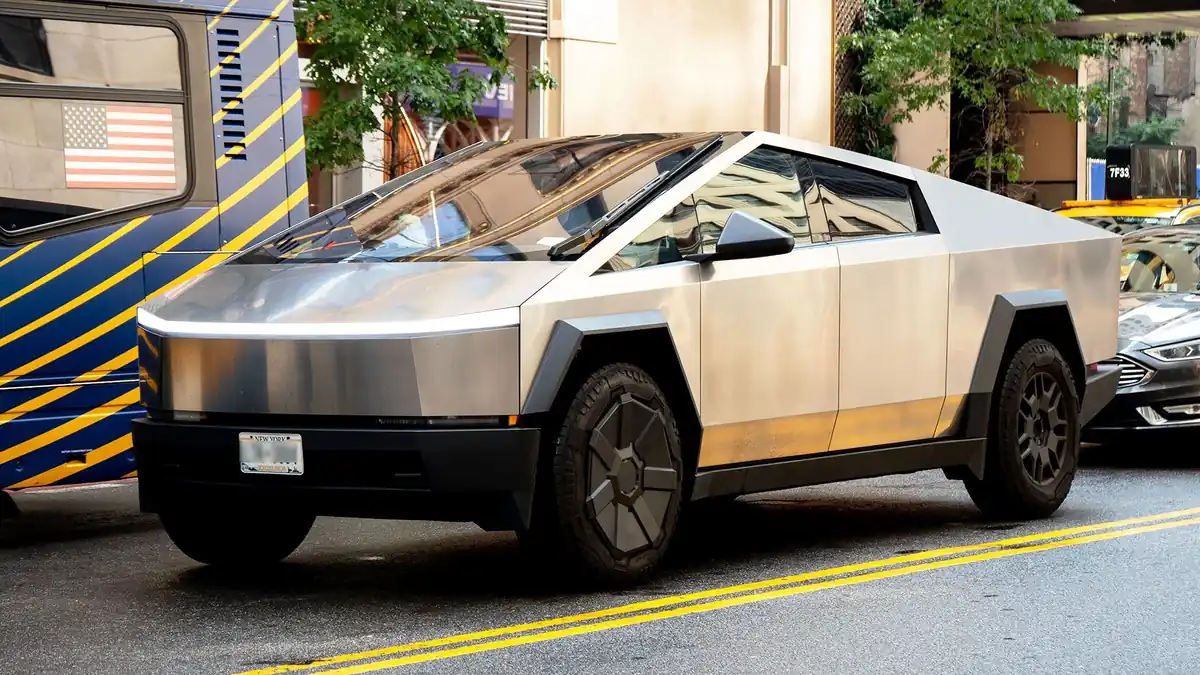
Tesla’s decision to wind down Cybertruck production at its Texas Gigafactory around 2027 marks a striking retreat from one of Elon Musk’s most distinctive automotive projects. The angular electric pickup never approached the annual volumes once envisioned, with estimated U.S. sales falling nearly by half in 2025. Musk wants the factory space and manufacturing attention redirected toward Cybercab, a purpose-built autonomous vehicle central to Tesla’s ambitions in ride-hailing and artificial intelligence. The move may improve how Tesla allocates capital and factory capacity, but it replaces a disappointing, already-commercialised product with a business model whose regulatory, operational and financial viability is still being tested.
Key Overview
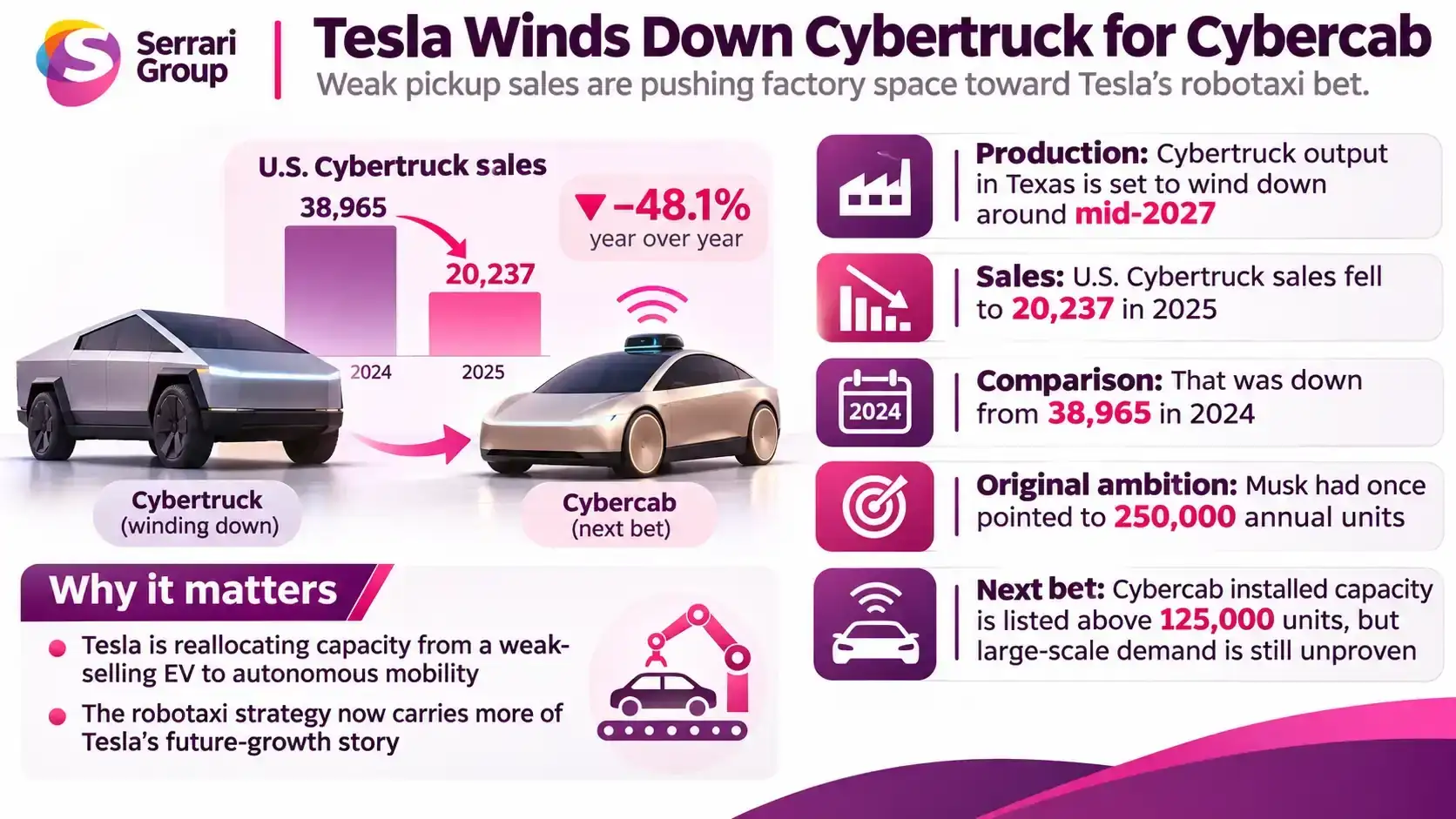
- Production shift: Musk said on November 6 that Tesla would wind down Cybertruck manufacturing at its Austin, Texas, plant around mid-2027 to make more Cybercabs.
- Weak sales: Estimated U.S. Cybertruck sales fell from 38,965 in 2024 to 20,237 in 2025, a 48.1% decline.
- Unfulfilled ambitions: The sales trajectory fell far short of Musk’s earlier suggestion that annual Cybertruck volume could eventually reach 250,000.
- Market barriers: The pickup’s polarising design, recalls and limited suitability for some overseas regulations constrained its potential customer base.
- Cybercab investment: Tesla’s third-quarter 2026 disclosures listed installed Cybercab capacity above 125,000 units annually, which is not the same as current production or sales.
- Regulatory challenge: U.S. safety authorities opened an audit of Tesla’s Cybercab self-certification following its commercial rollout in Austin.
Why Tesla Is Walking Away From a Signature Vehicle
The decision is fundamentally about opportunity cost. On November 6, Musk announced the Texas production wind-down, saying it would create room for increased Cybercab output. That is a significant strategic choice for a model marketed as an unconventional alternative to established American pickups. It also suggests management sees greater potential returns from dedicating scarce production capacity to autonomous mobility than from continuing to support disappointing pickup volumes.
Cybertruck reached customers in late 2023 after its 2019 unveiling. Musk had once discussed annual production of around 250,000 vehicles, but independent U.S. sales estimates show only 38,965 deliveries in 2024 and 20,237 in 2025. The latter figure represents a 48.1% annual contraction. The figures are estimates, rather than a model-specific global sales series published by Tesla, but the gap between aspirations and demand is too large to ignore.
A factory can be capable of producing far more vehicles than customers will buy. Maintaining tooling, labour allocation, procurement and production space for an underperforming model may be less attractive when management wants to launch another vehicle at greater scale. Cybertruck uses distinctive manufacturing processes and stainless-steel bodywork, limiting how easily its lines can be treated as interchangeable with conventional vehicle programmes. Reallocation therefore has potential economic benefits, even though the cost and timing of conversion have not been publicly quantified.
The announcement does not establish that all Cybertruck manufacturing will permanently cease worldwide. Texas is its only known production base, and no alternate plant has been confirmed. Subsequent deposit-refund reporting also showed that outstanding customer orders could outstrip the output Tesla plans to deliver before the wind-down. That apparent contradiction reflects a shrinking production plan, not proof that the vehicle achieved its original long-term demand targets.
Why the Cybertruck Failed to Become a Mainstream Pickup
Cybertruck’s design was both its strongest distinguishing feature and a commercial limitation. Its sharp-edged stainless-steel exterior immediately attracted attention, but the U.S. pickup market is dominated by customers who prioritise utility, price, service coverage, towing needs and familiarity. Novelty alone is insufficient to guarantee repeatable mass-market demand.
The model also suffered a series of quality and safety setbacks. By November 2026, recall reporting identified 11 campaigns since deliveries began, covering issues that required either physical work or software fixes. Recalls do not make every affected vehicle unsafe indefinitely, but repeated campaigns can damage buyer confidence and add service costs, particularly for a vehicle still establishing its reputation.
Its unusual construction also made overseas expansion difficult. In Europe, vehicle rules account for the safety of pedestrians and other vulnerable road users. The lack of European type approval has limited prospects for broad sales of a vehicle whose rigid bodywork and angular profile differ markedly from conventional designs. That removes an important possible growth market even as electric vehicles gain acceptance internationally.
Yet Tesla’s problem cannot be explained by styling alone. The wider American electric-pickup category has struggled to convert early enthusiasm into mass-market demand. Heavy vehicles require expensive batteries, and buyers can be sensitive to range under load, charging access, purchase prices and residual values. The Cybertruck’s weakness is therefore partly model-specific and partly evidence that electric pickups face different adoption barriers from smaller passenger EVs.
Context is everything. Stay ahead of shifting trends with today’s market updates, and uncover emerging opportunities using the Serrari Group Market Index and Marketplace. Then, take control of your own financial future by exploring our Money & Life Reset Transformation Blueprint ™ to build stronger habits, create better systems, and design a path toward lasting wealth.
Cybercab Is the Bigger Bet, but Its Economics Remain Unproven
Musk’s alternative is the Cybercab, a two-seat vehicle designed for a future in which passengers buy rides rather than necessarily owning the car. Without conventional driver controls, the product depends on autonomous driving systems and a service network capable of operating safely and reliably. That makes it a more consequential bet than another vehicle model: Tesla is attempting to shift from primarily selling cars to earning recurring revenue from transportation services.
In its third-quarter 2026 regulatory filing, Tesla said it had launched Cybercab and was investing heavily in software, autonomous capabilities and related infrastructure. It acknowledged that these expenditures would weigh on profitability during the investment phase. A separately disclosed installed manufacturing capacity of more than 125,000 Cybercabs a year signals physical production potential, not evidence of equivalent demand, completed units or profitable paid rides.
The commercial rationale could be compelling if Tesla operates vehicles for many paid hours, distributes fixed costs across frequent trips and reduces the labour expense associated with human drivers. However, that outcome depends on vehicle utilisation, maintenance, insurance, remote assistance, charging, depreciation and local regulations. Building a robotaxi more cheaply does not automatically mean operating a profitable robotaxi network.
Safety oversight is particularly important. After Cybercab’s Austin deployment, the federal safety regulator opened an audit on September 4 to examine whether Tesla had adequately certified compliance with applicable vehicle standards. An audit is not a finding of non-compliance, but it demonstrates that the service faces questions that ordinary factory production capacity cannot resolve. A vehicle without a steering wheel or pedals raises regulatory and operational issues fundamentally different from those involving conventional owner-driven cars.
The Financial Stakes Extend Beyond One Pickup Truck
Cybertruck’s limited volumes mean its discontinuation may have a relatively modest direct impact on Tesla’s consolidated sales. Nevertheless, the strategic implications are much larger. Tesla is asking investors to value it increasingly as a provider of autonomy, software and robotics rather than solely as a manufacturer competing for electric-vehicle market share.
The company’s September-quarter financial filing shows the tension. Revenue was approximately $28.05 billion in the third quarter, while net income attributable to common shareholders was $787 million, down from the comparable year-earlier quarter. Capital expenditure reached $13.01 billion over the first nine months of 2026, nearly twice the equivalent period in 2025. Tesla had substantial liquidity, but investors still need to judge whether its expanding investment commitments will deliver worthwhile returns.
That issue matters for shareholders because the Cybercab plan concentrates expectations on a business whose large-scale economics are not established. For workers and suppliers, converting production lines changes demand for parts, equipment and specialised skills. For Cybertruck owners, declining production could affect future resale perceptions and parts availability, although it does not by itself mean Tesla will stop offering service or supporting existing vehicles.
Tesla has also outlined a $3.3 billion German factory expansion with ambitions to produce Cybercabs there from 2029. That reinforces the seriousness of its geographic and industrial commitment, but the proposed annual production target remains a plan rather than realised orders or deliveries. Investing in multiple locations before a new service model proves itself can magnify either the upside or the cost of a strategic miscalculation.
What the Wind-Down Means for Tesla and the EV Industry
The Cybertruck decision is an admission that engineering ambition cannot replace product-market fit. Tesla successfully put a visually radical pickup into production, but sustaining a vehicle programme requires enough paying customers to justify the factory resources consumed. Redirecting those resources can be rational even when it means abandoning an iconic product.
For the broader EV industry, the lesson is that electrification does not guarantee uniform demand across vehicle segments. Automakers still need prices, capabilities and ownership economics that match specific customer needs. For Tesla, the challenge is more difficult: it must demonstrate that autonomy can become a scalable, safe and profitable service while maintaining its conventional vehicle business.
The most useful measures over the coming year will be the pace of Cybertruck’s production exit, Cybercab utilisation and revenue, regulatory outcomes, operating costs and the capital required to expand. A successful transition would turn factory space previously devoted to a weak-selling pickup into a recurring transport business. Failure would leave Tesla having traded a proven, if disappointing, revenue stream for an expensive promise. That is why the Cybertruck wind-down matters now: it makes Tesla’s future dependence on commercial autonomy more explicit than ever.
Sources: Reuters / Tesla / U.S. Securities and Exchange Commission / National Highway Traffic Safety Administration / Kelley Blue Book / CBS News / Electrek
Your financial future isn’t something you wait for—it’s something you build.
The real question is: when do you begin?
Move beyond simply staying informed.
Navigate the markets with clarity—track trends through the Serrari Group Market Index, uncover opportunities in the Serrari Marketplace, and build practical knowledge with our Curated Wealth Builder Platform.
Stay connected to what truly matters.
Get daily insights on macro trends and financial movements across Kenya, Africa, and global markets—delivered through the Serrari Newsletter.
Growth opens doors.
Advance your career through professional programs including ACCA, HESI A2, ATI TEAS 7 , HESI EXIT , NCLEX – RN and NCLEX – PN, Financial Literacy!🌟—designed to move you forward with confidence.
See where money is flowing—clearly and in real time.
Track Money Market Funds, Treasury Bills, Treasury Bonds, Green Bonds, and Fixed Deposits, alongside global and African indexes, key economic indicators, and the evolving Crypto and stablecoin landscape—all within Serrari’s Market Index.