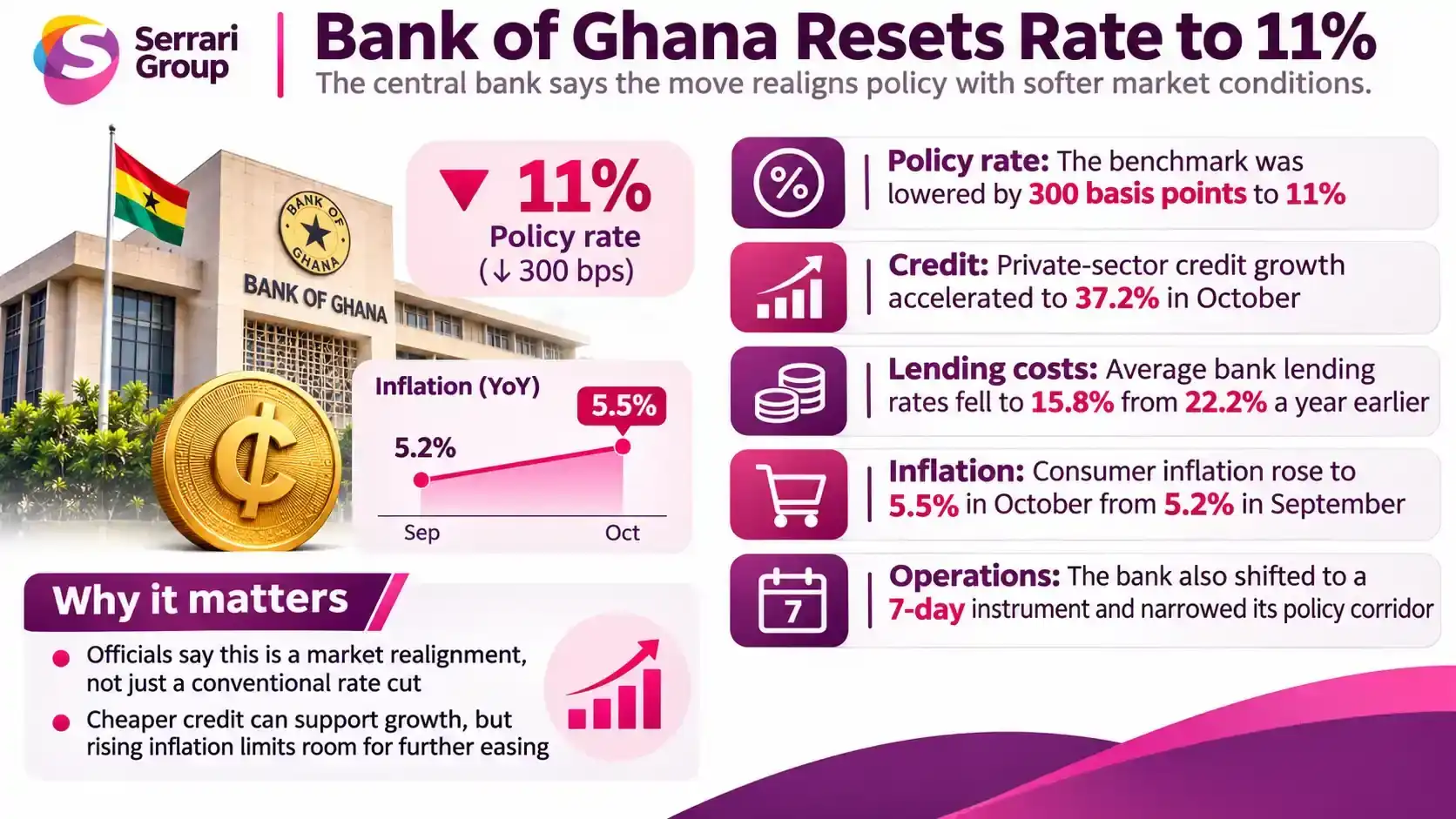
The Bank of Ghana reduced its monetary policy rate by 300 basis points from 14% to 11% on November 18, 2026, but Governor Johnson Pandit Asiama characterised the move as a correction to the way policy is signalled rather than a fresh, sweeping stimulus. Money-market rates had already declined below the old benchmark, weakening the connection between the announced rate and actual financing conditions. With private-sector credit growth accelerating and average bank lending rates dropping sharply, the central bank is seeking to make its policy instruments more credible and predictable. The challenge is timing: inflation has risen for three consecutive months, even as it remains below the central bank’s medium-term target range, making the durability of Ghana’s economic recovery the central question.
Key Overview
- Policy-rate adjustment: The benchmark fell from 14% to 11%, a reduction of 300 basis points, following the November 16–18 Monetary Policy Committee meeting.
- Operational reset: The bank is replacing its 14-day open-market instrument with a seven-day instrument and narrowing its policy corridor from ±400 to ±100 basis points.
- Faster credit growth: Private-sector credit increased 37.2% year on year in October, compared with 13.9% a year earlier.
- Lower lending costs: Average commercial-bank lending rates fell to 15.8% from 22.2% in October 2025.
- Inflation warning: Annual headline inflation reached 5.5% in October, up from 5.2% in September, its third consecutive monthly increase.
- What comes next: Whether lending rates, market yields and the cedi remain stable will help determine how much flexibility policymakers retain in 2027.
Why the Central Bank Calls This a Realignment, Not Just a Rate Cut
On paper, a three-percentage-point reduction in a benchmark rate looks like substantial monetary easing. But Ghana’s November decision is unusual because policymakers say the effective easing had already happened in financial markets. During the November 18 policy briefing, Governor Johnson Pandit Asiama explained that prevailing money-market rates were below the previously announced 14% rate. The headline benchmark was therefore giving an exaggerated impression of how restrictive monetary conditions remained.
Central banks use policy rates to influence shorter-term wholesale funding costs, which then shape deposit rates, government-security yields and the price banks charge borrowers. That mechanism works best when the announced rate corresponds closely with the prices formed in the money market. If the two drift apart, businesses and investors may struggle to interpret the central bank’s signal, even though transactions continue to take place at actual market rates.
The Monetary Policy Committee consequently chose to align the published rate with the market’s existing position. Its operating-framework announcement also replaced the 14-day open-market operations instrument with a seven-day instrument and reduced the interest-rate corridor surrounding the benchmark from four percentage points on either side to one percentage point. The corridor is intended to guide the range within which very short-term market rates trade.
Shorter operations can help policymakers respond more frequently to changes in banking-system liquidity, while a narrower corridor may make short-term rates cluster more consistently around the official target. These changes matter because credibility depends not only on what a central bank announces, but on whether its instruments reliably transmit that decision to commercial financing conditions.
The distinction should not be overstated. An 11% official rate still matters for contracts, expectations and future decisions. Yet it would be misleading to assume the entire 300-basis-point change will immediately appear as an equivalent reduction in every household or business loan; banks had already been reducing lending rates before the announcement.
Credit Recovery Shows Borrowing Conditions Were Already Improving
Evidence of that earlier easing is visible in the banking sector. The latest lending and credit figures show that average bank lending rates declined from 22.2% in October 2025 to 15.8% in October 2026. Over the same interval, annual private-sector credit growth accelerated from 13.9% to 37.2%. These are significant changes in the cost and pace of financing for the economy.
For companies, lower interest rates can make it less expensive to finance inventory, equipment and expansion. A business borrowing to import raw materials, for example, may find that a smaller interest bill improves its cash flow or makes a project financially viable. Cheaper credit may also help consumers fund essential purchases, although affordability still depends on individual incomes, collateral requirements and loan terms.
Importantly, the 37.2% growth figure measures a rate of increase in outstanding private-sector credit; it does not mean that 37.2% of all businesses obtained new loans. Nor does a decline in the average lending rate guarantee that small firms or first-time borrowers can access finance on those terms. Lending decisions continue to reflect credit history, sector risk and bank balance-sheet constraints.
The broader November economic assessment also put growth in the Composite Index of Economic Activity at 17.7% year on year in September, compared with 9.6% a year earlier. The index suggested stronger activity in areas including exports, construction and tourism. It is an indicator of activity rather than the same thing as annual GDP growth, but it supports the view that domestic conditions have improved.
The significance is that policy is catching up with a recovery that has already started. If the new benchmark gives banks and companies a clearer pricing reference, the central bank could reinforce the recovery without relying on an abrupt new credit boom.
Context is everything. Stay ahead of shifting trends with today’s market updates, and uncover emerging opportunities using the Serrari Group Market Index and Marketplace. Then, take control of your own financial future by exploring our Money & Life Reset Transformation Blueprint ™ to build stronger habits, create better systems, and design a path toward lasting wealth.
Rising Inflation Complicates the Easing Narrative
The decision nevertheless comes with a warning. Ghana’s annual inflation rate increased to 5.5% in October from 5.2% in September, marking the third consecutive monthly acceleration. The October inflation release showed that the pressure was not evenly spread across household spending categories.
Non-food inflation increased to 7.9% from 6.2%, reflecting pressures that included utility charges and energy costs. Food inflation, meanwhile, fell to 2.8% from 4.0%. That divergence matters for households because lower average inflation does not mean every essential expense is rising at the same pace. Electricity, transport and other non-food costs can squeeze purchasing power even when food-price inflation is relatively subdued.
Inflation also remains below the lower boundary of the central bank’s 8% target with a two-percentage-point tolerance band. That provides some room for policymakers to accommodate improving economic activity, but it is not a reason to dismiss the recent upward trend. Persistent energy-price increases, utility adjustments or weather-related disruption to agriculture could push inflation higher, potentially forcing the bank to reconsider its stance.
This is the central tension behind the November move. If the bank were responding only to weak economic growth, the reduction might suggest an urgent attempt to stimulate demand. Instead, growth and lending are strengthening while inflation has begun to accelerate. Treating the decision as operational realignment helps explain why policymakers are not necessarily signalling a further sequence of large cuts.
The Cedi, Reserves and Banks Will Determine How Much Room Remains
Monetary policy in Ghana also depends on currency and external financing conditions. A weaker cedi can increase the local-currency price of imported fuel, machinery and consumer goods, feeding into inflation. Lower domestic interest rates can change the returns investors earn on cedi assets, although exchange rates also reflect export receipts, imports, confidence and international financial conditions.
The latest foreign-exchange market report described renewed pressure on the cedi in mid-November amid demand for foreign currency. The central bank reported gross international reserves of about $12.1 billion as of November 17, equivalent to 4.4 months of import cover, below the $13.8 billion recorded at the end of 2025. These figures do not by themselves imply an imminent currency problem, but they help show why policymakers must monitor external conditions while adjusting interest-rate signals.
The quality of bank lending matters as much as its pace. A sharp acceleration in credit can support productive investment, but it may also create future repayment problems if lenders compromise underwriting standards. The banking sector’s reported non-performing loan ratio improved to 13.1% from 19.5%, indicating progress, yet a double-digit level still warrants attention.
For investors, the revised benchmark may help make Ghana’s short-term interest-rate environment easier to interpret. For borrowers, the practical test is whether financing remains accessible at sustainable costs. For savers, lower nominal returns need to be weighed against inflation, taxes and liquidity rather than viewed in isolation.
What Ghana’s November Decision Means for 2027
The Bank of Ghana has moved into a different stage of monetary policy. Earlier reductions in interest rates helped respond to easing price pressures, but the latest move is focused on restoring alignment between its announced benchmark and the market conditions that businesses already face. That is an important institutional objective because predictable policy transmission can reduce confusion and improve financial planning.
The next Monetary Policy Committee meeting is scheduled for January 2027. Ahead of it, the key indicators are straightforward: whether inflation continues rising, whether lending growth remains supported by improving credit quality, whether market interest rates remain close to the new policy benchmark and whether the cedi faces renewed external pressure.
For Ghana’s economy, success will not be measured simply by the 11% headline. It will be measured by whether the central bank can preserve price stability while allowing banks to finance productive activity at rates that businesses can afford. The November realignment is therefore less a declaration that monetary easing is complete than an attempt to build a more reliable framework for whatever decisions come next.
Sources: Bank of Ghana / Graphic Online / 3News / Citi Newsroom / MyJoyOnline / Reuters
Your financial future isn’t something you wait for—it’s something you build.
The real question is: when do you begin?
Move beyond simply staying informed.
Navigate the markets with clarity—track trends through the Serrari Group Market Index, uncover opportunities in the Serrari Marketplace, and build practical knowledge with our Curated Wealth Builder Platform.
Stay connected to what truly matters.
Get daily insights on macro trends and financial movements across Kenya, Africa, and global markets—delivered through the Serrari Newsletter.
Growth opens doors.
Advance your career through professional programs including ACCA, HESI A2, ATI TEAS 7 , HESI EXIT , NCLEX – RN and NCLEX – PN, Financial Literacy!🌟—designed to move you forward with confidence.
See where money is flowing—clearly and in real time.
Track Money Market Funds, Treasury Bills, Treasury Bonds, Green Bonds, and Fixed Deposits, alongside global and African indexes, key economic indicators, and the evolving Crypto and stablecoin landscape—all within Serrari’s Market Index.