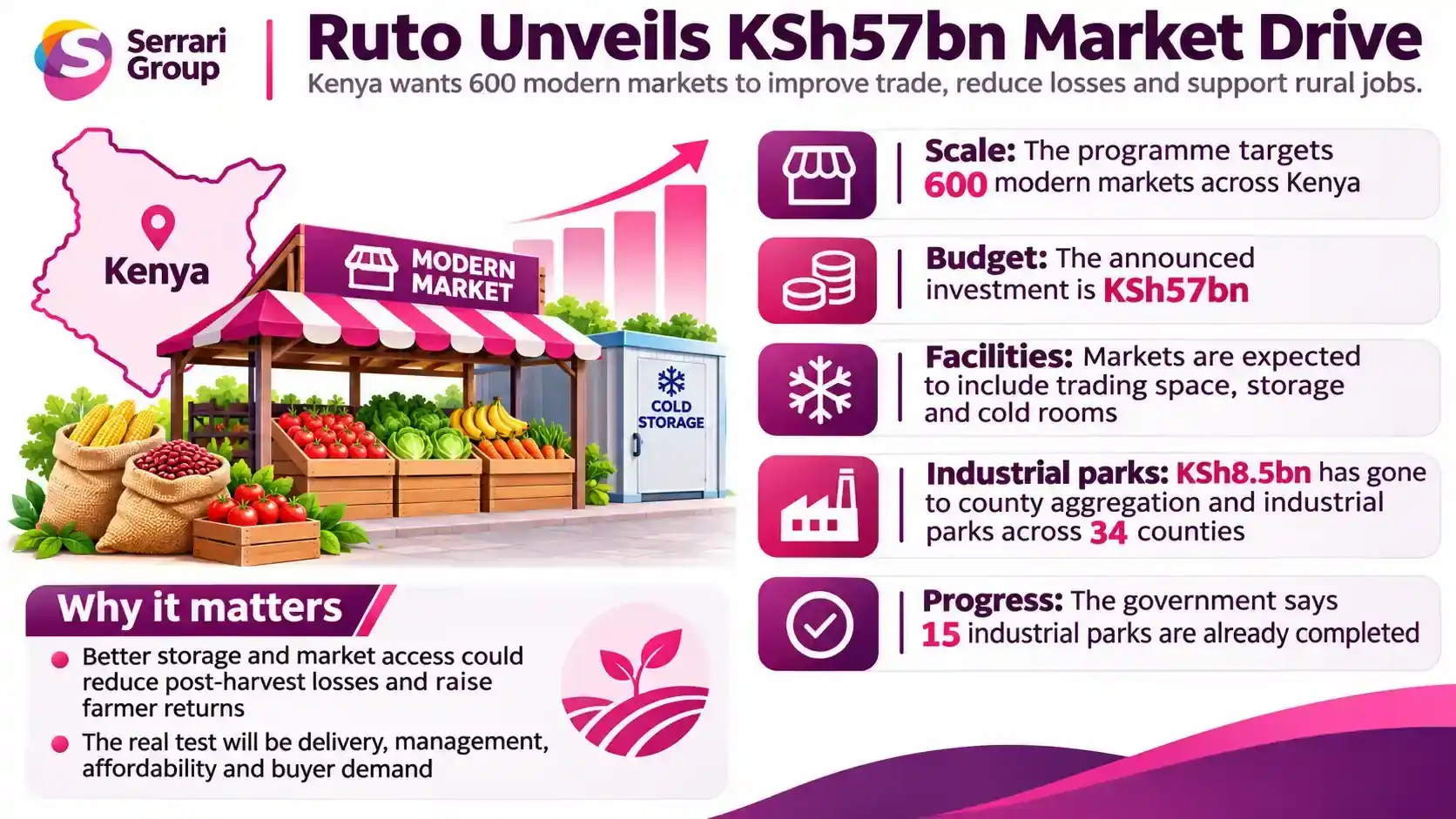
President William Ruto has put Kenya’s informal traders and agricultural supply chains at the centre of a KSh57 billion programme to develop 600 modern markets, promising sheltered trading areas, storage facilities and cold rooms. In his November 18, 2026 State of the Nation Address, he linked the programme to KSh8.5 billion invested in county aggregation and industrial parks, 15 of which the government says are complete. The ambition is to move more produce from farms to buyers with less waste and create opportunities to process goods locally. But the economic benefits will depend on the distinction between projects announced, buildings completed and facilities that traders can afford and use consistently.
Key Overview
- National programme: The government says it is developing 600 modern markets at an estimated total cost of KSh57 billion.
- Average implied cost: Dividing that total by the target gives KSh95 million per market, an arithmetic average rather than an approved budget for every site.
- Facilities promised: Trading space, storage and cold rooms are intended to improve conditions and reduce losses in perishable produce.
- County processing: Ruto reported KSh8.5 billion invested in aggregation and industrial parks across 34 counties, with 15 described as completed.
- Progress still to prove: Earlier budget reporting showed 476 markets packaged for development and 354 under implementation, figures that do not mean 354 were operational.
- Critical test: Affordable stall fees, functioning refrigeration, reliable utilities, trader access and actual producer earnings will determine whether the investment delivers value.
Why Kenya Is Investing in Markets Rather Than Trading Stalls Alone
Ruto’s November 18 State of the Nation Address presented the market programme as part of a larger effort to connect agricultural production with commercial buyers and processing capacity. The rationale is that farmers do not lose income only because they produce too little. They can also lose it because produce spoils before sale, storage is inadequate or traders have few dependable routes to customers.
Traditional open-air markets often operate with limited shelter, drainage, organised loading space or refrigeration. For a vegetable farmer or fish seller, these shortcomings become financial losses when goods deteriorate before a buyer arrives. Traders may respond by accepting low prices late in the day or paying intermediaries to move produce quickly. Better infrastructure could change those calculations, particularly for highly perishable products.
The reported KSh57 billion commitment is therefore about more than replacing temporary stalls with permanent structures. Storage and cold rooms could allow producers and traders to hold products longer, manage delivery schedules and negotiate with less immediate pressure to sell. The effect would vary by crop and location: grain needs different facilities from fresh fish, milk or leafy vegetables.
There is an important limitation. A cold room produces value only if its power supply, maintenance, operating rules and user charges are dependable. A market can look modern yet remain commercially ineffective if traders cannot afford the rent or buyers cannot access it easily. Infrastructure is a necessary input, not a guarantee of higher farm-gate prices.
What KSh57 Billion Buys and How Much Has Actually Been Delivered
The nationwide headline is large, but it needs to be interpreted carefully. Dividing KSh57 billion by 600 markets yields an implied average of KSh95 million per location. That calculation does not establish that every market costs the same or that the entire amount has been spent. Land conditions, market size, utilities, cold storage and construction requirements will differ considerably.
The distinction between targets and progress is equally important. In 2026 budget implementation reporting, the government said 476 markets had been packaged for development, with 354 already under implementation. A project can be packaged, contracted, under construction, physically completed or open for business; those stages cannot be treated interchangeably. The November speech set out the wider 600-market ambition without providing a complete, independently audited site-by-site operational tally.
The government has previously used several types of market infrastructure, including modern markets, smaller market sheds and Economic Stimulus Programme facilities. These classifications matter when comparing totals. Without a consistent public register showing each project’s budget, contractor, stage, completion date and number of occupied stalls, it is difficult to judge whether the programme is delivering on schedule or at comparable cost.
For traders, transparency is not an abstract concern. Delays can mean months of operating from temporary locations, losing established customers or facing extra transport costs. The best indicators of progress would include operational stalls, actual occupancy, functioning sanitation and cooling equipment, and the total cost of keeping the facilities open.
How County Industrial Parks Fit Into the Strategy
The market programme forms one side of the government’s proposed agricultural value chain. The other involves county aggregation and industrial parks, intended to bring together produce collection, processing machinery and manufacturing services closer to where crops are grown. In his address, Ruto reported KSh8.5 billion invested across 34 counties and said 15 parks were complete.
That is a different investment from the KSh57 billion modern-markets programme and should not be added to it as though both figures describe the same construction budget. The parks are meant to handle activities such as processing, sorting or packaging, while markets support trade and distribution. Together, they could help producers capture more value before products reach the final buyer.
Kisii provides a practical example. The commissioning of its industrial park in November highlighted plans for avocado processing. Instead of relying solely on raw fruit sales, growers could potentially supply processors producing oil or other higher-value goods. Similar county specialisation plans include cassava starch in Busia, fish-feed production in Migori and sunflower oil in Garissa.
However, a completed building is not synonymous with an operating factory. Machinery must be installed, suppliers contracted, quality standards met and commercial customers secured. A processing facility also needs enough reliable raw material to run efficiently. If utilisation remains low, the public investment may create impressive infrastructure without delivering the expected jobs or higher producer margins.
Context is everything. Stay ahead of shifting trends with today’s market updates, and uncover emerging opportunities using the Serrari Group Market Index and Marketplace. Then, take control of your own financial future by exploring our Money & Life Reset Transformation Blueprint ™ to build stronger habits, create better systems, and design a path toward lasting wealth.
Why Cold Storage Could Matter for Farmer Incomes
Post-harvest losses are among the clearest economic problems these facilities could address. Recent reporting on Kenya’s cold-chain needs cited agriculture-sector estimates that 30%–40% of produce can be lost after harvest, although the actual rate varies substantially by commodity, location and methodology. The figure should not be interpreted as a measured national loss rate for every agricultural product.
Refrigeration and improved handling can increase the share of produce reaching consumers in saleable condition. This matters for supply as well as farmer earnings: when fewer tomatoes, fruits or vegetables spoil in transit, more of each harvest can reach the market. Over time, that could moderate avoidable seasonal shortages, although prices will still depend on weather, transport costs, demand and broader production conditions.
Evidence from cold-storage programmes supporting smallholders also shows why reliable energy and financing arrangements are central to making refrigeration accessible. Cold rooms can be expensive to operate and may not help smaller traders if charges exceed the value of the produce saved.
The distribution of benefits is consequently as important as the engineering. If only large wholesalers can afford cold storage, the facilities may reinforce their bargaining advantage. Affordable, transparently managed access for cooperatives, smallholder groups and individual traders would improve the chance that the benefits reach farmers rather than being absorbed entirely by intermediaries.
Will New Markets Deliver Jobs and Better Prices?
Construction can generate temporary work for builders, suppliers and transporters. Once a market opens, more durable employment may emerge in handling, logistics, refrigeration maintenance, cleaning, security and food processing. Yet the number of jobs created cannot be inferred directly from the KSh57 billion investment figure. Some traders may simply relocate from existing markets, producing better working conditions without a matching increase in net employment.
The same caution applies to prices. Bringing farmers closer to buyers can reduce some transaction costs, but higher selling prices do not automatically follow. Buyers still negotiate according to supply, quality, competition and transport economics. A farmer might benefit through lower spoilage or more predictable demand even without a large increase in the market price of the crop.
Affordability is another possible obstacle. New markets often come with formal stall allocations, service charges and operating rules. Those arrangements can improve sanitation and accountability, but poorly designed fees or allocation processes may exclude the small traders the programme is supposed to support. County governments will have an important role in ensuring that new facilities remain accessible and commercially active.
What Would Make the Programme a Success?
The announcement comes at a politically significant moment as the government presents its record ahead of the 2027 election cycle. That makes measurable delivery especially important. A useful assessment should compare the number of operational markets with the 600-market target, track spending against approved budgets, and publish occupancy and maintenance information after opening.
For industrial parks, the relevant measures go further: operating manufacturers, processing volumes, jobs sustained, sales generated and the share of local farmers supplying each facility. For markets, indicators such as trader costs, reduction in spoilage, functioning cold rooms and customer traffic would reveal whether modernisation changes economic outcomes rather than simply the appearance of trading spaces.
Ultimately, Kenya’s KSh57 billion programme addresses a real structural problem: too much value can be lost between production and sale. But turning construction spending into stronger rural incomes requires disciplined execution, affordable facilities and functioning commercial connections. The success of the initiative will be decided not by how many markets are announced, but by how reliably they help farmers, traders and buyers do business.
Sources: Parliament of Kenya / Nairobi Leo / People Daily / The Eastleigh Voice / Kenya Broadcasting Corporation / Gusii Press / Daily Nation / United Nations Capital Development Fund
Your financial future isn’t something you wait for—it’s something you build.
The real question is: when do you begin?
Move beyond simply staying informed.
Navigate the markets with clarity—track trends through the Serrari Group Market Index, uncover opportunities in the Serrari Marketplace, and build practical knowledge with our Curated Wealth Builder Platform.
Stay connected to what truly matters.
Get daily insights on macro trends and financial movements across Kenya, Africa, and global markets—delivered through the Serrari Newsletter.
Growth opens doors.
Advance your career through professional programs including ACCA, HESI A2, ATI TEAS 7 , HESI EXIT , NCLEX – RN and NCLEX – PN, Financial Literacy!🌟—designed to move you forward with confidence.
See where money is flowing—clearly and in real time.
Track Money Market Funds, Treasury Bills, Treasury Bonds, Green Bonds, and Fixed Deposits, alongside global and African indexes, key economic indicators, and the evolving Crypto and stablecoin landscape—all within Serrari’s Market Index.