Nvidia reported $115.8 billion in fiscal third-quarter revenue on November 17, 2026, more than double a year earlier, demonstrating that demand for artificial intelligence infrastructure remains formidable despite the abrupt resignation of founder Jensen Huang. Data-centre sales of $107.6 billion and fourth-quarter revenue guidance of $130 billion offered reassurance that customers are still buying advanced computing systems under interim chief executive Colette Kress. Yet the earnings announcement also exposed a more complicated investment case: China shipments have stopped, AI infrastructure partners depend on continued financing, and an initial stock-market rebound lost momentum. The central question is no longer simply whether Nvidia can sell chips, but whether the wider AI industry can turn exceptionally expensive computing investments into durable profits.
Key Overview
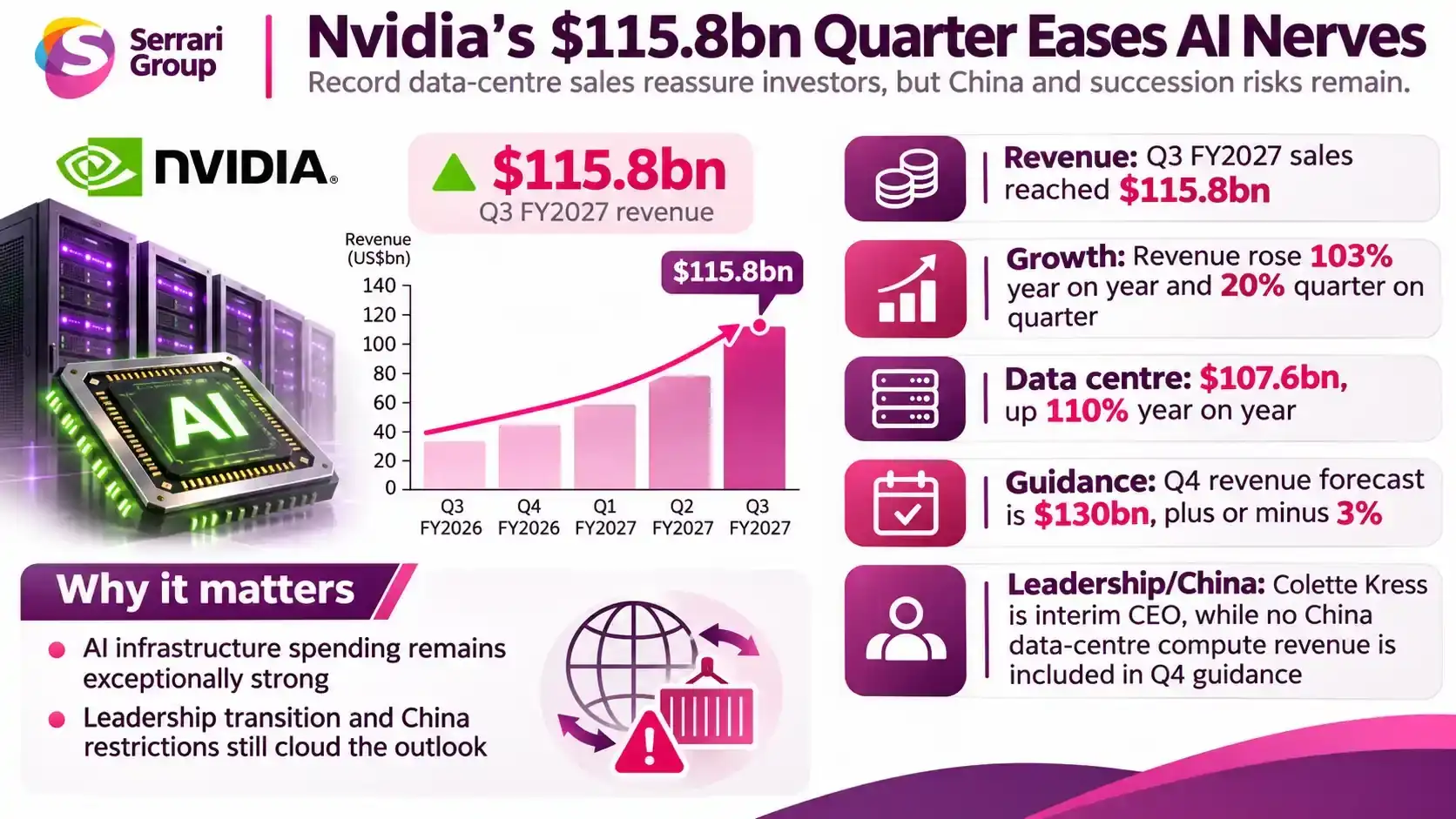
- Record revenue: Fiscal third-quarter sales reached $115.8 billion, up 20% sequentially and 103% year on year.
- Data-centre demand: The division generated $107.6 billion, an increase of 110% from a year earlier, supported by the Vera Rubin platform’s early rollout.
- Stronger forecast: Nvidia expects fourth-quarter revenue of $130 billion, plus or minus 3%, although the quarter contains an additional week.
- Leadership disruption: Jensen Huang resigned in November, and finance chief Colette Kress is serving as interim CEO while the board seeks a successor.
- China exposure: The company reported $2.4 billion in licensed Hopper-product sales to China during the quarter but is excluding Chinese data-centre compute revenue from its next-quarter forecast.
- Investor test: Shares across the AI sector initially rallied, but enthusiasm became uneven as investors questioned valuations, financing and the sustainability of infrastructure spending.
Why Nvidia’s Earnings Matter Beyond a Record Sales Figure
The scale of Nvidia’s latest results is extraordinary, but the reason they matter is more specific than their size. Its November 17 earnings disclosure showed revenue rising from $57.0 billion a year earlier to $115.8 billion for the quarter ended October 25. The company also posted $65.3 billion in generally accepted accounting principles net income and diluted earnings of $2.70 per share. Those figures suggest that its dominant role in supplying high-performance AI computing remains commercially powerful.
The data-centre division accounted for approximately 93% of total revenue. Its $107.6 billion in sales increased 21% from the preceding quarter, outpacing the company’s overall sequential growth. That concentration makes Nvidia an unusually direct indicator of how aggressively cloud operators, AI developers and enterprise customers continue investing in computing capacity.
The key driver is the race to train and deploy more capable AI systems. Unlike conventional software growth, advanced AI expansion often requires substantial physical infrastructure: processors, networking, servers, power and cooling. The Vera Rubin NVL72 rollout provides another generation of equipment for customers building such facilities, helping explain why Nvidia can sustain growth even after its revenue base has become exceptionally large.
Its outlook reinforced the message. The company projected fourth-quarter sales of $130 billion, plus or minus 3%, above the $125.25 billion analyst consensus cited in contemporaneous reporting. However, the forecast includes an additional week, so the projected sequential increase should not be read as an entirely like-for-like acceleration. Nvidia also expects its gross margin to moderate to 71%–72%, down from 74.8% in the reported quarter. Continued revenue expansion therefore does not guarantee that margins and earnings will rise at the same rate.
Founder Exit Creates a Governance Test, Not an Immediate Sales Collapse
Nvidia delivered the results just days after an unprecedented leadership rupture. The board’s November 12 transition announcement confirmed Huang’s resignation as president, chief executive and director, and appointed chief financial officer Kress to lead the company on an interim basis. The company has begun searching for a permanent replacement, considering both internal and external candidates.
Huang’s departure followed reports of personal misconduct and an investigation involving a woman alleged to have links to Chinese intelligence. Those allegations should be distinguished from established findings: Nvidia’s formal transition statement did not present a completed investigation or adjudicate the underlying claims. The board subsequently signalled that it did not intend to reinstate Huang, making succession planning an immediate governance priority.
The reason this matters to shareholders is that Huang’s influence extended far beyond quarterly financial management. He helped shape Nvidia’s chip roadmap, developer ecosystem and relationships with major AI customers over three decades. Replacing that combination of technical vision, industry relationships and strategic authority is more difficult than filling an ordinary executive vacancy.
Kress offers continuity rather than an untested outsider. Having served as CFO since 2013, she has experience with the company’s finances, capital allocation and expansion. Nevertheless, strong quarterly numbers largely reflect orders, engineering work and product decisions made well before the leadership change. They demonstrate operational resilience so far, not that every longer-term succession risk has been resolved.
Nvidia also returned $28.1 billion to shareholders through repurchases and dividends during the quarter and reported $227.3 billion remaining under its buyback authorisation. Such distributions demonstrate financial capacity, but they cannot independently replace trusted leadership or guarantee future growth. Investors will be watching whether the next CEO preserves product execution while exercising discipline over increasingly large commitments to AI infrastructure partners.
Context is everything. Stay ahead of shifting trends with today’s market updates, and uncover emerging opportunities using the Serrari Group Market Index and Marketplace. Then, take control of your own financial future by exploring our Money & Life Reset Transformation Blueprint ™ to build stronger habits, create better systems, and design a path toward lasting wealth.
China Restrictions Show That Demand Alone Cannot Secure Sales
A second challenge comes from the widening separation between technological demand and the ability to serve particular markets. Nvidia reported $2.4 billion in third-quarter sales of licensed Hopper-generation data-centre products to China, but it has stopped further shipments and assumes no Chinese data-centre compute revenue in its fourth-quarter outlook.
This is not simply a story of customers losing interest. U.S. export controls restrict advanced semiconductor sales, while Chinese authorities have also constrained imports as the country seeks greater technological independence. Under the revised U.S. licensing framework, certain products, including the H200, became eligible for case-by-case review rather than unrestricted shipment. Eligible transactions also faced a 25% tariff-related requirement, complicating economics and logistics.
According to reporting on detained chip inventories, roughly 600,000 advanced Nvidia processors had accumulated in Hong Kong while awaiting approval for mainland imports. That figure illustrates how policy obstacles can interrupt the conversion of potential demand into recognised sales.
For Nvidia, the immediate risk is lost access to a major computing market. For its customers and suppliers, it is uncertainty about procurement, delivery schedules and future permissible product specifications. More broadly, the restrictions create incentives for Chinese companies to develop domestic substitutes, potentially strengthening competing ecosystems over time. Nvidia’s exceptionally strong sales elsewhere currently cushion the impact, but geopolitical constraints can shape its addressable market independently of product quality.
AI Stocks’ Uneven Response Reveals Deeper Valuation Concerns
Financial markets initially welcomed the results. Early November 18 trading reports described gains in Nvidia-related cloud operators, semiconductor companies and Asian technology shares. The immediate logic was straightforward: if the largest supplier of AI processors continues to exceed sales expectations, suppliers and customers throughout the infrastructure chain may benefit.
That optimism proved fragile. By later in Wednesday’s session, market coverage showed Nvidia’s initial rally fading, with the stock reversing earlier gains amid a choppy wider market. This change is important because it separates reassurance about near-term chip demand from confidence in the prices investors are willing to pay for AI-related businesses.
The economic question is whether AI providers can earn sufficient revenue from the computing capacity they are purchasing. Businesses such as CoreWeave and Nebius invest heavily in facilities and processors and seek returns by renting computing resources to developers and enterprises. Strong chip orders are encouraging for Nvidia, but they can also imply rising capital requirements, financing needs and depreciation costs for its customers.
An AI infrastructure boom becomes self-sustaining only when usage, pricing and operating cash flows justify those investments. Investors must therefore distinguish equipment suppliers’ current revenue from the future profitability of those buying the equipment. This is why even a blockbuster earnings report cannot permanently resolve concerns about excessive construction, costly financing or slowing demand for AI services.
The anticipated listing of Anthropic adds a separate valuation test. Its IPO prospectus outlines a major share offering and complex investor arrangements, while contemporary reporting has indicated a potential valuation above $1 trillion. The final offering price and trading performance, however, should not be treated as settled until confirmed. The market’s response will offer another indication of how much investors are prepared to pay for the AI industry’s anticipated future earnings.
What Investors Should Watch Next
Nvidia’s results answered one immediate question: the company’s operations and sales momentum have continued through a sudden leadership transition. They did not answer every question about future shareholder returns. The most consequential indicators now are the appointment of a credible permanent CEO, the sustainability of data-centre orders, gross-margin performance, changes to China export access and whether major AI customers can finance expansion without undermining their balance sheets.
The wider supply chain also matters. Contract manufacturer TSMC produces Nvidia’s advanced chips, while system builders such as Super Micro integrate processors into high-performance servers. Cloud providers including CoreWeave and Nebius deploy these systems for customers. Disruption or weaker economics at any stage can eventually affect orders for the next generation of hardware.
For now, Nvidia has provided compelling evidence that the AI buildout remains active. But its significance to markets runs beyond reassuring investors about one quarter. It demonstrates that computing demand can remain strong while governance, geopolitics and valuation risks intensify simultaneously. The next phase of the AI investment cycle will be judged less by the number of processors sold and more by whether the businesses using them can generate sustainable returns.
Sources: NVIDIA / U.S. Securities and Exchange Commission / U.S. Government Publishing Office / Reuters / Associated Press / Anthropic
Your financial future isn’t something you wait for—it’s something you build.
The real question is: when do you begin?
Move beyond simply staying informed.
Navigate the markets with clarity—track trends through the Serrari Group Market Index, uncover opportunities in the Serrari Marketplace, and build practical knowledge with our Curated Wealth Builder Platform.
Stay connected to what truly matters.
Get daily insights on macro trends and financial movements across Kenya, Africa, and global markets—delivered through the Serrari Newsletter.
Growth opens doors.
Advance your career through professional programs including ACCA, HESI A2, ATI TEAS 7 , HESI EXIT , NCLEX – RN and NCLEX – PN, Financial Literacy!🌟—designed to move you forward with confidence.
See where money is flowing—clearly and in real time.
Track Money Market Funds, Treasury Bills, Treasury Bonds, Green Bonds, and Fixed Deposits, alongside global and African indexes, key economic indicators, and the evolving Crypto and stablecoin landscape—all within Serrari’s Market Index.