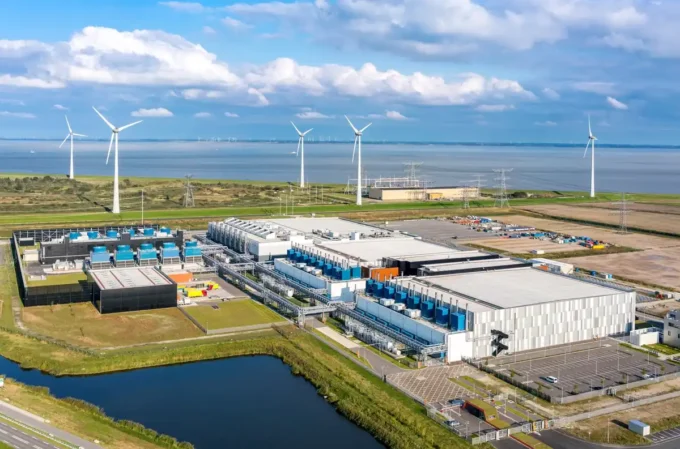
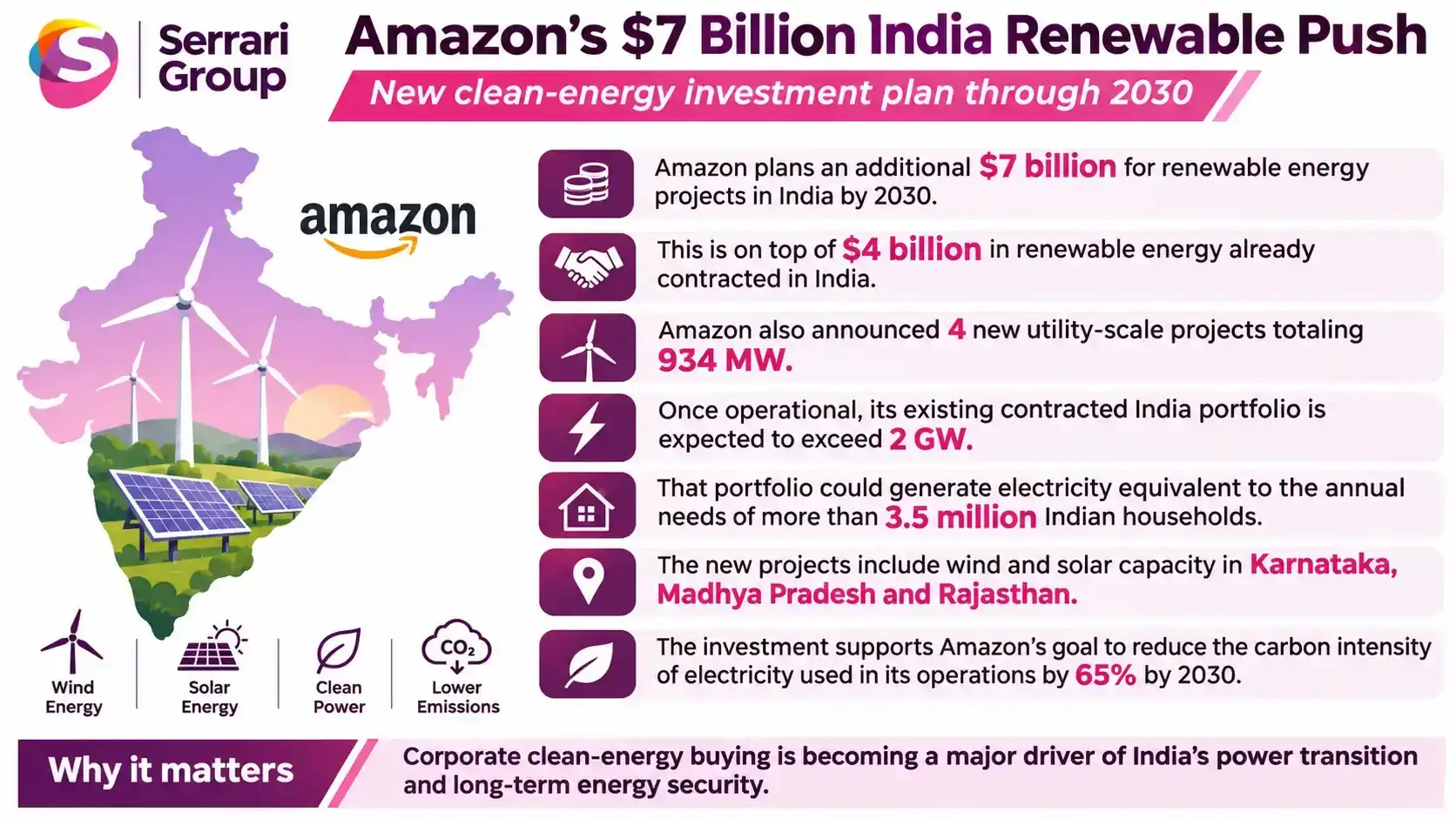
Amazon has announced plans to invest an additional $7 billion in renewable energy projects across India by 2030, building on $4 billion in existing contracted investments. Alongside the commitment, the company unveiled four wind and solar projects totaling 934 megawatts (MW), which fall within its existing contracted portfolio rather than the new funding pledge. The move reflects a convergence of pressures: Amazon needs more reliable low-carbon electricity as its operations grow, India wants to accelerate clean power development, and corporate customers increasingly demand evidence that businesses can expand without increasing electricity-related emissions at the same pace. The real test will be whether contracted capacity becomes operational generation that strengthens the grid as well as Amazon’s energy supply.
Key Overview
- New commitment: Amazon plans an additional $7 billion in Indian renewable energy investment by 2030, beyond $4 billion already contracted.
- Four projects: A combined 934 MW of wind, solar and hybrid capacity has been announced in Karnataka, Madhya Pradesh and Rajasthan.
- Existing pipeline: The newly unveiled projects form part of the $4 billion contracted portfolio, which Amazon expects to exceed 2 GW once operational.
- Energy ambition: Amazon aims to cut the carbon intensity of electricity powering its global operations by 65% by 2030 versus 2019.
- National importance: India is pursuing 500 GW of installed non-fossil power capacity by 2030, making corporate power purchasing increasingly relevant.
- Critical distinction: Investment announcements and contracted megawatts are not the same as completed plants, electricity delivered or emissions avoided.
Why Amazon Is Committing Billions to Indian Clean Energy
Amazon’s November 17 announcement is about more than corporate environmental branding. The company is attempting to secure a pathway for growth in a market where electricity demand, digital commerce, logistics and computing needs are expanding, while governments and customers expect lower-emission operations.
The new $7 billion commitment is additional to $4 billion already contracted. That means the combined figure exceeds $11 billion in planned and contracted activity, but it should not be presented as money already spent or projects already built. Neither does the announcement establish a complete schedule for how the additional funding will be allocated.
For a company operating warehouses, offices, delivery infrastructure and cloud services, electricity is both an operational necessity and an exposure to long-term cost and supply risks. Supporting new generation can help address that exposure while contributing to the power system its facilities depend on. However, a renewable power purchase agreement does not, by itself, guarantee uninterrupted electricity at every facility or eliminate the need for grid connections and backup arrangements.
The financial logic is equally important. Long-term electricity procurement agreements can give renewable developers the visibility needed to finance construction, while giving buyers greater predictability over contracted supply terms. Actual savings depend on tariff structures, market prices, transmission costs, contract design and when power is generated. Amazon has not disclosed enough detail to calculate a financial return on the newly announced $7 billion.
What the Four New Wind and Solar Projects Actually Add
The company announced four utility-scale projects with a combined contracted capacity of 934 MW. Karnataka will host a 234 MW wind farm, described by Amazon as its largest wind project contracted in Asia, and a 200 MW combined wind-and-solar project. Madhya Pradesh will host a 300 MW solar project, while Rajasthan will host another 200 MW solar project.
Their geographical spread matters. Wind and solar resources vary by location and hour, so combining projects across states and technologies can diversify generation profiles. Yet solar output falls at night and wind output changes with weather. More capacity therefore creates opportunities for clean electricity procurement without automatically delivering continuous, around-the-clock carbon-free power.
The four projects are secured through long-term power purchase agreements. Crucially, the 934 MW belongs to Amazon’s existing $4 billion contracted projects, not the incremental $7 billion commitment. Once the existing contracted projects become operational, Amazon says that portfolio will exceed 2 GW and produce electricity equivalent to the annual requirements of more than 3.5 million Indian households. This is an energy-equivalence comparison, not a promise to provide dedicated power connections to that many homes.
Amazon says its current Indian clean-energy footprint includes 14 utility-scale wind and solar projects and 43 on-site solar installations, or 57 projects in total. On-site installations can directly support facility electricity needs, while utility-scale projects add generation to the wider power system. The distinction matters when assessing which projects physically supply operations and which contribute to broader electricity procurement and decarbonization goals.
Why India Needs Corporate Buyers to Help Scale Its Grid
India’s energy transition is unfolding against growing demand from households, manufacturing, transport and digital infrastructure. The government aims to reach 500 GW of non-fossil electricity capacity by 2030. It reported more than 300 GW of non-fossil installed capacity by July 31, 2026, marking substantial progress while leaving a large expansion still to accomplish.
The target covers non-fossil capacity, not renewable energy alone; categories such as nuclear power are also relevant. And installed capacity must not be confused with electricity generated: the contribution of each technology depends on availability and utilization. Progress toward capacity targets therefore needs to be judged alongside transmission investment, storage, power-market design and actual generation.
This is where corporate procurement can make a difference. Developers often need predictable future revenue before lenders will finance large wind or solar facilities. A credible long-term buyer can lower uncertainty for a project and support the construction of generation capacity that serves the wider market. It also creates commercial demand for cleaner power without relying entirely on government procurement.
Still, the benefits are not automatic. New projects require land, permits, transmission access, capable developers and functioning grid connections. Rapid additions of variable solar and wind generation increase the importance of flexibility, forecasting and investment in networks. India’s transmission planning for renewable integration makes clear that clean generation growth must be matched by the infrastructure needed to deliver it.
For local economies, projects can support construction contracts, engineering work, equipment supply and ongoing operations. The scale and durability of those opportunities will vary, however, and no project-specific job-creation estimate was provided in the new announcement. Claims of guaranteed lower household bills would likewise go beyond the available evidence.
Context is everything. Stay ahead of shifting trends with today’s market updates, and uncover emerging opportunities using the Serrari Group Market Index and Marketplace. Then, take control of your own financial future by exploring our Money & Life Reset Transformation Blueprint ™ to build stronger habits, create better systems, and design a path toward lasting wealth.
Why Amazon’s New Emissions Target Changes the Stakes
The India pledge also accompanies a new company-wide climate metric. Amazon has set a 2030 goal to reduce electricity carbon intensity by 65% from its 2019 baseline. Carbon intensity here concerns emissions associated with each unit of electricity used across global operations, rather than an unconditional 65% reduction in the company’s total emissions.
That distinction is essential. A business can reduce emissions per electricity unit while consuming more electricity overall. Absolute emissions may move differently depending on energy consumption growth, the electricity supply mix and accounting methods. Amazon’s separate ambition to achieve net-zero carbon emissions by 2040 therefore remains a wider challenge than meeting an electricity-intensity target alone.
The company’s 2025 sustainability disclosures underscore the tension. Amazon reported that its absolute carbon emissions increased in 2025, even as its overall carbon intensity had fallen substantially since 2019. Its overall corporate carbon-intensity measure is not identical to the newly announced electricity-specific metric, so the two should not be treated as interchangeable.
Amazon says it has more than 700 carbon-free energy projects worldwide representing over 40 GW. The Indian expansion adds scale to that global strategy, but performance ultimately depends on commissioning dates, actual power output, the emissions characteristics of grids and transparent progress reporting. Purchasing enough renewable energy annually to match electricity consumption is also different from supplying every hour of demand with carbon-free power.
The Broader Business Impact Beyond Electricity
Amazon’s energy announcement sits within a wider set of operational changes in India. The company reports more than 15,000 electric vehicles deployed across over 500 cities and a collaboration with Tata Motors involving 3,000 electric trucks. These measures address transport-related emissions rather than the electricity generation addressed by the new investment pledge.
The company also reports reaching water-positive status across its direct Indian operations in 2025, ahead of its target, and says more than half of customer orders in India now use reduced or original packaging. Such initiatives may support a broader sustainability strategy, but each needs separate measurement. Renewable electricity spending should not be counted as proof that logistics, packaging and water impacts have all been resolved.
For other multinationals operating in India, the investment may reinforce the commercial appeal of long-term clean-energy purchasing. Large buyers can help create a pipeline for project developers and financing institutions, potentially expanding market depth. Smaller companies, however, may not have the bargaining power or credit profiles needed to secure equally attractive contracts. That creates a policy question about whether cleaner electricity becomes broadly accessible or remains easiest to obtain for major corporate buyers.
What Will Determine Whether the $7 Billion Delivers
The immediate announcement is significant because it combines a large additional investment pledge, an identified 934 MW batch of contracted projects and a measurable global electricity-carbon-intensity goal. But they represent different stages of delivery. The new funding is a future commitment; the four projects are contracted within an existing portfolio; capacity figures describe potential output, not annual electricity actually delivered.
The next indicators worth watching are the commissioning of contracted projects, further disclosure on the additional investment, the ability of India’s grid to absorb new generation, and Amazon’s annual progress toward its 2030 target. Transparent reporting on generation and emissions outcomes will matter more than repeating investment totals.
For India, the central opportunity is to turn corporate demand into new electricity supply and productive infrastructure while pursuing national energy-security and climate objectives. For Amazon, it is to support expanding operations while limiting their electricity-related carbon impact. The reason this matters now is that growth in digital and physical commerce is increasing the need for dependable power at precisely the moment companies face greater pressure to make that power cleaner.
Sources: Amazon / Reuters / Press Information Bureau, Government of India / Ministry of Power, Government of India
Your financial future isn’t something you wait for—it’s something you build.
The real question is: when do you begin?
Move beyond simply staying informed.
Navigate the markets with clarity—track trends through the Serrari Group Market Index, uncover opportunities in the Serrari Marketplace, and build practical knowledge with our Curated Wealth Builder Platform.
Stay connected to what truly matters.
Get daily insights on macro trends and financial movements across Kenya, Africa, and global markets—delivered through the Serrari Newsletter.
Growth opens doors.
Advance your career through professional programs including ACCA, HESI A2, ATI TEAS 7 , HESI EXIT , NCLEX – RN and NCLEX – PN, Financial Literacy!🌟—designed to move you forward with confidence.
See where money is flowing—clearly and in real time.
Track Money Market Funds, Treasury Bills, Treasury Bonds, Green Bonds, and Fixed Deposits, alongside global and African indexes, key economic indicators, and the evolving Crypto and stablecoin landscape—all within Serrari’s Market Index.