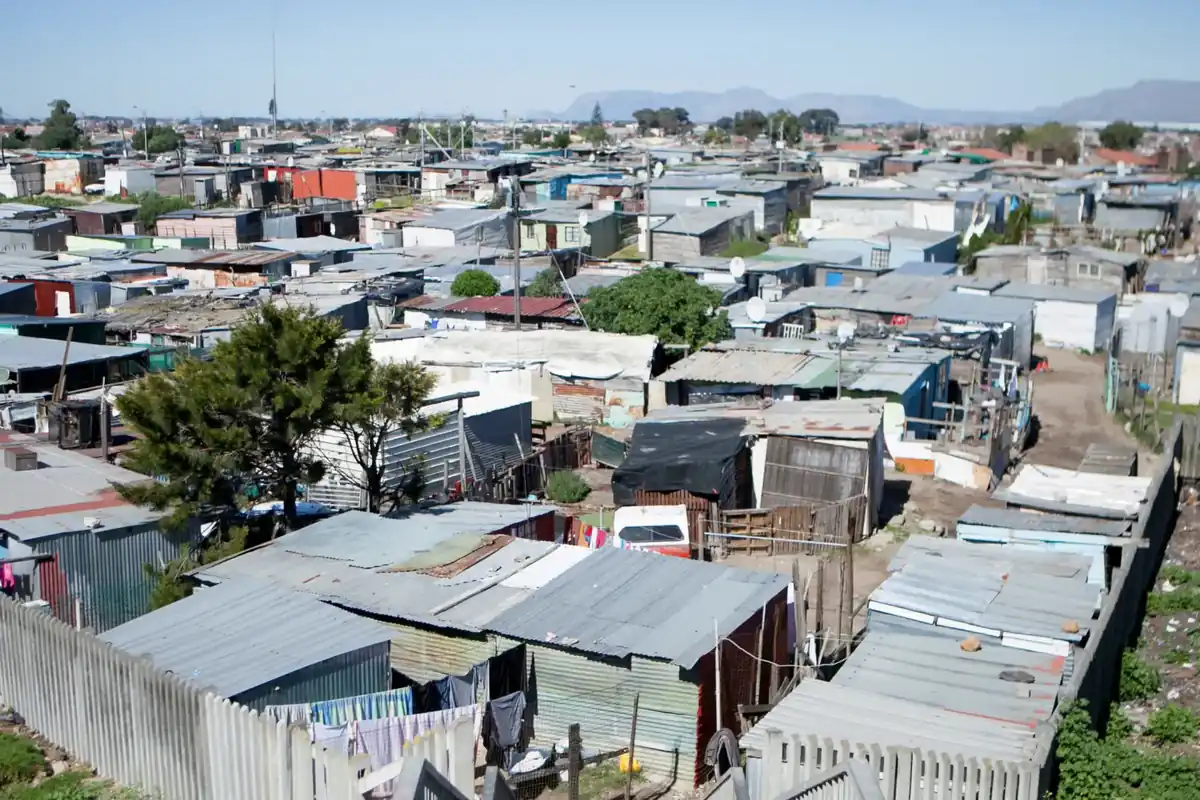
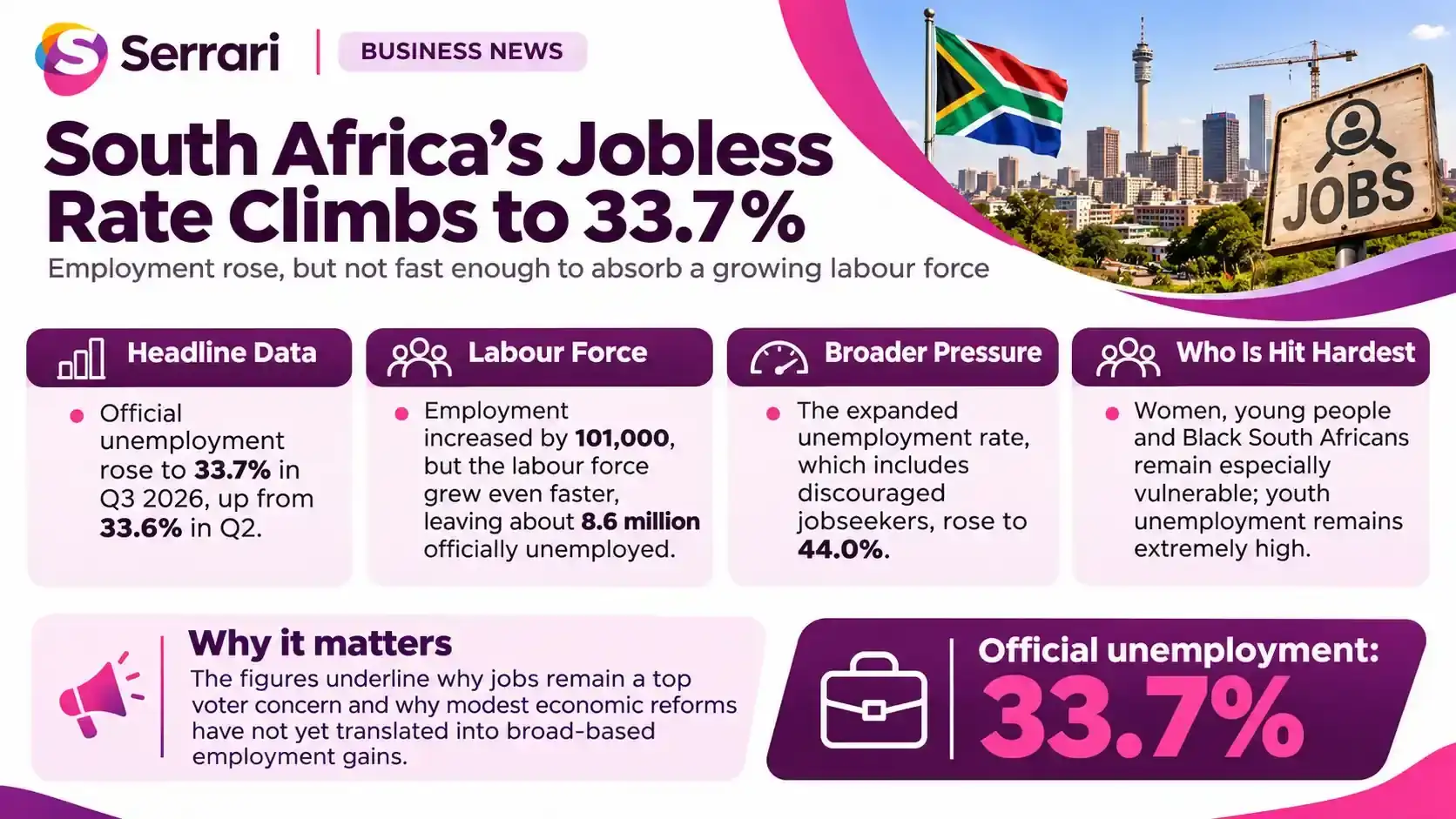
South Africa’s unemployment rate increased to 33.7% in the third quarter of 2026, from 33.6% in the previous quarter, even as the economy added jobs. The latest figures reveal the central contradiction in the country’s labour market: employment is growing in some industries, but not quickly enough to absorb everyone seeking work. Released days after the African National Congress (ANC) suffered a sharp municipal-election setback, the data sharpen questions about whether economic reforms are producing results that households can feel. With 8.6 million people officially unemployed and a broader measure reaching 44%, the challenge is not simply to restore growth but to make it more labour-intensive and accessible.
Key Overview
- Official unemployment: The rate rose 0.1 percentage point to 33.7% in July–September 2026, its third consecutive quarterly increase this year.
- Jobs and jobseekers: Employment rose by 101,000 to 16.8 million, but unemployment also increased by 97,000 to 8.6 million as the labour force expanded.
- Broader pressure: The unemployment measure incorporating the potential labour force reached 44%, while 3.7 million people were classified as discouraged jobseekers.
- Uneven sectors: Finance, manufacturing and mining added jobs, while private households, agriculture and construction shed workers.
- Youth challenge: Unemployment among those aged 15–34 stood at 47.3%, even after a marginal decline in the rate.
- Political backdrop: The ANC’s municipal-election vote share fell to 30.76%, compared with 45.59% in 2021, amid wider frustration over jobs and public services.
Why Unemployment Rose Even Though South Africa Created Jobs
The third-quarter labour survey illustrates why counting new jobs alone can be misleading. Between July and September, 101,000 additional people were employed. Yet the labour force—the combined total of those employed and officially unemployed—expanded by 198,000. The result was 97,000 more unemployed people and a small increase in the jobless rate.
This does not mean every new entrant was a school leaver or that all additional jobseekers had been previously inactive. Movements into and out of employment, active job search and economic inactivity can all affect quarterly estimates. The essential point is that the supply of people seeking work grew faster than the number of positions available.
A tenth of a percentage point may appear insignificant, particularly in a household survey subject to sampling variation. The more important finding is the persistently high starting level. A country with roughly one in three active labour-market participants unemployed cannot treat modest employment gains as sufficient progress. With the official rate above 30% for years, even several positive quarters would not quickly repair the accumulated shortfall in jobs.
The broader labour-underutilisation figures reinforce that concern. The combined unemployment-and-potential-labour-force measure increased from 43.8% to 44.0%. It captures unemployed people alongside those who want work but are either not currently searching or are unavailable under the survey’s definitions. It is distinct from the still broader 46.3% measure that also considers insufficient working hours.
Why Some Industries Are Hiring While Others Cut Workers
South Africa’s labour market is not moving uniformly. Finance, manufacturing and mining recorded employment gains, according to the sector breakdown. Those increases suggest that parts of the formal economy continue to find demand for workers. But they were offset by losses in private households, agriculture and construction, leaving the net improvement relatively modest.
Private households lost approximately 68,000 positions, agriculture 34,000 and construction 8,000. These sectors matter because many positions are accessible to workers without advanced qualifications and can provide income in communities where alternative formal employment is scarce. Losing such jobs can deepen household vulnerability even when higher-skilled positions are opening elsewhere.
The survey also showed a 268,000 increase in formal-sector employment and a 98,000 decline in informal-sector employment. The coexistence of those movements signals that the apparent strength of one part of the economy does not necessarily translate into broad-based labour-market security. A growing company may recruit engineers and financial specialists while small traders, domestic workers or agricultural labourers face weak demand.
The arithmetic also exposes a policy problem: it is not enough to expand economic activity in sectors that require specialised qualifications. South Africa needs growth that creates opportunities for those with limited experience, weak access to transport and uneven educational preparation. Otherwise, productivity can improve without substantially reducing unemployment.
Why Economic Reforms Have Not Yet Delivered Enough Employment
South Africa’s government has prioritised reforms in electricity, freight logistics and private-sector participation, aiming to remove constraints that make businesses expensive to operate. More reliable power and ports can encourage investment, improve exports and support production. But the effects on employment can take years and depend on firms’ willingness to expand payrolls rather than use existing workers and equipment more efficiently.
An international economic assessment welcomed progress on electricity and logistics while calling for stronger implementation and improvements to the business environment. Problems with rail services, port efficiency, local infrastructure and regulatory uncertainty can hold back businesses even when some national indicators improve.
This helps explain why a modest economic recovery can coexist with entrenched unemployment. A manufacturer may benefit from fewer power interruptions but postpone hiring if freight remains costly or export orders are uncertain. A small business may see sales improve but avoid taking on permanent staff when transport, municipal services or financing remain unreliable.
Structural disadvantages compound these obstacles. Many jobseekers live far from employment centres, face high commuting costs or lack the networks and experience employers demand. Hiring can therefore remain difficult even when vacancies exist. Reforms must address where opportunities are created, which skills they require and whether workers can realistically reach them.
Context is everything. Stay ahead of shifting trends with today’s market updates, and uncover emerging opportunities using the Serrari Group Market Index and Marketplace. Then, take control of your own financial future by exploring our Money & Life Reset Transformation Blueprint ™ to build stronger habits, create better systems, and design a path toward lasting wealth.
Young Workers and Discouraged Jobseekers Face the Sharpest Barriers
The burden is especially severe for young South Africans. The latest youth employment analysis put unemployment among 15- to 34-year-olds at 47.3%. Although the rate eased slightly, youth employment also declined by about 5,000. A falling unemployment rate is therefore not necessarily evidence that more young people secured work; changes in participation and the number actively seeking employment can influence the measure.
First-time entrants often lack the work experience that employers prefer, while extended unemployment can gradually erode skills and confidence. Each year without meaningful employment can delay household formation, savings accumulation and investment in further education. For the wider economy, it reduces consumer spending and limits the potential tax base.
The survey recorded 70,000 additional discouraged jobseekers, bringing their total to approximately 3.7 million. These are people available for work who have stopped searching because they see little prospect of success. Their absence from the official unemployment count is precisely why the 33.7% headline does not capture the full scale of labour-market exclusion.
Women and Black South Africans also remain disproportionately exposed to unemployment, reflecting longstanding inequalities in access to education, assets, transport and economic opportunity. Addressing these barriers requires more than an aggregate growth target. Affordable mobility, credible training pathways, business formation and access to jobs near underserved communities all affect who benefits when the economy expands.
Why the Figures Matter After the ANC’s Election Defeat
The labour release followed the November 4 municipal elections, in which the ANC’s national vote share fell to 30.76% from approximately 45.59% five years earlier. The party remained the largest nationally but lost substantial support, making coalition negotiations central to local governance in many municipalities.
The election was not a referendum on the unemployment rate alone. Voters also judged water supply, sanitation, electricity, local accountability, crime and the quality of municipal management. Still, prolonged joblessness magnifies dissatisfaction with those failures. People without steady incomes are less able to absorb transport costs, service interruptions or rising living expenses, and may judge economic promises by whether anyone in their household has found work.
The result creates pressure on both the ANC and its partners in the national coalition formed after the 2024 election. Parties must demonstrate not only that reforms are being announced, but that they are producing investment, viable enterprises and employment. Meanwhile, fractured local councils may complicate service delivery and investor confidence if coalition negotiations become unstable.
Yet the timing should not be confused with causation. Third-quarter employment data cover July to September, before the municipal vote. The figures help illuminate the economic climate in which the election took place; they cannot show how individual voters made their decisions or establish that unemployment alone caused the ANC’s losses.
The Bigger Test: Growth That Reaches More Households
South Africa’s immediate priority is to sustain job creation across a wider range of industries while bringing more people into productive work. That means following through on electricity, transport and municipal reforms, but also reducing the obstacles facing smaller businesses and first-time workers. Apprenticeships and practical training can help, provided they connect to actual employer demand rather than simply produce additional qualifications.
Future labour surveys will need to show more than a small decline in the percentage unemployed. Durable improvement would include stronger employment gains, falling numbers of discouraged jobseekers, greater youth participation in paid work and growth in accessible sectors such as construction, services and manufacturing. Policymakers should also examine regional differences because national averages conceal substantially different local job markets.
For households, the stakes are direct: sustained employment means income, greater financial security and less dependence on relatives or public support. For businesses, a larger employed population creates customers and stronger domestic demand. For the government, it can improve revenue collection while easing some social pressures.
The third-quarter increase from 33.6% to 33.7% is small, but its significance lies in what has not changed. South Africa remains an economy in which too many people are excluded from work even when some industries expand. After a bruising election, turning economic reform into broad-based employment has become both a development necessity and an urgent test of political credibility.
Sources: Statistics South Africa / South African Government News Agency / Reuters / Mail & Guardian / International Monetary Fund
Your financial future isn’t something you wait for—it’s something you build.
The real question is: when do you begin?
Move beyond simply staying informed.
Navigate the markets with clarity—track trends through the Serrari Group Market Index, uncover opportunities in the Serrari Marketplace, and build practical knowledge with our Curated Wealth Builder Platform.
Stay connected to what truly matters.
Get daily insights on macro trends and financial movements across Kenya, Africa, and global markets—delivered through the Serrari Newsletter.
Growth opens doors.
Advance your career through professional programs including ACCA, HESI A2, ATI TEAS 7 , HESI EXIT , NCLEX – RN and NCLEX – PN, Financial Literacy!🌟—designed to move you forward with confidence.
See where money is flowing—clearly and in real time.
Track Money Market Funds, Treasury Bills, Treasury Bonds, Green Bonds, and Fixed Deposits, alongside global and African indexes, key economic indicators, and the evolving Crypto and stablecoin landscape—all within Serrari’s Market Index.