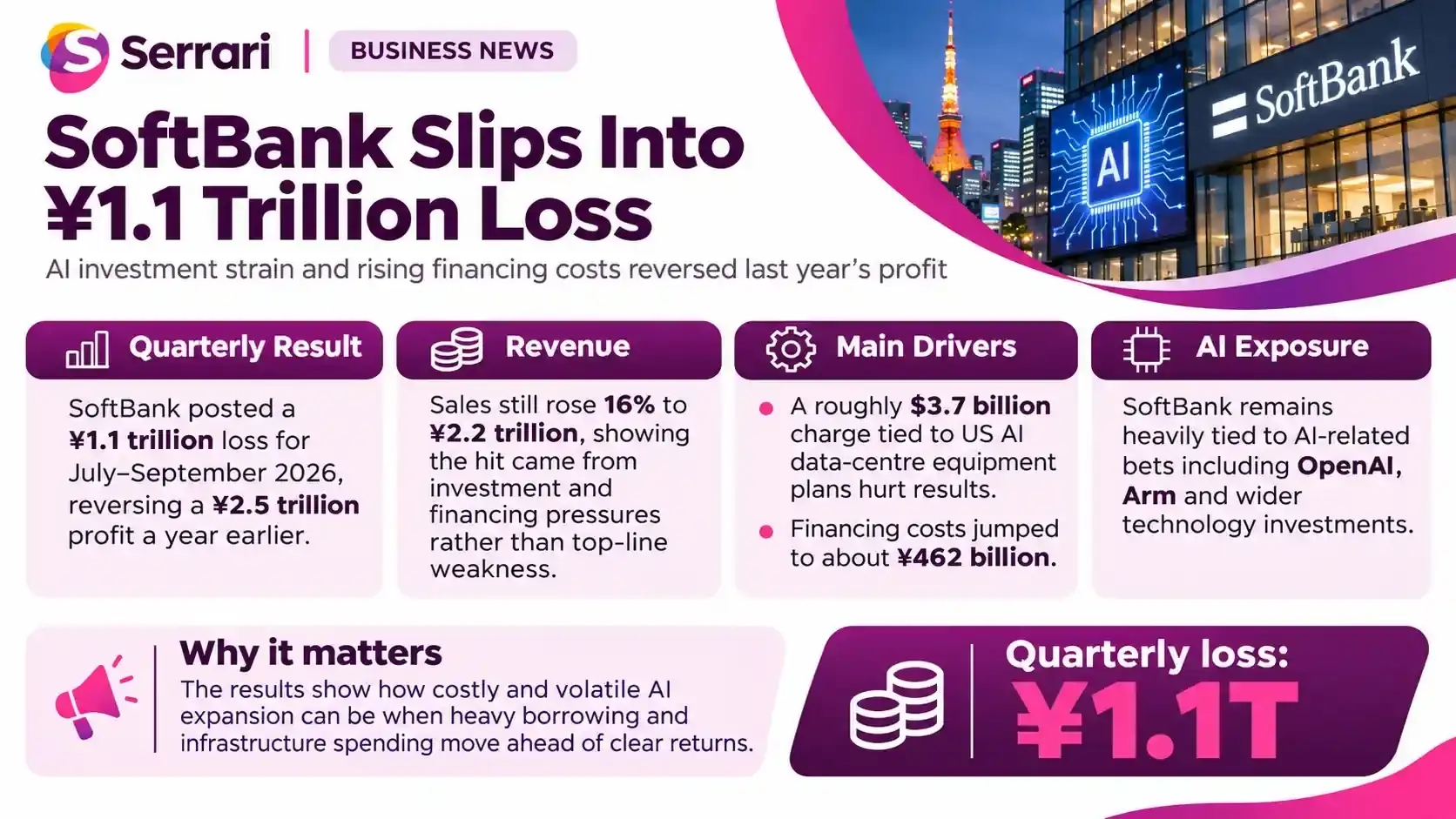
Japan’s SoftBank Group reported a roughly ¥1.1 trillion ($7 billion) net loss for the July–September 2026 quarter, reversing a ¥2.5 trillion profit a year earlier despite growing revenue. The setback reflects more than a change in investor enthusiasm for artificial intelligence: an expensive revision to US data-centre equipment plans, sharply higher financing expenses and volatile technology investments all weighed on the results. For founder Masayoshi Son, the figures pose a central question about SoftBank’s strategy: can the financial rewards from AI arrive quickly enough to justify the capital and borrowing required to build it?
Key Overview
- Quarterly reversal: SoftBank posted a roughly ¥1.1 trillion net loss, compared with a ¥2.5 trillion profit a year earlier.
- Revenue growth: Sales increased about 16% to ¥2.2 trillion, underscoring the difference between operating activity and investment-driven earnings.
- Infrastructure setback: Revised US data-centre equipment procurement plans produced a reported ¥597.2 billion ($3.7 billion) charge.
- Debt pressure: Quarterly financing expenses more than doubled to approximately ¥462 billion.
- AI concentration: SoftBank’s exposure to OpenAI, Arm and computing infrastructure makes its valuation increasingly sensitive to AI economics.
- Investor question: The group must demonstrate that its capital-intensive AI investments can generate durable returns rather than depend primarily on rising valuations.
Why SoftBank Fell Into Losses Despite Rising Revenue
SoftBank’s November 10 earnings disclosure revealed a stark difference between expanding business activity and the profitability of the group as a whole. Sales increased from approximately ¥1.9 trillion to ¥2.2 trillion, yet the company moved from a substantial profit to a substantial loss. The comparison illustrates why SoftBank cannot be assessed like a conventional telecommunications or software company.
Its consolidated earnings are heavily influenced by the value of investments, exceptional charges and the cost of financing large transactions. A rise in revenue does not necessarily offset losses elsewhere in the investment portfolio. Similarly, unrealised gains can make one quarter appear exceptionally profitable without creating an equivalent amount of cash.
The year-earlier profit benefited from a large gain associated with an increase in the valuation of SoftBank’s investment in OpenAI. That favourable comparison was difficult to repeat. The latest quarter also included significant expenditure linked to the infrastructure supporting the AI boom.
One of the clearest drivers was a roughly $3.7 billion charge arising from changes to procurement plans for power-generation equipment intended for US AI data-centre projects. SoftBank had committed funds to equipment before some project requirements were finalised. When the plans changed, part of that expenditure had to be recognised as a loss.
This matters because electricity supply has become a critical constraint on expanding AI computing capacity. Data centres need enormous, reliable power resources, and developers often seek equipment and capacity well before facilities begin generating revenue. Securing essential components early can reduce the risk of delays, but it also creates financial exposure if designs, schedules or deployment plans change.
The charge therefore illustrates an operational weakness in the AI investment cycle: companies may need to spend heavily before they have complete certainty about what they will ultimately build. It should not, however, be interpreted as proof that all of SoftBank’s AI investments have failed or that the entire quarterly loss resulted from falling AI-company valuations.
Rising Borrowing Costs Add Another Layer of Risk
SoftBank’s finances face additional pressure from the way its expansion is funded. Its quarterly financing costs rose to about ¥462 billion, more than double the year-earlier level. These expenses weigh on earnings regardless of whether new investments eventually prove successful.
The company has relied on a mixture of loans, bond issuance, asset-backed borrowing and investment realisations to support its ambitions. Some borrowing is secured against valuable holdings, including shares in chip designer Arm. Such structures can provide access to large sums of money without an immediate sale of strategic assets, but they also expose the group to market fluctuations.
If the value of pledged shares declines significantly, a borrower may face tighter financing terms, pressure to provide additional collateral or reduced flexibility to raise further funds. The extent of any such pressure depends on the specific loan arrangements; a decline in a share price does not automatically mean a lender will demand repayment.
For shareholders, the concern is a potential mismatch between short-term obligations and long-term returns. Interest must be paid according to financing agreements, while investments in AI models, robotics and data centres may take years to produce sufficient cash flow. That timing difference can make the strategy vulnerable during periods when borrowing is expensive or investors are less willing to fund speculative growth.
Context is everything. Stay ahead of shifting trends with today’s market updates, and uncover emerging opportunities using the Serrari Group Market Index and Marketplace. Then, take control of your own financial future by exploring our Money & Life Reset Transformation Blueprint ™ to build stronger habits, create better systems, and design a path toward lasting wealth.
OpenAI and Arm Make SoftBank a Concentrated AI Investment
Founder Masayoshi Son has repeatedly positioned SoftBank around technologies he believes will transform entire industries. The company’s earlier investments ranged across internet platforms, e-commerce, ride-hailing and telecommunications. Its present strategy places artificial intelligence at the centre of that vision.
SoftBank’s approximately $64.6 billion commitment to a 13% OpenAI stake is a particularly consequential part of this approach. It provides substantial exposure to one of the companies developing advanced AI systems, but also ties a large amount of capital to an investment whose future value depends on growth, profitability and the possibility of eventual liquidity.
There is a difference between the strategic importance of an AI developer and the return it delivers to a shareholder. A company can attract users, increase revenue and lead technological change while still requiring enormous spending on computing infrastructure, research and talent. The value investors assign to that business depends on whether its future earnings can justify the capital committed today.
Arm introduces a different type of exposure. Its semiconductor designs play a role in computing markets, making it an important asset for SoftBank. But a listed technology holding also carries daily market-price volatility, and declines in its valuation can affect SoftBank’s net asset value and borrowing flexibility.
The group also participates in AI through its Vision Fund investments and infrastructure initiatives. That creates exposure across different parts of the same technology supply chain, from model developers to computing hardware and data-centre development. Diversification across businesses is not necessarily diversification across economic risks when many of those businesses depend on the same expansion of AI spending.
Why Investors Are Questioning the AI Spending Boom
The wider issue is whether revenue generated by AI services can ultimately support the extraordinary investment in computing capacity. AI developers require chips, electricity, cooling systems, networking equipment and increasingly large facilities. Infrastructure suppliers can receive orders well before end users demonstrate that they will pay enough for AI applications to justify the full cost.
This is not an argument that demand for AI is disappearing. Rather, investors are distinguishing between technological adoption and satisfactory financial returns. Strong growth in usage does not guarantee attractive margins when providing the service is costly and competitors continue investing aggressively.
SoftBank’s results arrive as market participants reassess the price they are willing to pay for future AI earnings. Its shares had lost substantial value from earlier 2026 levels, even though they jumped nearly 14% in Tokyo on November 10 before the results were published. That pre-announcement rise should not be mistaken for a positive market reaction to the earnings themselves.
The distinction is important. Equity prices may move because of expectations, positioning or broader market conditions before a company discloses new information. The subsequent response can be very different once investors assess the details, particularly when an earnings miss reveals costs that analysts had not fully anticipated.
For SoftBank, a sustained recovery is likely to depend less on excitement surrounding AI announcements and more on evidence that infrastructure projects are being executed efficiently, financing costs are manageable and investee companies can translate growth into stronger cash generation.
What the Loss Means for SoftBank and the Technology Sector
The consequences reach beyond one Japanese investment group. SoftBank is a major source of capital for companies working on technologies that require substantial upfront investment. If its funding becomes more expensive or its shareholders demand stricter capital discipline, management may have to become more selective about new commitments.
That could affect the pace of funding for startups and infrastructure projects, although the loss alone does not establish that SoftBank will cut investment. The company may instead seek to refinance obligations, sell selected assets, bring in co-investors or stagger spending so projects align more closely with achievable demand.
Other technology investors face similar questions. Large investments can create competitive advantages where computing capacity is scarce, but they can also destroy value if equipment becomes obsolete, projects are delayed or customers generate lower revenue than expected. The risk is especially pronounced when financing obligations accumulate before project economics become clear.
The key metrics to watch in coming quarters are therefore broader than headline net profit: the cost of borrowing, the value of assets relative to debt, available liquidity, realised investment proceeds, data-centre execution and the commercial performance of major AI holdings all matter.
SoftBank’s latest loss does not settle the debate over artificial intelligence’s long-term economic potential. It does reveal the substantial financial cost of trying to build the industry’s future before its ultimate profitability is known. Son’s strategy can still deliver gains if AI adoption and monetisation accelerate, but investors now have a concrete reminder that technological promise and shareholder returns do not always arrive on the same timetable.
Sources: SoftBank Group / Reuters / Associated Press / Channel News Asia / Investing.com
Your financial future isn’t something you wait for—it’s something you build.
The real question is: when do you begin?
Move beyond simply staying informed.
Navigate the markets with clarity—track trends through the Serrari Group Market Index, uncover opportunities in the Serrari Marketplace, and build practical knowledge with our Curated Wealth Builder Platform.
Stay connected to what truly matters.
Get daily insights on macro trends and financial movements across Kenya, Africa, and global markets—delivered through the Serrari Newsletter.
Growth opens doors.
Advance your career through professional programs including ACCA, HESI A2, ATI TEAS 7 , HESI EXIT , NCLEX – RN and NCLEX – PN, Financial Literacy!🌟—designed to move you forward with confidence.
See where money is flowing—clearly and in real time.
Track Money Market Funds, Treasury Bills, Treasury Bonds, Green Bonds, and Fixed Deposits, alongside global and African indexes, key economic indicators, and the evolving Crypto and stablecoin landscape—all within Serrari’s Market Index.